
Monmore Greyhound Results: What This Guide Covers
 Available in US
Every trap. Every time. Full Monmore data.
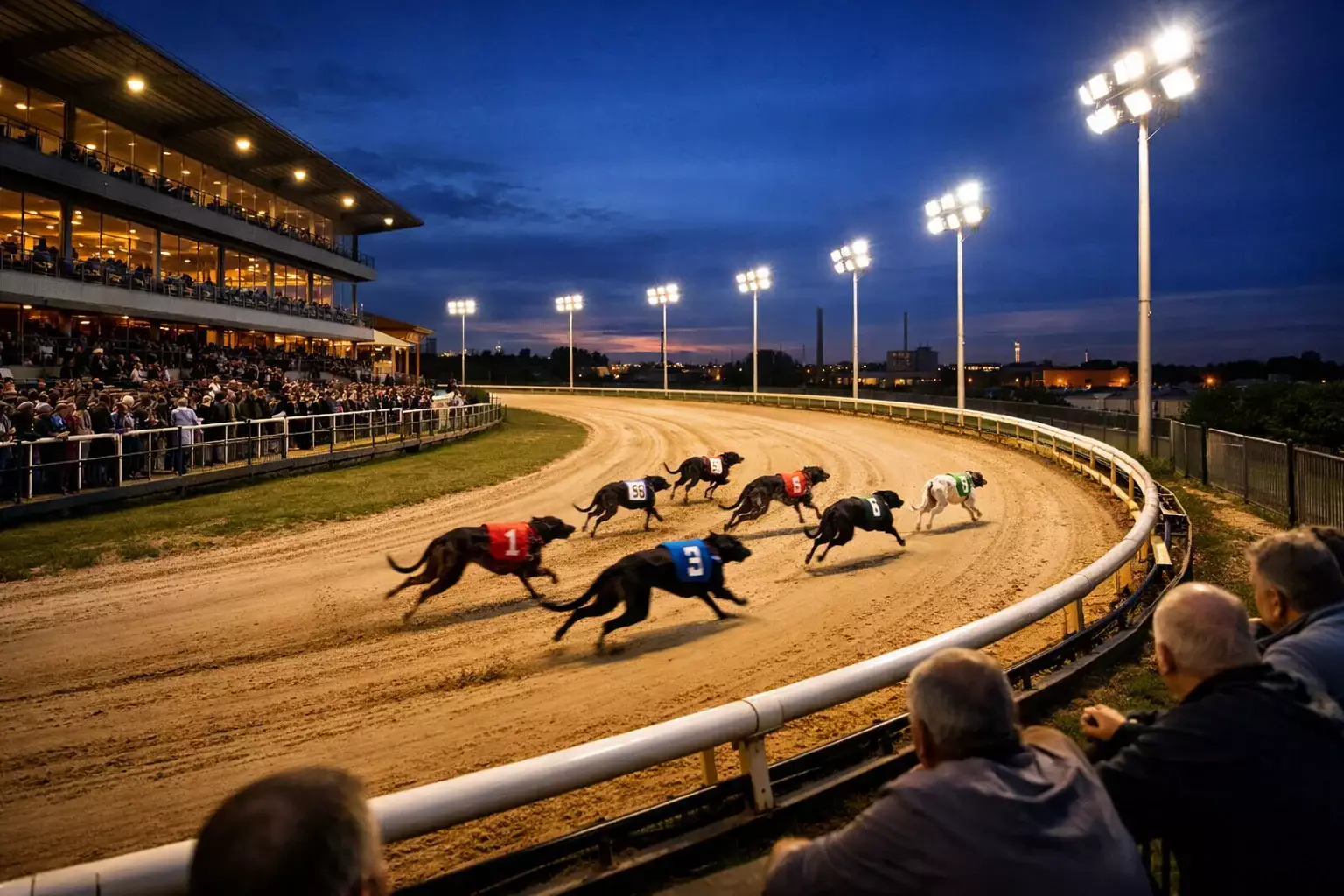
Monmore greyhound results tell you more than which dog crossed the line first. They tell you about trap draws, sectional splits, running styles, and the kind of form data that separates a considered bet from a coin toss. This guide pulls all of that together for one of the busiest tracks in British greyhound racing, giving you the full Monmore data set: race schedule, track records, trap statistics, distance breakdowns, and the wider betting context that shapes every card.
Monmore Green Stadium sits on Sutherland Avenue in Wolverhampton, West Midlands, and has been staging greyhound racing since 11 January 1928, when 10,000 spectators turned up to the opening meeting organised by the Midland Greyhound Racing Association. That was a different era, of course. The UK once had more than 77 licensed greyhound tracks; today, just 18 GBGB-licensed stadiums remain active, with around 500 registered trainers, 15,000 owners, and roughly 6,000 greyhounds entering the sport each year. Monmore is one of the survivors, and it does rather more than survive. Owned and operated by Entain Group, Monmore is part of Premier Greyhound Racing's portfolio of nine tracks that collectively invest over £2.5 million in open racing prize money. The place earns its keep.
What makes Monmore worth a dedicated guide rather than a generic results widget? Three things. First, the track runs six days a week, producing a volume of results that demands a structured approach to interpretation. Second, Monmore hosts some of the sport's marquee competitions — the Golden Jacket, the Winter Derby, the Ladbrokes Puppy Derby — meaning the quality of racing here regularly exceeds what you would find at a pure BAGS venue. Third, the 419-metre circuit with five race distances (264 m, 480 m, 630 m, 684 m, and 835 m) creates distinct tactical puzzles depending on the trip. A dog that dominates the 264-metre dash may be irrelevant over 835 metres, and vice versa.
This is not a results-only page. If you want today's Monmore results, you can find the latest race outcomes through the GBGB results service or major data providers. What this guide does is contextualise those results. It explains how to read them, what the abbreviations mean, where the trap biases lie, how the distances play out, and what the safety and welfare data says about the standards at the track. Whether you are a regular Monmore punter refining your approach or someone trying to understand a racecard for the first time, the sections below are built around the information that actually moves your understanding forward.
The Monmore Numbers That Matter Most
- Monmore Green's 419-metre circuit offers five race distances (264 m to 835 m), each producing different trap bias patterns and tactical profiles worth tracking separately.
- The track races six days a week — BAGS afternoons Monday through Wednesday and Friday, evening cards Thursday and Saturday — generating one of the highest result volumes of any UK venue.
- GBGB's 2024 injury data records a 1.07% track injury rate across all licensed stadiums, the lowest figure since measurement began, with 94% of retired greyhounds successfully rehomed.
- UK greyhound betting turnover reached £794 million in 2023–24, though that figure has fallen 23% in real terms over three years, raising questions about the sport's long-term funding.
- Greyhound racing marks its centenary in 2026 — one hundred years since the first oval-track meeting at Belle Vue, Manchester — while Wales moves to ban the sport entirely.
Race Days and Meeting Types at Monmore Green
BAGS Afternoons: The Weekday Engine
Most of the results you will see from Monmore come from BAGS meetings — the Bookmakers' Afternoon Greyhound Service that has been the financial backbone of UK greyhound racing since the early 1980s. At Monmore, BAGS cards run on Mondays, Tuesdays, Wednesdays, and Fridays, typically with the first race going off around 10:30 or 11:00 in the morning and the final race wrapping up by mid-afternoon. These meetings exist primarily as a betting-shop product: the races are broadcast via SIS (Satellite Information Services) directly into licensed betting offices and online platforms, ensuring a steady stream of wagering content throughout the day.
The scale of BAGS nationally is considerable. Across all UK tracks, approximately 5,772 greyhounds participate in around 74 meetings every week, a 71% increase from the 3,360 dogs running weekly in 2017. Monmore contributes a significant share of that total, and its four BAGS days per week make it one of the most prolific venues in the system. For the form student, this is good news: a high frequency of meetings means more data, more recent form, and more opportunities to spot patterns in trap draws, sectional times, and trainer strike rates.
BAGS races are typically graded affairs — A1 through D4 — where the field is assembled by the racing manager based on recent times and finishing positions. Open races are rare on afternoon cards. The prize money is lower than evening meetings, funded largely by the media-rights payments from bookmakers. This is transactional racing: it serves a purpose, it generates results, and the dogs run to their abilities regardless of the time of day.
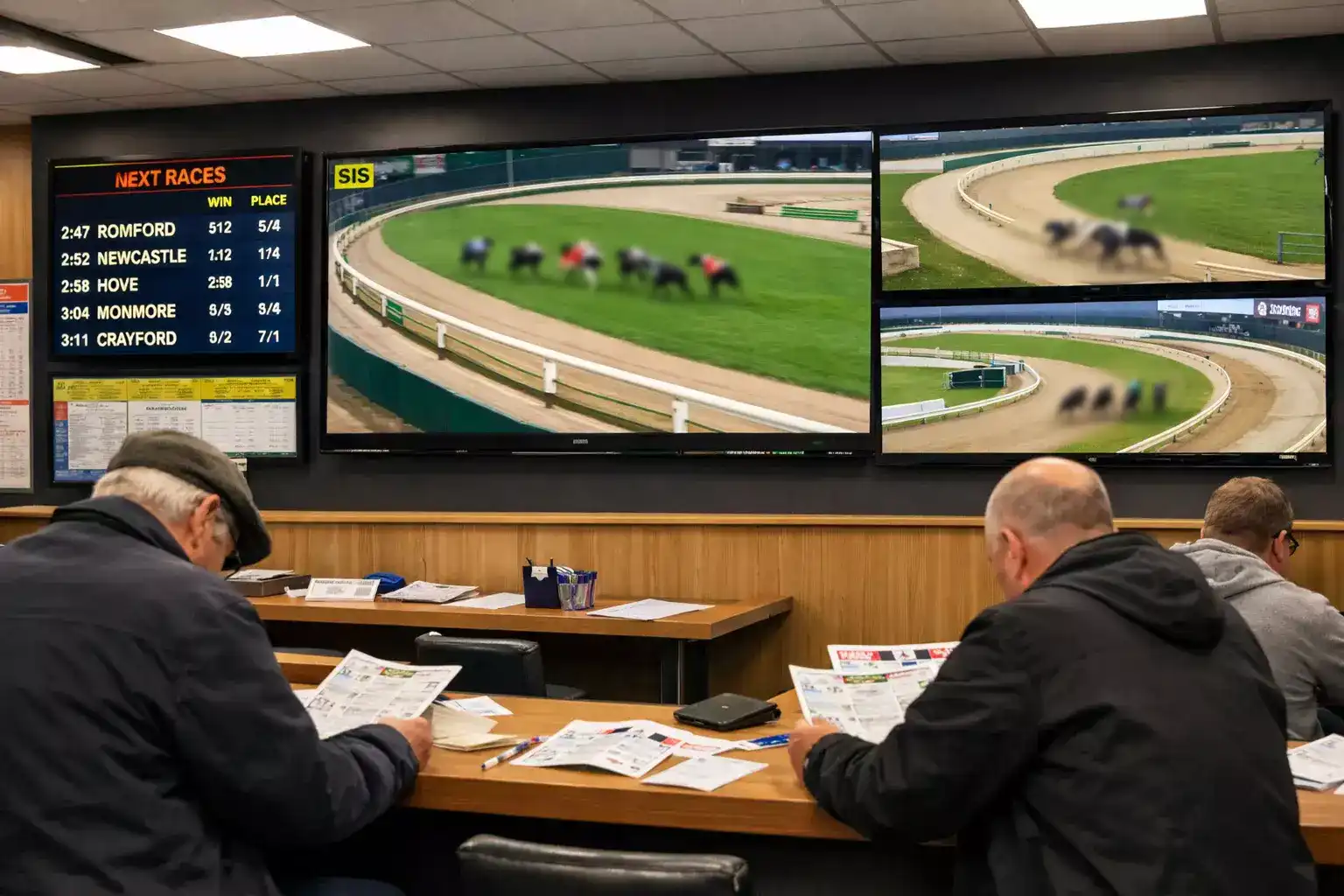
Thursday and Saturday Evenings: The Flagship Cards
The character of Monmore changes on Thursday and Saturday evenings. These are the meetings designed for spectators — the cards with higher-grade races, open competitions, and the kind of atmosphere that a purely betting-driven afternoon meeting does not try to create. First race is usually around 18:30 or 19:00, with the final race finishing before 22:00.
Evening cards at Monmore carry the venue's showcase competitions. The Golden Jacket, the Winter Derby, the Ladbrokes Puppy Derby, and the Trafalgar Cup are all staged on evening meetings, which means the quality of the fields is materially higher than what you will encounter on a Tuesday afternoon. Grading still applies to the bread-and-butter races on the card, but you can expect at least one or two open races per evening meeting, drawing dogs from other tracks and trainers who bring their best runners for the prize money.
For result analysis, the distinction between BAGS and evening meetings matters. Evening fields tend to be more competitive, with tighter finishing margins and less predictable outcomes. The SP (starting price) market is generally more liquid on evening cards because more punters are engaged, and the form data from these meetings carries more weight when assessing a dog's true ability. If a greyhound runs a strong sectional time on a Saturday evening at Monmore against open-class opposition, that tells you more than the same time recorded in a Monday morning D3 race.
When to Expect Results
Results from Monmore are typically available within minutes of each race finishing. The SIS broadcast feed captures the finishing order, times, and starting prices in real time, and these are pushed to major results providers — Timeform, Sporting Life, the GBGB results service — almost immediately. Full result details, including running comments and sectional times, may take slightly longer to appear, particularly on busy multi-track afternoons when results from several venues are being processed simultaneously. For BAGS meetings, expect the full card results to be settled by 16:00 at the latest. For evening meetings, the complete set of results is usually published by 22:30.
Knowing when Monmore races does not mean much until you can actually read what those results are telling you. The next section breaks down the format line by line.
How to Read Monmore Greyhound Results
A greyhound result line is dense with information, and most of it is compressed into abbreviations that mean nothing unless you know the code. Every GBGB-licensed track uses the same standardised format, so once you can read a Monmore result, you can read any result from any of the 18 active UK stadiums. Here is what each element tells you.
The Result Line Decoded
A typical Monmore result line reads something like this: a finishing position, the dog's name, a trap number, a sequence of abbreviated running comments, the final time, and the starting price. Some results also include sectional times — the clock at intermediate points of the race — and the distances between finishers (measured in lengths). Each piece serves a different analytical purpose.
The finishing position is self-explanatory: 1st through 6th, with standard suffixes (1st, 2nd, 3rd). The trap number tells you which starting box the dog ran from, numbered 1 (inside rail) to 6 (outside). The final time is recorded in seconds to two decimal places — and it only makes sense when read against the distance. A time of 28.50 means very different things over 480 metres versus 264 metres.
Common running-comment abbreviations in Monmore results:
- EP — Early Pace. The dog showed strong speed in the opening section of the race.
- SAw — Slow Away. The dog lost ground at the start, either due to a poor trap break or hesitation.
- Rls — Rails. The dog ran along the inside rail for a significant portion of the race.
- Mid — Middle. The dog raced in the middle of the track, neither hugging the rail nor running wide.
- W — Wide. The dog ran on the outside of the field, taking a longer route around bends.
- Led — Led. The dog was at the front of the field at one or more points during the race.
- Crd — Crowded. The dog experienced interference from other runners, typically on a bend or at the first turn.
- Bmp — Bumped. The dog made physical contact with another runner.
- RnUp — Ran Up. The dog finished strongly, closing ground on the leaders in the final section.
- Chl — Challenged. The dog made a move towards the lead without necessarily getting there.
What the Abbreviations Tell You About Running Style
The abbreviations are not just labels — they reveal a dog's running style, and running style is one of the most reliable predictors of future performance at a specific track. A dog consistently tagged with EP and Led is an early-pace front-runner, the type that benefits from a clear run to the first bend and suffers badly when caught in traffic. A dog marked with SAw and RnUp is a closer: slow to start but capable of making up ground in the final straight. At Monmore, where the first bend arrives at just 103 metres from the traps, a slow-away dog from Trap 6 has a very different task ahead of it than a slow-away dog from Trap 1.
Crowding comments (Crd, Bmp) are not excuses — they are information. If a dog finishes fourth but the result line shows "Crd 1st, Bmp 2nd," that tells you the dog's finishing position understates its actual ability on the night. Experienced form readers treat crowded runs as disguised form, and some of the best-value bets at Monmore come from dogs whose last result looked poor on paper but whose running comments suggest they were unlucky.
Reading the Starting Price
The SP (starting price) is the final odds at which the dog was available when the race started. It is expressed in fractional format (e.g., 5/2, 11/4, 7/1) and reflects the collective judgement of the on-track betting market. An SP of 2/1 means the market considered the dog one of the fancied runners; an SP of 10/1 suggests it was an outsider. Comparing a dog's SP to its actual finishing position over a series of races is one of the simplest ways to identify value: a dog that regularly finishes in the top two at SPs of 5/1 or above is being systematically underestimated by the market.
Forecast and tricast dividends are also published with the results. A forecast pays out if you correctly predict the first and second finishers in exact order; a tricast requires the first three in order. These are displayed as a single dividend per unit stake — for example, "Forecast £14.20" means a £1 forecast bet returned £14.20.
Understanding result abbreviations is step one. Step two is knowing what the race distance tells you about why a dog ran the way it did.
Monmore Race Distances: 264 m to 835 m Explained
Monmore Green offers five race distances, and each one asks a fundamentally different question of the dogs running it. The track's 419-metre circumference with distances of 264, 480, 630, 684, and 835 metres means that a single evening card can feature everything from a two-bend dash where the race is over in fifteen seconds to a six-bend marathon that tests stamina, tactical positioning, and the dog's willingness to keep running when the legs start asking questions.
264 Metres: The Sprint
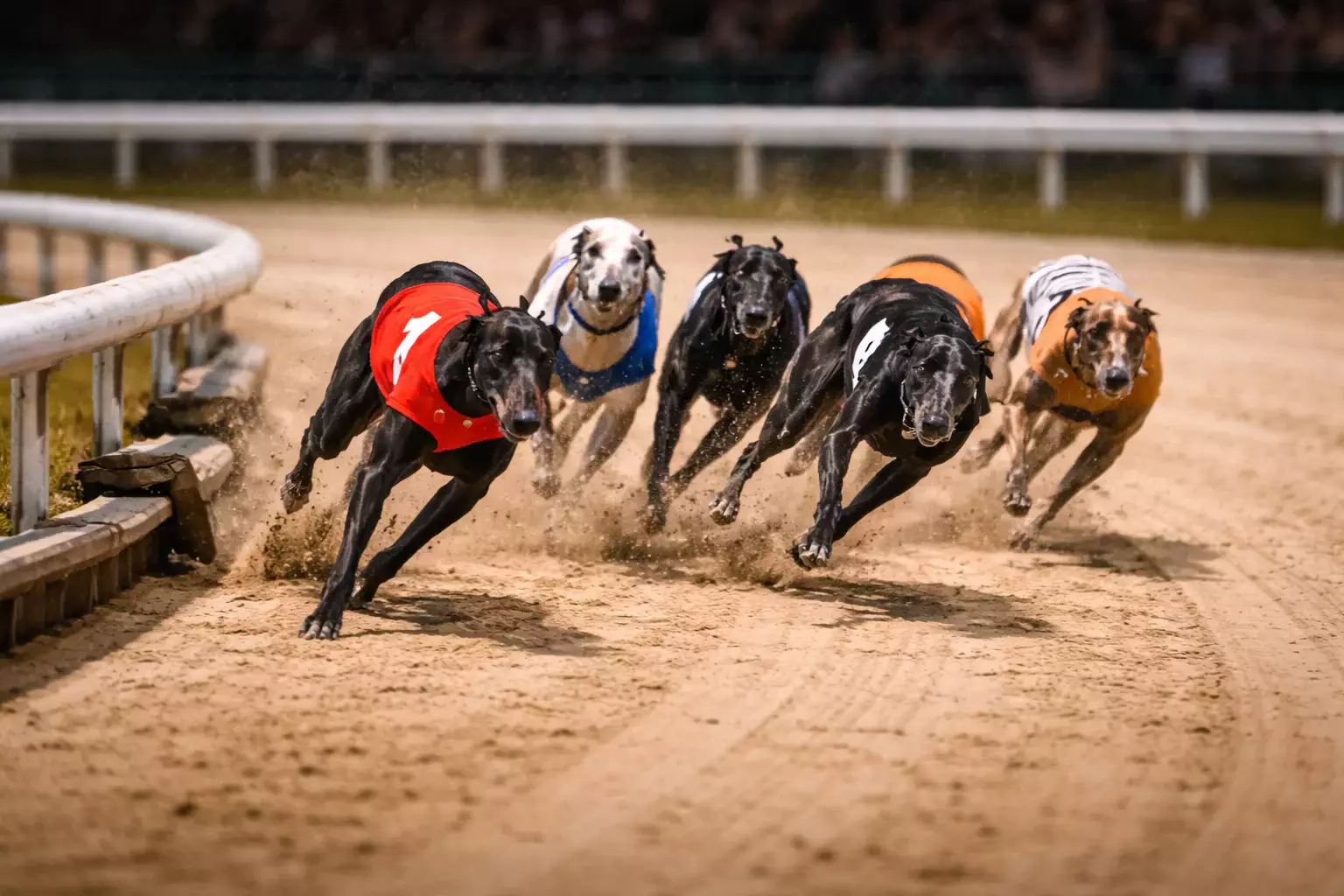
The 264-metre race at Monmore is the shortest standard distance in UK greyhound racing. It covers two bends — the dogs break from the traps, negotiate the first and second turns, and finish on the back straight. The entire affair takes roughly 15 to 16 seconds, which means there is essentially no time to recover from a poor start. Early pace is everything. A dog that is slow away from Trap 1 in a 264-metre race is, for practical purposes, already beaten. The track record over this distance stands at 15.32 seconds, set by Parliament Act in August 2001 — a time that has survived more than two decades of racing, which tells you something about how close to the physical limit it sits.
Sprint races at Monmore are often used for dogs whose stamina does not stretch to the standard trip, or for fast-break specialists who thrive when the race is decided in the first hundred metres. From a betting perspective, the 264-metre distance amplifies trap draw significance. Inside traps (1 and 2) have a structural advantage because they have less ground to cover to the first bend, and in a race this short, the leader at the first bend almost always wins.
480 Metres: The Standard Trip
The majority of races at Monmore are run over 480 metres — the standard four-bend distance that forms the backbone of UK greyhound racing nationwide. It is the trip on which dogs are graded, the trip on which most open competitions are contested, and the trip that produces the richest data set for form analysis. If you only follow one distance at Monmore, this is the one.
Over 480 metres, the balance between early pace and stamina is roughly even. A fast breaker can dominate if the first bend goes cleanly, but there is enough track remaining for a well-positioned closer to make up ground on the final straight. The track record is 27.91 seconds, set by Express Hancho on 23 August 2003. That time has stood for over twenty years, making it one of the more durable records in the sport. Modern greyhounds approach it but rarely match it, partly because track surfaces and preparation methods have evolved in ways that prioritise safety over raw speed.
630 Metres and 684 Metres: The Middle Distances
The 630-metre and 684-metre trips at Monmore occupy the middle ground between standard and marathon racing. Both involve six bends, and both require dogs that can maintain pace beyond the point where pure sprinters begin to fade. The 684-metre distance is particularly significant because it hosts the Golden Jacket, one of Monmore's prestige Category One competitions, making it the track's signature stayer distance.
At these distances, running style matters more than trap draw. A dog that can sit behind the pace through the first circuit and then pick up in the second half of the race has a genuine tactical advantage, because front-runners who burn their speed early often struggle to hold position through the fifth and sixth bends. The data from 630 m and 684 m races at Monmore consistently shows a higher rate of late-closing winners compared to the 480 m standard.
835 Metres: The Marathon
The 835-metre trip is Monmore's longest distance, and it is a specialist test that only a subset of the greyhound population is suited to. The race covers the full circuit twice — or near enough — and the physical demands are substantially different from anything at 480 metres. Stamina is the primary requirement, but so is the ability to navigate traffic repeatedly through eight bends without losing position or wasting energy on wide runs.
Marathon races at Monmore are less frequently programmed than the 480 m standard, which means the sample size for trap statistics and form data is smaller. This is worth remembering: if you are trying to assess trap bias over 835 metres, you need a larger time window to collect meaningful data than you would for the 480 m distance, simply because there are fewer races to draw from.
Distance tells you what kind of race to expect. The next step is understanding the physical track itself — its geometry, surface, and the safety data behind the results.
Track Specifications and Safety Data
Monmore Green is a 419-metre sand circuit with a Swaffham-type hare and a first-bend distance of 103 metres from the traps. The stadium accommodates 1,150 spectators with parking for 400 vehicles. These are not just logistical details — every dimension of the track feeds directly into the results you are trying to interpret. The 103-metre run to the first bend, for instance, is relatively short by UK standards, which gives early-pace dogs an advantage and penalises wide runners who need more time to find a racing line. If you see a dog consistently tagged with "W" (wide) in Monmore results, that dog is covering more ground per bend than one running the rail, and over four or six bends the cumulative disadvantage adds up.
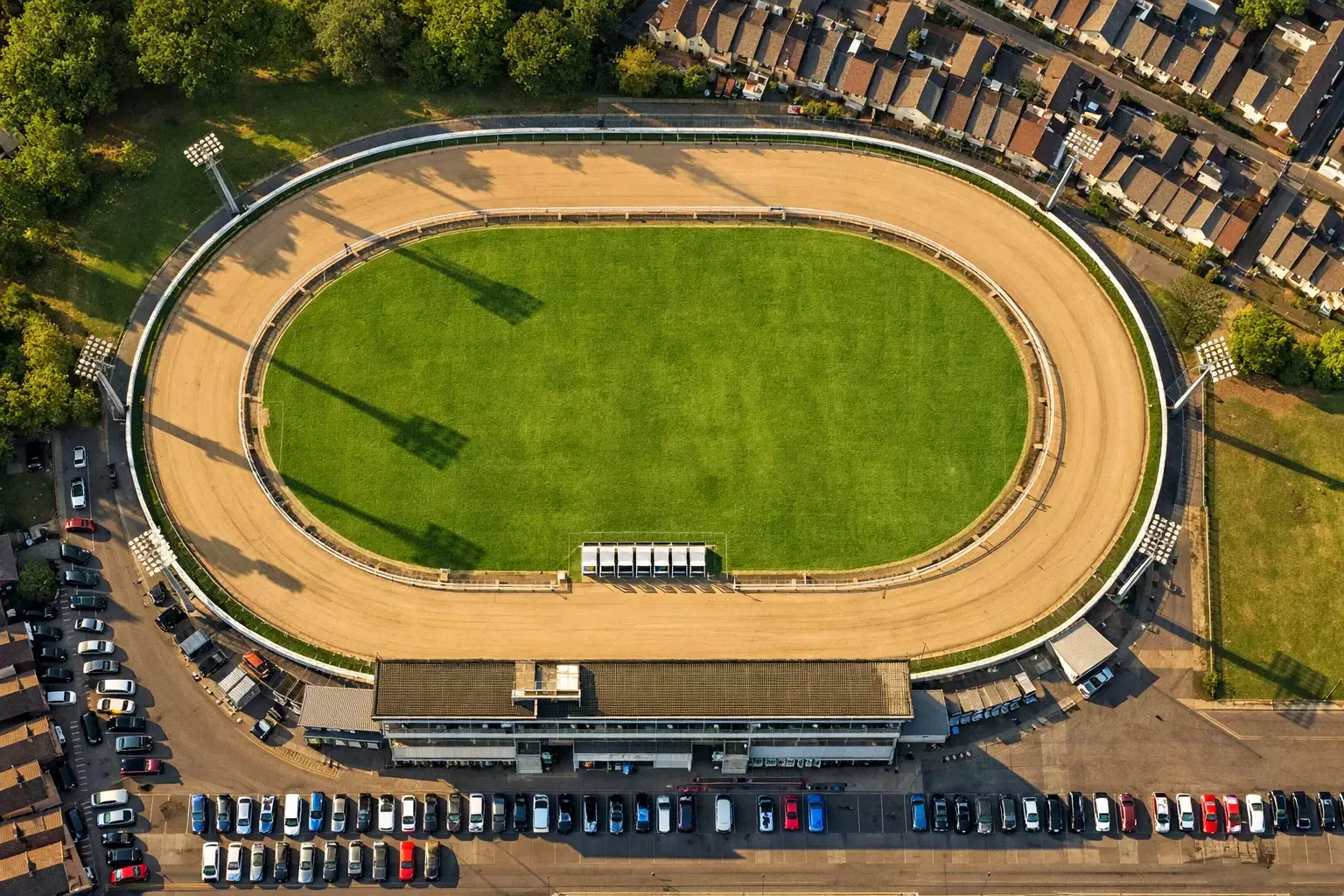
The sand surface at Monmore is maintained to GBGB specifications, with regular inspections by the Sports Turf Research Institute (STRI) to ensure consistent depth and moisture levels. Sand tracks respond to weather differently than you might expect: heavy rain can compact the surface and create a faster track, while dry conditions sometimes produce slower times because the sand is looser underfoot. This is counterintuitive for punters accustomed to horse racing, where soft ground usually means slower times. At Monmore, checking the weather on race day is not a ritual — it is a genuine form factor.
Welfare and Safety Data
The results at Monmore and every other GBGB track exist within a regulated welfare framework that has tightened significantly over the past six years. According to the GBGB's 2024 Injury and Retirement Data, the track injury rate across all licensed stadiums fell to 1.07% — meaning 3,809 injuries recorded from 355,682 individual race starts. That is a record low since data collection began in its current form.
The retirement data is equally significant. In 2024, 94% of greyhounds leaving the racing population were successfully rehomed or retained by their connections, up from 88% in 2018. Only three dogs were euthanised for economic reasons in 2024, compared to 175 in 2018. These are industry-wide figures rather than Monmore-specific numbers, but they apply to every track under GBGB licensing, and Monmore's compliance is audited as part of the scheme.
Interactive Tool
Welfare Improvement Calculator, and Trap 1 Advantage vs Baseline
Quantify the GBGB's welfare progress since 2018, and see exactly how far Monmore's Trap 1 result diverged from the theoretical baseline.
Euthanasia Reduction
-
-
Rehomed Improvement
-
Dogs Fewer Euthanised
-
Rehomed 2024
-
What this guide gives as two separate figures: "94% of greyhounds... successfully rehomed... up from 88% in 2018" and "Only three dogs were euthanised... compared to 175 in 2018." Neither gap is calculated — rehoming improved by 6 percentage points, while euthanasia fell by 98.3% (172 fewer dogs).
Advantage Over Baseline
-
-
Observed Win Rate
-
Theoretical Baseline
-
Multiple
-
What this guide gives as observed result and baseline separately: "Trap 1 won 7 out of 12 races — a 58% win rate against an expected baseline of under 17%." The exact gap is never stated — it's 41.7 percentage points, meaning Trap 1 won 3.50x as often as the theoretical baseline predicts.
"There is much to be pleased and encouraged by in this year's data. It shows that the initiatives we have introduced in recent years are now embedded and are helping to consolidate the significant progress we have made since 2018 across all measures." — Mark Bird, Chief Executive, GBGB
Monmore's 419 m circuit with a 103 m run to the first bend creates a structurally significant inside-rail advantage, while the GBGB's 2024 injury rate of 1.07% represents the lowest figure on record across all licensed tracks.
Monmore Track Records by Distance
Track records at Monmore serve a dual purpose. They are historical markers — evidence of exceptional performances by specific dogs on specific nights — and they are analytical baselines. When you see a dog clock 28.30 over 480 metres at Monmore, knowing that the track record is 27.91 tells you that the dog ran roughly a length and a half off the all-time best. That context matters when you are comparing times across different meetings or against dogs whose personal bests were set at other venues.
| Distance | Record Time | Dog | Date |
|---|---|---|---|
| 264 m | 15.32 s | Parliament Act | 28 August 2001 |
| 480 m | 27.91 s | Express Hancho | 23 August 2003 |
| 630 m | 38.04 s | — | — |
| 684 m | 41.20 s | Mongys Wild | — |
| 835 m | 52.01 s | — | — |
Source: GreyhoundRacing.co.uk
Several things stand out from this table. The 264 m and 480 m records are both over two decades old, which is unusual. Most UK tracks see their records challenged every few years as breeding programmes produce faster dogs. The longevity of Monmore's sprint and standard records may reflect changes to the track surface or preparation methods that have prioritised safety margins over outright speed. It may also simply mean that Parliament Act and Express Hancho were genuinely exceptional animals on the right night.
For form assessment, the relevant number is not the record itself but the gap between a dog's recent time and the record. A dog running consistently within half a second of the track record over 480 metres is operating at an elite level for the venue. A dog running a full second off the record is mid-grade. Two seconds off, and you are looking at a dog in the lower grading bands. The records give you a fixed reference point against which to calibrate everything else.
Trap Statistics and Bias at Monmore
Trap bias is the single most underused piece of publicly available data in greyhound betting. Every track has one — a measurable tendency for certain trap positions to produce more winners than probability would predict — and Monmore is no exception. In a perfectly neutral six-trap race, each box would win approximately 16.66% of the time. In practice, no track in Britain hits that theoretical distribution. Track geometry, the position of the first bend, the hare running line, and even the camber of the surface all conspire to give certain traps a structural advantage.
The Monmore Bias: What the Data Shows
The documented cases are striking. In one meeting at Monmore, Trap 1 won 7 out of 12 races — a 58% win rate against an expected baseline of under 17%. The dogs that won from Trap 1 that night were not all favourites; their SPs ranged from 2/1 to 10/1, which means the market was not fully pricing in the trap advantage. That is a single meeting, of course, and you should not build an entire strategy around one data point. But it illustrates a broader pattern: at Monmore, inside traps tend to outperform over time, particularly at shorter distances where the first-bend advantage is most pronounced.
The reason is geometric. With the first bend at 103 metres from the boxes, a dog breaking from Trap 1 has the shortest path to the bend and can establish a rail position almost immediately. A dog from Trap 6 needs to cross the entire width of the track to find the rail, and in the process risks getting caught in traffic. Over 264 metres, this is often decisive. Over 480 metres, the advantage is still present but diluted by additional bends where wide runners can recover. Over 835 metres, the effect is weakest because the longer race gives dogs more time to find their running position regardless of trap draw.
Where to Find Monthly Trap Data
SIS Racing publishes monthly trap statistics for 15 UK tracks, including Monmore, covering trap win percentages, forecast and tricast returns, and leading trainers by strike rate. This is the single most useful free data source for systematic trap analysis. The monthly granularity matters because trap bias is not static — it shifts with track conditions, seasonal weather patterns, and changes to track preparation. A trap that overperforms in dry summer months may revert to average in a wet winter, and the only way to detect that is to track the data month by month.
Practical tip: Do not treat trap bias as a standalone betting system. Use it as a filter. If your form analysis points to two dogs in a race, and one of them is drawn in a historically favoured trap at Monmore while the other is not, that is a meaningful tiebreaker. If your only reason for backing a dog is its trap number, you are overweighting one variable and ignoring everything else.
Major Competitions: Golden Jacket, Winter Derby and More
Monmore is not just a high-volume BAGS track. It is a venue that punches above its weight in the competition calendar, hosting several Category One and Category Two events that attract dogs from across the country. The total prize fund for UK greyhound racing stands at £15,737,122, with the Greyhound Derby winner taking £175,000 — but Monmore's own competitions carve out a respectable slice of that total.
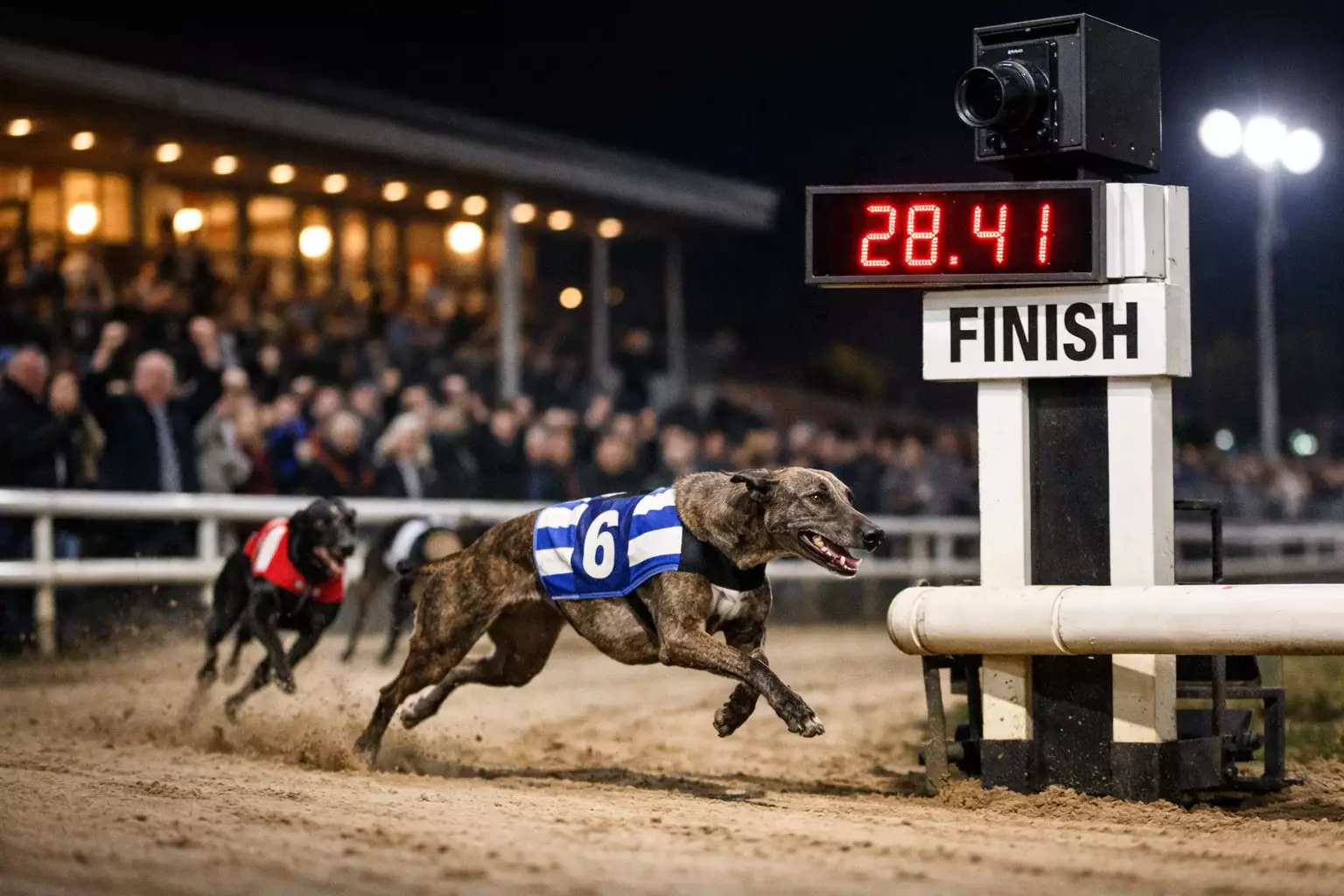
The Golden Jacket
The Golden Jacket is Monmore's flagship competition, run over 684 metres and reserved for stayers who can handle the demands of six bends at a track that favours early pace. It carries Category One status, meaning it attracts the highest standard of entries and offers prize money commensurate with its prestige. The format follows the classic progression from heats to semi-finals to final, with the competition typically running across three or four weeks of evening meetings. Dogs that perform well in the Golden Jacket often go on to contest national stayer events at other venues, making Monmore a proving ground for the longer distances.
The Winter Derby
Run over the standard 480 metres, the Winter Derby is Monmore's premier middle-distance competition and traditionally takes place in the first quarter of the year. The final carries a prize of around £10,000 — significant money by UK greyhound standards, where most graded races offer prizes in the low hundreds. The 2026 edition of the Winter Derby falls in a centenary year for the sport, adding a layer of historical context to what is already one of the Midlands' most anticipated greyhound events.
Ladbrokes Puppy Derby and Trafalgar Cup
The Ladbrokes Puppy Derby at Monmore has its roots in the Midland Puppy Championship, which dates back to 1943. Run over 480 metres, it is open to young greyhounds and serves as an early indicator of which dogs may go on to contest the major open races in their prime. The Trafalgar Cup, a more recent addition to the Monmore calendar (launched in 2015), provides another pathway for developing dogs and adds depth to the venue's year-round fixture list.
What underpins these competitions financially is the structure created by Premier Greyhound Racing (PGR), the joint venture between Entain and Arena Racing Company that controls media rights for nine UK greyhound tracks including Monmore. PGR has committed over £2.5 million to open racing prize money, and it is this funding that allows Monmore to sustain competitions at a level that a standalone track could not afford. The commercial model is straightforward: bookmaker media-rights fees fund the prize money, which attracts better dogs, which generates more betting interest, which justifies the media-rights fees. As long as the loop holds, the competitions continue.
Notable Trainers and Dogs at Monmore
Greyhound results do not happen in isolation from the people preparing the dogs, and at Monmore the trainer factor is as relevant to your analysis as trap draw or distance. The track operates under a contract-trainer system, where a core group of trainers are allocated kennel space and supply dogs for the regular graded cards, supplemented by visiting trainers who bring entries for open competitions and evening meetings.
Blastoff Josifa holds the Monmore record for the most graded starts at a single track: 203 career runs at Monmore Green, producing 49 wins. That is a strike rate of just over 24% across a career spanning several years — a model of consistency in a sport where many dogs are retired or moved to other tracks long before reaching triple figures in starts.
Trainers at Monmore develop reputations for specific strengths. Some are known for producing fast-break sprinters who dominate the 264-metre trip. Others specialise in preparing stayers for the 684-metre and 835-metre distances, conditioning their dogs for the stamina demands that those trips impose. When reading Monmore results, noting which trainer prepared which dog gives you an additional data point: a trainer with a high strike rate on Saturday evening cards is likely sending their best dogs to the meetings that matter most, while their BAGS runners on a Wednesday afternoon may be lower-grade animals running for conditioning rather than prizes.
"We are delighted to share the latest progress report. It has also been fantastic to see so many licence holders taking up our educational opportunities which helps ensure that our welfare initiatives are being consistently implemented." — Tiffany Blackett, Executive Veterinarian, GBGB
The professionalisation of training at GBGB-licensed tracks has accelerated in recent years, with mandatory CPD (continuing professional development) programmes and welfare training requirements that did not exist a decade ago. For the form analyst, this means that the gap between the best-prepared and worst-prepared dogs in a graded field is narrower than it used to be. The margins are thinner, which is precisely why details like trap draw, sectional times, and running comments become more valuable — they are the variables that still differentiate dogs in a race where basic fitness and preparation are closer to a common standard.
Betting Landscape: Where Monmore Fits
To understand the results at Monmore — or any UK greyhound track — you need to understand the economics that sustain the sport. The racing exists because the betting exists, and the betting landscape for greyhound racing in Britain is shifting in ways that affect everything from prize money to how many meetings are programmed each week.
The Money: Turnover, Decline, and the Funding Gap
According to Gambling Commission data reported by SBC News, the total betting turnover on greyhound racing in UK bookmakers' offices reached £794 million for the period April 2023 to March 2024. That is a substantial number on its face, but the trend line is unfavourable. As Racing Post analysis of Gambling Commission statistics noted, greyhound betting turnover has declined 23% in real terms over three years when adjusted for inflation. The sport is making less money in a market that is making more — online casino and football betting have absorbed much of the growth in UK gambling spending, leaving greyhounds with a shrinking share.
The downstream effect is visible in the numbers from the British Greyhound Racing Fund (BGRF), which collects voluntary contributions from bookmakers to fund welfare and prize money. BGRF revenue for 2023–24 came in at £7.3 million, down 4% from £7.6 million the previous year. The historical norm for the fund was £10–14 million, and in one peak year it exceeded £20 million. Today's figure represents a structural decline in the financial relationship between bookmakers and the sport they profit from.
The Levy Debate
This is where the politics enter. Unlike horse racing, which benefits from a statutory levy on bookmakers' profits, greyhound racing relies on a voluntary contribution — currently around 0.6% of gross profits from greyhound bets. The question of whether this should become a statutory obligation has been debated in Parliament. As recorded in Hansard, a 1% statutory levy on gross betting turnover would generate approximately £11.6 million for greyhound welfare, while a 1.5% levy would produce £17.5 million. Either figure would represent a significant uplift from the current voluntary arrangement and could fund improvements in prize money, track infrastructure, and rehoming programmes. The bookmakers, unsurprisingly, prefer the status quo.
The Regulatory Horizon: Wales, Scotland, and the Centenary
Greyhound racing in 2026 arrives at its centenary — one hundred years since the first oval-track meeting with a mechanical hare took place at Belle Vue, Manchester, in 1926. The milestone is celebrated by the sport's supporters but arrives against a backdrop of political pressure. The Prohibition of Greyhound Racing (Wales) Bill, introduced in the Senedd on 29 September 2025 and approved at Stage 2 by 36 votes to 50, would ban greyhound racing in Wales with a commencement window between 1 April 2027 and 1 April 2030. Wales currently has one licensed track (Valley Stadium), but the precedent matters more than the geography.
"This bill shows we are a progressive nation committed to ethical standards, animal welfare and forward thinking legislation." — Huw Irranca-Davies, Deputy First Minister, Welsh Government
Scotland has no licensed tracks, but the Scottish Animal Welfare Commission concluded in 2023 that the risks of poor welfare in commercial greyhound racing outweigh the likely positives, language that keeps the door open for legislative action north of the border. For Monmore and the other English tracks, the Welsh precedent creates political uncertainty that the sport has not faced before. Whether you view this as necessary reform or regulatory overreach, the practical consequence for punters is straightforward: the number of UK venues may shrink further in the coming years, concentrating more racing — and more results — at the surviving stadiums.
Frequently Asked Questions
What days does Monmore race, and when are results available?
Monmore stages BAGS afternoon meetings on Mondays, Tuesdays, Wednesdays, and Fridays, with first races typically starting between 10:30 and 11:00. Evening meetings run on Thursdays and Saturdays, with first race around 18:30 to 19:00. Results are available within minutes of each race finishing through the SIS broadcast network, and full results — including running comments, sectional times, and starting prices — are published on platforms like Timeform, Sporting Life, and the GBGB results service. Afternoon card results are usually complete by 16:00; evening card results by 22:30.
What do the abbreviations in greyhound results mean?
Greyhound result abbreviations describe how a dog ran during the race. The most common include EP (early pace — strong start), SAw (slow away — poor trap break), Led (led the field), Rls (ran the inside rail), Mid (ran in the middle of the track), W (ran wide), Crd (crowded — experienced interference), and Bmp (bumped — physical contact with another runner). These comments are standardised across all 18 GBGB-licensed tracks in the UK, so the same codes apply whether you are reading Monmore results or results from any other venue. The full guide to abbreviations is covered in the "How to Read Monmore Greyhound Results" section above.
How many race distances does Monmore offer, and which is most common?
Monmore offers five race distances: 264 m (sprint, two bends), 480 m (standard, four bends), 630 m (middle distance, six bends), 684 m (middle distance/stayer, six bends), and 835 m (marathon). The 480-metre standard is the most frequently raced distance and the trip on which dogs are graded. It is also the distance used for most open competitions at the track, including the Winter Derby and the Ladbrokes Puppy Derby. The 684-metre trip hosts the Golden Jacket, Monmore's flagship stayer competition.
Greyhound Racing Glossary
SP (Starting Price) — the final odds offered on a dog at the moment the race begins, determined by the on-course betting market. The SP is the price at which all bets placed at "starting price" are settled.
Forecast — a bet requiring you to predict the first and second finishers in exact order. The dividend is calculated based on the combined SPs of the two dogs and is published as a single payout figure per unit stake.
Tricast — a bet requiring the first three finishers in exact order. Tricast dividends are typically much larger than forecasts due to the increased difficulty, and they are only available in races with six or more runners.
BAGS (Bookmakers' Afternoon Greyhound Service) — the system that schedules and broadcasts daytime greyhound meetings to licensed betting shops. BAGS meetings are the primary source of weekday results at Monmore and most other UK tracks.
Graded Race — a race in which the field is assembled by the racing manager based on recent form and times. Dogs are placed in grades from A1 (highest) to D4 (lowest), and the grading determines the quality of the fields they race against.
Open Race — a race with no grading restrictions, open to any dog that meets the entry criteria. Open races carry higher prize money and attract better-quality fields than graded races. Major competitions like the Golden Jacket are open events.
Sectional Time — the time recorded at an intermediate point during a race, typically at the first bend or the midway point. Sectional times reveal whether a dog's overall time was built on early speed, a strong finish, or a consistent pace throughout.
Trap Draw — the box from which a dog starts the race, numbered 1 (closest to the inside rail) to 6 (furthest out). Trap draw influences a dog's racing line, particularly through the first bend, and is a measurable factor in race outcomes.
Going — the condition of the track surface at the time of racing. On sand tracks like Monmore, going is affected by moisture levels, temperature, and recent weather. It influences running times and can shift trap bias patterns.
