

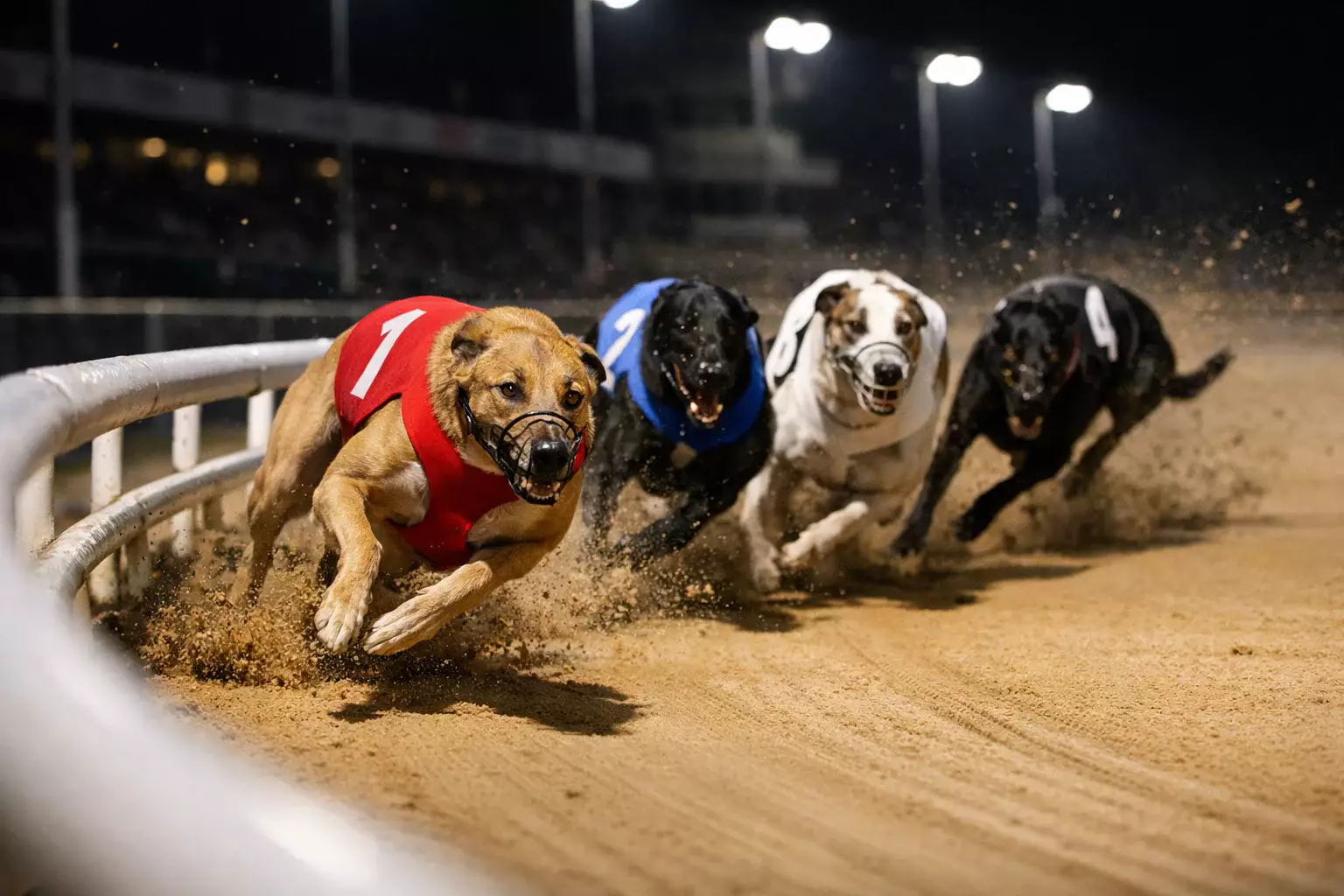
Every greyhound race at Monmore Green starts with a distance printed on the racecard, and that number is the single most important piece of information you can read before studying anything else. Not the trap draw, not the trainer’s strike rate, not the dog’s last finishing position — the distance. Because distance is the first variable, and it shapes everything that follows: which dogs are suited, which traps matter, how the race will be run tactically, and what the finishing time actually tells you about performance.
Monmore offers five race distances: 264, 480, 630, 684 and 835 metres, run on a 419-metre circumference circuit with the first bend arriving at 103 metres from the start. That layout means a 264-metre race never reaches the second bend. A 480-metre race takes the dogs around two bends. A 630-metre race adds a third bend and a back straight. A 684-metre race adds yet another turn. And an 835-metre race is a full two-lap affair that tests a dog’s ability to sustain pace over almost a kilometre of sand.
These are not arbitrary measurements. Each distance at Monmore selects for a different physical profile: the explosive starter who can break, lead, and win before stamina becomes a factor; the versatile racer who can trap, bend, and sustain through two turns; the stayer who waits, conserves, and picks up tiring dogs in the final hundred metres. A dog that dominates 264-metre sprints may struggle at 480 metres if it cannot hold pace around two bends. A dog that grinds out 835-metre victories may be hopelessly outpaced over the sprint trip. The racecard tells you the distance; the form book tells you whether the dog belongs at it.
This guide breaks down all five Monmore distances in turn, from the shortest to the longest. For each distance, we will look at how the race unfolds physically on the track, which attributes separate the winners from the losers, how the distance interacts with trap position, and what to look for in the results when evaluating a performance. By the end, you should be able to pick up a Monmore racecard, see “480m A3” or “264m D2”, and know — before you read a single line of form — what kind of race you are about to assess.
The 264 m Sprint: Pure Early Pace
The 264-metre race at Monmore is the shortest trip on the card and the most unforgiving. The dogs break from the boxes, hit the first bend at around 103 metres, negotiate that single turn, and cross the finishing line on the back straight. There is no second bend. There is no back-straight recovery phase. There is barely time for a dog that breaks slowly to make up ground, which is why the 264m sprint is often described as a trapping contest disguised as a race.
In practical terms, the result of a 264m race at Monmore is usually decided in the first two to three seconds. A dog that hits the lid (the front of its trap) cleanly and accelerates to the rail before the bend has a structural advantage that is almost impossible to overcome. The geometry of the track makes this clear: at 103 metres to the first turn, inside runners on a tight bend have less ground to cover than wide runners. A dog drawn in trap one or two that breaks level with the field will naturally arrive at the bend with a positional lead, and there is simply not enough race left for a dog behind to close the gap.
This makes the 264m the distance where trap draw matters most. You will see this reflected in the results: trap one and trap two produce a disproportionately high number of winners at this trip. The effect is not subtle. On some meeting days at Monmore, the inside traps dominate the sprint races to a degree that would look suspicious if you did not understand the physics of a tight bend on a 419-metre circuit. It is not rigging; it is geometry.
For form readers, the abbreviations in 264m results carry particular weight. EP — early pace — is the marker you want. A dog described as “EP, Led” in its last 264m run is a dog that trapped fast and led from box to line, which is the ideal running style for this distance. A dog described as “SAw” — slow away — has a serious problem at 264 metres. Even half a length lost at the start can mean two or three lengths by the bend, and that deficit is terminal over such a short trip.
The 264m sprint also produces the most predictable sectional times. Because the race is short and essentially one-paced — dogs run flat out from start to finish with no need to ration effort — the split between the first section and the run to the line is less informative than at longer distances. What matters is total time. The track record for this distance has stood since 2001, and any time within a second of it indicates a genuinely quick sprinter. Times above 16.5 seconds suggest a dog that is either below sprint grade or was compromised by trouble in running.
One thing the 264m sprint does not tell you: whether a dog has stamina. A dog that wins comfortably over this trip may fall apart at 480 metres because the sprint never asks the question. This is why trainers sometimes use the 264m as a confidence-builder for dogs coming back from injury or a run of poor form — a short, sharp race that lets the dog lead and win without the physical demands of a longer trip.
The 480 m Standard: The Heart of Monmore’s Card
If you follow Monmore results on any given day, the 480-metre race will appear more often than any other distance. It is the standard trip — the distance around which the grading system is built, the distance at which most dogs are assessed, and the distance that produces the largest volume of form data. On a typical 12-race BAGS card, eight to ten of those races will be run over 480 metres. It is the bread and butter of Monmore’s weekly output, and understanding how it plays is fundamental to reading the results intelligently.
Physically, the 480m takes the dogs from the boxes, through the first bend at 103 metres, down the back straight, around the second bend, and to the finish line on the home straight. Two bends and two straights — a complete journey around Monmore’s circuit. This is where the track’s characteristics are fully expressed: the tight first turn rewards dogs that break from inside traps and rail quickly, but the back straight and second bend introduce enough racing to allow dogs with mid-race pace to recover from a moderate start. Unlike the 264m sprint, a slow away at 480 metres is not necessarily fatal. It is a disadvantage, but a dog with strong middle-section pace can sometimes work through the field on the back straight and challenge on the run to the line.
The 480m is also where Monmore’s major competitions play out. The Golden Jacket, the Puppy Derby, and the Gold Cup are all contested over this distance, which tells you something about its status within the sport: it is considered the truest test of an all-round greyhound. Across UK greyhound racing as a whole, total annual prize money reaches approximately £15.7 million, and a substantial share of that flows through 480-metre events — including the English Greyhound Derby, whose winner collects £175,000. A dog that excels at 480 metres needs to trap at least adequately, bend with enough skill to hold position through two turns, and sustain pace for roughly 28 to 30 seconds of flat-out running. The track record for 480 metres at Monmore is 27.91 seconds, set by Express Hancho on 23 August 2003. That time has stood for over two decades, which gives you a sense of how exceptional it was — and how difficult it is to run below 28 seconds on this particular circuit.
For results analysis, the 480m offers the richest data environment at Monmore. Because so many races are run at this distance, you can build a meaningful form profile for almost any dog on the Monmore contract. Recent finishing times can be compared directly (accounting for going conditions), trap performance can be tracked across multiple runs at the same distance, and sectional times — when available — can be broken down into a first-section split (box to first bend) and a second-section split (first bend to finish), revealing whether a dog is a frontrunner that fades or a closer that finishes stronger than it starts.
The grading bands at 480m run from A1 (the highest at Monmore) through to D4 or lower, and each band represents a time window. An A1 dog will have recently run in the low 28-second range; a D4 dog might be running 30 seconds or slower. When you see a 480m result, checking the grade tells you immediately what speed bracket the field occupies, and any dog that runs significantly faster or slower than its grade suggests is either improving rapidly or regressing — both useful signals for future betting.
One subtlety worth noting: the 480m is the distance where track conditions have the most measurable effect. A heavy, rain-soaked track at Monmore will typically add 0.3 to 0.5 seconds to 480m times across the card, and that adjustment cascades through the grading system. A dog that posts 29.2 seconds on a heavy evening is not the same as a dog that posts 29.2 on fast ground — but the raw result line will not always tell you which surface the race was run on. Cross-referencing the meeting date with weather conditions is one of those small analytical habits that separates informed results reading from guesswork.
630 m and 684 m: Where Stamina Begins to Matter
The 630-metre and 684-metre distances at Monmore occupy the middle ground between the standard 480m and the full marathon, and they introduce a quality that shorter races largely ignore: stamina. A dog can get away with being one-paced at 264 metres and still competitive at 480 metres if its early speed is exceptional. At 630 metres and beyond, one-paced dogs get found out. The extra distance — an additional bend and back straight compared to the standard trip — means the field strings out, pace differences compound, and the finishing order increasingly reflects which dogs have genuine reserves of endurance rather than just raw speed.
The 630m race at Monmore takes the dogs around three bends. From the boxes, they negotiate the first turn at 103 metres, run the back straight, take the second bend, and then continue past the standard 480m finish line, around a third bend, and onto the back straight again before crossing the line. This is where the race develops its distinctive character: the first 480 metres often look similar to a standard race, with the usual trapping battles and mid-race position changes, but the final 150 metres become a separate contest. Dogs that led through the first two bends may begin to shorten stride. Dogs that sat in behind, conserving energy, start to close. The result often hinges not on who was fastest early but on who slowed down least late.
The 684m distance adds another wrinkle. The extra 54 metres beyond the 630m trip take the dogs into a fourth bend, which means this distance tests bending stamina as well as straight-line endurance. A dog that stays on strongly through two bends may find the third and fourth bends — taken on increasingly tired legs — expose a weakness in its cornering technique. Crowding and checking (Crd in the result comments) become more common at 684m because the field is more closely bunched late in the race, and tired dogs do not bend as cleanly as fresh ones.
From a form-analysis perspective, the 630m and 684m distances reward a different approach to results reading. Early pace is still relevant — a dog that leads into the first bend has an advantage at any distance — but it is no longer the dominant factor. You should pay closer attention to finishing speed, which can sometimes be inferred from the result comments. Phrases like “RnOn” (ran on) or “FinWl” (finished well) indicate a dog that was strongest at the end, which is the profile you want at these middle distances. Conversely, “Tired” or “Wkn” (weakened) in the final section of a 630m result is a red flag for any future entry at the same trip or longer.
These distances appear less frequently on the Monmore racecard than the 480m, so the form sample is smaller. A dog might run 630m only once a fortnight, which means building a form picture takes longer and requires more patience than at the standard distance. That reduced sample size is itself useful information: if a trainer chooses to enter a dog at 630m or 684m rather than the default 480m, it usually means they believe the dog is suited to the longer trip. The entry is the first piece of form, before the race even runs.
The 835 m Marathon: Endurance on a Tight Circuit
The 835-metre race is Monmore’s longest standard distance and, in the view of many regulars, its most fascinating. This is a two-lap race on a 419-metre circuit, which means the dogs pass the start/finish area twice. They break from the boxes, complete an entire lap — four bends, two straights — and then do it all again before crossing the line. The total running time for competitive 835m dogs at Monmore typically falls between 53 and 56 seconds, which makes this race roughly twice as long as a standard 480m. That doubling of duration changes the nature of the contest entirely.
At 835 metres, early pace is not just less important — it can be actively harmful. A dog that blazes to the front and leads through the first lap is spending energy that it will desperately need on the second lap, and the dogs sitting three or four lengths behind it know this. Marathon racing is a game of conservation and timing. The best stayers at Monmore are dogs that settle into a rhythm, hold a tracking position through the first circuit, and then accelerate — or, more accurately, decelerate less — through the final three bends and the run to the line. The result comments for 835m races tell this story clearly: you will see phrases like “Prom” (prominent, meaning the dog raced near the front without leading) and “ChlFr3” (challenged from the third bend) far more often than “Led1” at this distance.
The tight geometry of Monmore’s circuit makes the marathon uniquely demanding. Eight bends on tired legs mean that a dog’s cornering ability is tested repeatedly, and any dog that runs wide — either through fatigue or habit — loses significant ground over two laps. The cumulative effect of running wide on all four second-lap bends could easily add two or three lengths to a dog’s total distance covered, which at marathon pace translates to a full second or more. For this reason, rail runners with clean bending technique are disproportionately represented among Monmore 835m winners, and the results reflect it: inside traps have an even more pronounced advantage at the marathon trip than at 264m sprints, though for a completely different reason. At 264m, inside traps win because the race is too short to recover from positional disadvantage. At 835m, inside traps win because rail-running over eight bends is geometrically shorter.
The 835m distance appears sparingly on the Monmore card — perhaps one or two races on a standard evening meeting, and sometimes none at all on a BAGS afternoon. This scarcity means that the pool of dedicated stayers at Monmore is small, and the form book is thinner than at any other distance. If you are analysing 835m results, you are working with a limited data set, and individual performances carry more weight than they would at 480m, where a single poor run is easily absorbed into a larger body of evidence. A dog that finishes strongly in an 835m race at Monmore is telling you something definitive about its stamina, because the distance offers nowhere to hide.
How Distance Choice Shapes Trap Bias
The relationship between distance and trap draw at Monmore is not fixed — it shifts depending on which trip is being run, and understanding that shift is one of the most practical things you can take from studying the results. The starting boxes are in the same position regardless of distance, and the first bend arrives at the same 103-metre mark every time. But what happens after that bend, and how many more bends follow, changes the value of each trap position dramatically.
At 264 metres, the trap bias is straightforward: inside boxes dominate. Trap one and trap two are the most advantageous positions because the race is essentially a dash to the first bend and a short run down the back straight. Dogs drawn inside have less ground to cover on the bend and reach the finish without ever needing to race wide. The data backs this up emphatically. In one documented meeting at Monmore, trap one produced winners in seven out of twelve races — a 58 per cent strike rate against a theoretical expectation of 16.66 per cent. That is not a marginal edge; it is a fundamental structural advantage embedded in the track’s geometry at the sprint distance.
At 480 metres, the bias softens. Inside traps still hold an advantage into the first bend, but the back straight and second bend introduce enough racing for dogs in middle and outside traps to find running room. A dog drawn in trap five that has strong mid-race pace can negotiate the first bend in third or fourth position and then use the back straight to challenge, arriving at the second bend with enough momentum to take the lead. The 480m trap statistics at Monmore still favour the inside, but the distribution is less extreme than at 264m — trap one wins more often than trap six, but the gap is percentage points rather than multiples.
At 630m, 684m and 835m, the trap-bias picture becomes more nuanced. The extra bends and longer race duration mean that early positional advantage erodes over time. A dog drawn in trap six that is outpaced early can still find a position on the rail during the second or third bend and benefit from the shorter path on subsequent turns. The marathon distance, with its eight bends, rewards dogs that can find the rail and stick to it regardless of where they started — which means a dog’s racing style matters more than its starting position. In the results, you will see 835m winners emerging from every trap, though the inside positions still produce a slightly higher frequency of winners because geometry never stops mattering, even when the race is long enough to allow wide runners to recover.
The practical takeaway for anyone using distance-specific trap data to inform their analysis: never apply a single track-wide trap bias to all distances. The Monmore trap numbers need to be filtered by trip. A trap-one bias that looks overwhelming when you aggregate all distances is actually driven largely by the sprint results, and applying that bias to an 835m selection is a misuse of the data. The most useful approach is to track trap win percentages per distance over a rolling period — monthly or quarterly — and compare each distance’s profile separately. This is exactly the kind of breakdown that SIS Racing publishes in its monthly trap statistics for fifteen UK tracks including Monmore, and it is the starting point for any serious distance-specific form analysis.
Track Records by Distance at Monmore
Track records serve as the ultimate benchmark for each distance. They represent the fastest time ever recorded under race conditions on that specific trip, and while no dog runs at record pace on a routine Tuesday afternoon, the records provide a fixed reference point against which all other performances can be measured. If a dog posts a time within a second of the track record at any distance, you are looking at an exceptional run.
Monmore’s track records span decades and reflect both the quality of the dogs that have raced at the stadium and the evolution of the track surface and running conditions over time. The 264m record of 15.32 seconds was set by Parliament Act on 28 August 2001, while the 480m record of 27.91 seconds was set by Express Hancho on 23 August 2003. Both records have stood for over twenty years. That longevity is partly a reflection of the dogs’ quality at the time, but also of the track conditions on the night — a fast surface, warm weather, and perhaps a tailwind through the home straight can combine to produce a time that sits beyond the reach of subsequent runners by margins too small to see but too large to bridge.
For the middle and marathon distances, the records are equally informative. The 630m, 684m, and 835m records each tell a story about what the track demands at those trips: the gap between the 630m record and the 684m record reveals how much the extra bend costs in real time, while the 835m record — a two-lap effort — shows what a top-class stayer can sustain over nearly a kilometre of competitive running.
Track records also serve as a welfare indicator. The times are not just athletic benchmarks; they are set on a track that operates within GBGB’s safety framework. As GBGB Executive Veterinarian Tiffany Blackett noted when sharing welfare progress data, the organisation has been encouraged to see licence holders embracing educational opportunities that help ensure welfare initiatives are consistently implemented across tracks. That context matters because record-chasing is not the objective — records happen as a byproduct of healthy, well-managed dogs running on a track that meets modern safety standards. A record set on a track with a 1.07 per cent injury rate across over 355,000 starts nationally tells you that speed and welfare are not mutually exclusive.
When using track records as a form tool, the key is proportion. A dog that runs 28.4 seconds over 480m is half a second off the record — quick, but not extraordinary. A dog that runs 28.0 is within a tenth of Express Hancho’s mark, which means it is either a genuinely outstanding animal or the conditions that night were unusually favourable. Either way, a time that close to the record demands attention, because it tells you the dog’s ceiling is near the theoretical maximum for the track. And knowing a dog’s ceiling is one of the most valuable things a form reader can learn, because it defines not just what the dog has done, but what it is capable of doing.
The full picture is in our Monmore greyhound results guide.
