

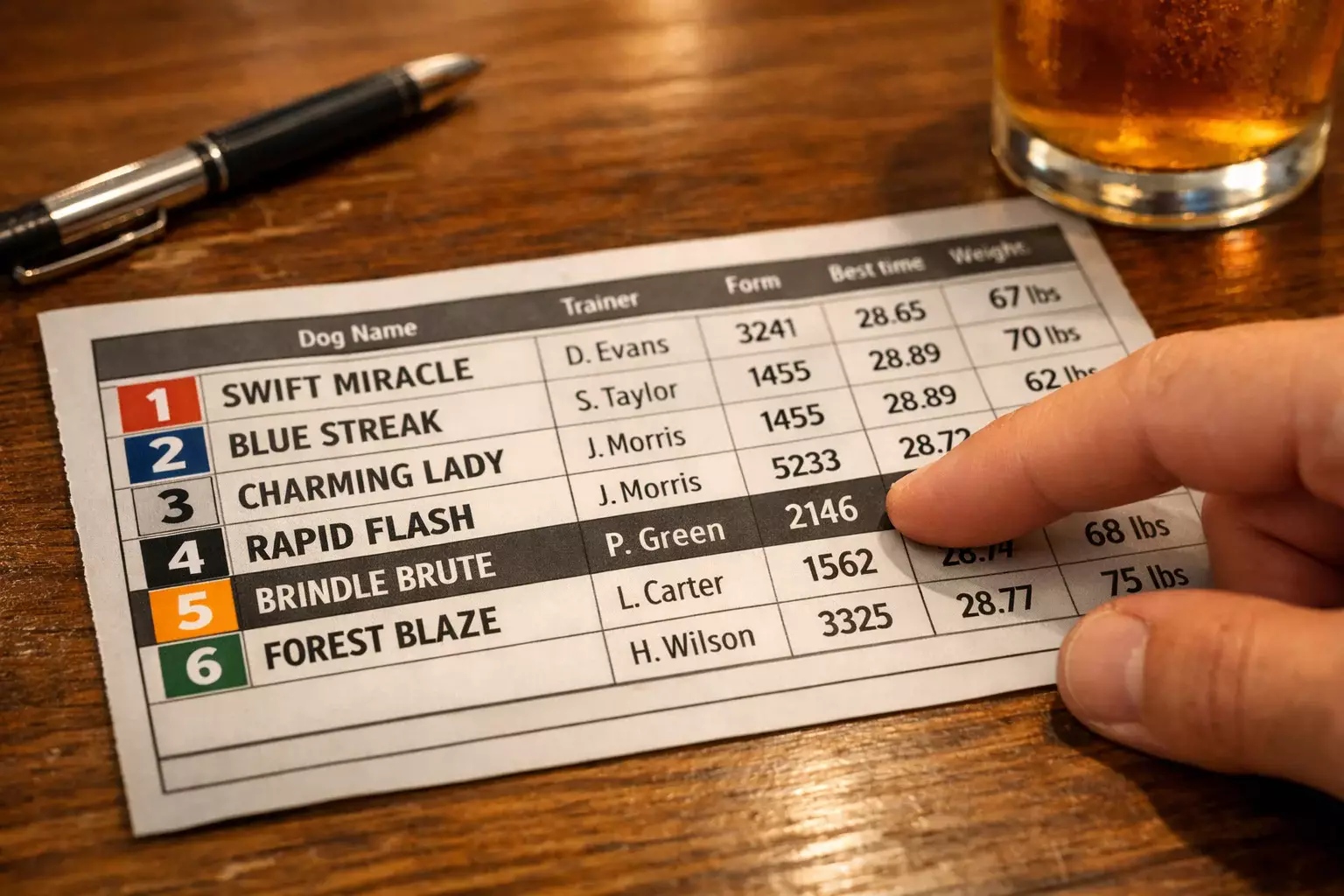
The Racecard Is Your Pre-Race Briefing
Before a single trap opens at Monmore, you have access to a document that tells you almost everything you need to know about the race ahead. The racecard is the pre-race briefing — a structured summary of every dog in the field, its recent history, its trainer, its trap draw, and its best times. It is the most information-dense page in greyhound racing, and learning to read it quickly and accurately is the difference between betting with a plan and betting with a hunch.
Racecards at Monmore are available on-course in printed form and online through bookmaker websites and dedicated greyhound racing platforms like Sporting Life and Timeform. The online versions are usually more detailed, including additional data fields and links to full form histories, but the core structure is the same. Every racecard for every meeting follows the same format, which means that once you know how to read a Monmore card, you can read a card from any GBGB track. That standardisation is deliberate — GBGB oversees the registration of approximately 6,000 greyhounds annually, and a uniform format ensures consistency across the 18 licensed stadiums.
Every Column on a Monmore Racecard Explained
A standard Monmore racecard for a single race displays six rows — one per dog — and multiple columns of data. The trap number comes first, coloured to match the jacket the dog will wear: red for trap one, blue for two, white for three, black for four, orange for five, and striped for six. The colour coding is not decorative. It allows you to track the dog during the race when all you can see is a blur of colour rounding a bend.
Next to the trap number is the dog’s name, followed by its trainer. The trainer column is worth noting because it is the first variable most beginners skip. Knowing the trainer tells you who prepared the dog, and a trainer’s overall strike rate — available on statistics sites — adds a layer of information that the racecard itself does not quantify but that you can bring to it.
The form figures follow. These are a condensed history of the dog’s most recent finishes, listed as single digits: 1 means first, 2 means second, and so on. A dash means the dog did not finish, and a letter — such as F for fell or R for refused — indicates an incident. Reading the form figures left to right gives you a chronological sequence, with the most recent run on the right. A dog showing 312211 has improved steadily, with its last two runs producing wins. A dog showing 654643 has been struggling.
Best time is listed next, usually the dog’s fastest recorded time over the race distance at Monmore. This gives you a ceiling — the best the dog has achieved. Comparing best times across the six dogs in a race provides a rough guide to relative ability, though best times can be misleading if they were set months ago in different conditions. Weight is also listed, typically in kilograms, and significant weight changes between runs can indicate changes in fitness or condition.
Additional columns may include the dog’s sire and dam (parentage), date of birth, and the distance of the race. Some online racecards add Monmore-specific data such as recent sectional times, trap records for the dog at the venue, and the calculated grade. The more detailed the racecard, the more information you have before the traps open — and information, not luck, is what separates consistent punters from occasional winners.
Decoding the Form Figures: Numbers, Letters, Dashes
Form figures are the racecard’s most compressed data, and beginners often find them intimidating. They should not be. The system is logical, and a few minutes of practice makes it intuitive.
Each digit represents a finishing position in a recent race. A 1 is a win. A 6 is last place. The figures are listed in chronological order from left to right, so the rightmost digit is the most recent run. If a dog’s form reads 321, it finished third two races ago, second last time, and first most recently. That is an improving pattern, and it tells you the dog is trending in the right direction.
Letters and symbols interrupt the sequence when something unusual happened. An F indicates a fall — the dog went down during the race. An R means the dog refused to chase or was withdrawn at the start. A dash typically indicates a non-finish for other reasons. These interruptions matter. A dog whose form reads 11F21 was winning consistently until it fell, returned and won again. The fall is a red flag — was it caused by interference, or does the dog have a running-style issue that makes falls more likely? The form figure raises the question. Checking the full result and running comment answers it.
The letter T in some racecard formats indicates a trial run rather than a competitive race. Trials are used to assess a dog’s fitness after a break, test it over a new distance, or establish a grading time. Trial results do not carry the same weight as competitive form — the dog was not racing against rivals — but they provide a useful data point, particularly for dogs returning from injury or transferring from another track.
Turning the Racecard into a Quick Assessment
Reading a racecard should not take fifteen minutes. With practice, you can scan a six-dog field in two or three minutes and form a preliminary view of the race. The method is simple: look at the form figures first, eliminate dogs in poor form, compare the best times of the remaining contenders, note the trap draws, and check whether any dog has a clear advantage in early pace from its box position.
A quick assessment is not a final assessment. It is a filter. If three of the six dogs can be eliminated because their form figures are poor, their best times are significantly slower, or their running style clashes with their trap draw, you are left with three contenders. Deciding between them requires more detailed work — checking the full result histories, comparing sectional times, reviewing the trainer’s recent strike rate — but the racecard has done its job by narrowing the field from six to three in under three minutes.
The racecard is a starting point, not a verdict. But it is the best starting point available, and the punters who use it consistently outperform those who skip straight to the odds. Every column means something. Every form figure tells a story. The racecard hands you the briefing; what you do with it is up to you.
The wider context is set out in our Monmore greyhound results guide.
