

Two Result Formats, Two Different Purposes
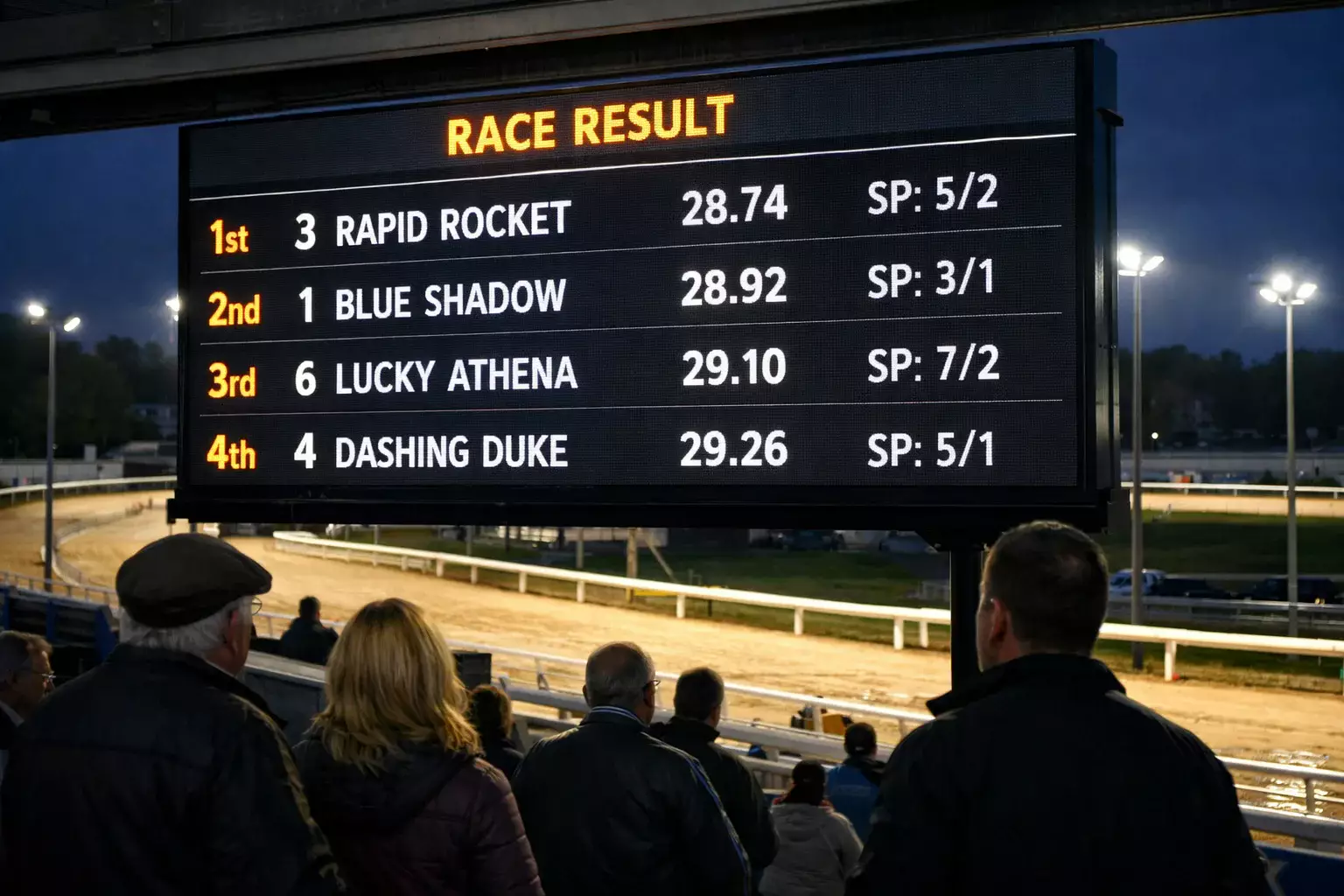
After every race at Monmore Green, two versions of the result enter the world almost simultaneously. The fast result tells you who won, in what time, and at what starting price. The full result tells you all of that plus how the race unfolded: the running comments for each dog, the distances between finishers, the sectional times, the forecast and tricast payouts, and the detailed race narrative that explains what happened from trap to line. Both versions describe the same event. They serve entirely different purposes.
If you are a casual punter checking whether your accumulator landed, the fast result is all you need. If you are a form student building a profile of a dog’s running style, the fast result is useless — you need the full version. Understanding what each format contains, where to find it, and which one matches your needs saves time and prevents the kind of shallow analysis that comes from treating a finishing time as the whole story.
Monmore produces results across six racing days per week — BAGS meetings on Monday, Tuesday, Wednesday and Friday, evening cards on Thursday and Saturday. That volume generates a constant flow of data, and how you consume it depends on what you are trying to do with it.
Fast Results: Winner, Time and SP in Seconds
Fast results appear within seconds of a race finishing. They are the first output of the SIS data feed: the winner’s name, the trap number, the finishing time, and the starting price. On most bookmaker platforms, fast results are delivered as a push notification or an auto-updating results page that refreshes without requiring the user to reload. The information is minimal by design — it is built for speed, not depth.
For bet settlement, fast results are sufficient. If you backed the dog in trap three to win and the fast result shows trap three as the winner, your bet is settled. The time and SP confirm the official return. You do not need the running comments, the sectional splits, or the forecast payout to know whether you won. The fast result gives you the outcome and nothing else.
The limitation is obvious. A fast result tells you nothing about how the race was run. It does not tell you whether the winner led from the traps or came from behind. It does not tell you whether the second-placed dog was unlucky, checked on the bend, or simply outpaced. It does not tell you whether the third-placed dog ran a faster sectional than the winner but lost ground through traffic. All of that information exists — it is captured by the timing system and recorded by the race commentator — but it does not appear in the fast result. If you are using fast results as your primary form database, you are working with a fraction of the available data.
Fast results are best suited to three use cases: checking bet outcomes, monitoring live meetings in real time, and compiling a quick overview of a day’s racing before diving into the detail. They are the headline. The story is elsewhere.
Full Results: Running Comments, Sectionals and Forecasts
Full results take longer to appear — typically 10 to 30 minutes after a race, depending on the platform — but they contain everything the fast result omits. The standard full result for a Monmore race includes the finishing order of all six dogs, each dog’s finishing time, the distances between finishers (expressed in lengths), the starting price for each dog, the running comment for each dog, the sectional time where available, and the forecast and tricast payouts.
The running comments are the most analytically valuable element. A comment like u201cEP, led to the first bend, held on under pressureu201d tells you that the dog showed early pace, secured the rail position, and maintained its lead against challengers. A comment like u201cSAw, mid-division, ran on lateu201d tells you the dog was slow away from the traps, raced in the middle of the pack, and finished strongly. These narratives compress the race into a sentence, and each sentence contains information that shapes your assessment of the dogu2019s next run.
Distances between finishers add another layer. If the winner beat the second dog by four lengths, the race was not competitive at the business end. If the first three finishers were separated by a neck and a short head, the race was closely contested and any of the front three could have won with a slightly different run. The distance data tells you how to weight the finishing positions — a second-place finish beaten by a neck is fundamentally different from a second-place finish beaten by eight lengths, even though the racecard will show a u201c2u201d in both cases.
Full results also include the GBGB-standard data fields that feed into the governing body’s annual reports: the number of starters, any withdrawals or non-runners, and injury notifications where applicable. The injury rate of 1.07% across all GBGB tracks in 2024 is derived from exactly this data, aggregated across every full result from every meeting at every licensed stadium.
Best Sources for Each Format: Timeform, Sporting Life, GBGB
Fast results are available from virtually every bookmaker that carries Monmore racing. Ladbrokes, Coral, William Hill, Betfred, Paddy Power, and Betfair all publish fast results as part of their standard greyhound service. The SIS data feed powers most of these, which means the results are consistent across platforms — the same winner, the same time, the same SP. The only difference is presentation: some sites display the information more cleanly than others.
Full results require more specialist sources. Timeform is widely regarded as the most comprehensive greyhound results service in the UK, offering detailed running comments, sectional data, and form histories for every GBGB meeting. The service is subscription-based for its deepest features but offers a substantial amount of free data that is more detailed than the fast-result feeds from bookmakers.
Sporting Life provides full results alongside racecards and form guides, with a user interface that makes it easy to navigate between meetings and compare dogs across multiple runs. The GBGB website publishes official results and data, including the injury and retirement statistics that underpin the sport’s welfare reporting. For Monmore-specific data, the track’s own results are accessible through its website and through the SIS Racing platform, which publishes monthly statistical summaries.
The practical recommendation is straightforward. Use fast results for real-time monitoring and bet checking. Use Timeform or Sporting Life for form analysis and dog profiling. Use the GBGB site for official data and welfare context. No single source provides everything, but the combination of a fast-result feed and a full-result database gives you complete coverage of every Monmore meeting, every race, and every dog that runs at the track.
The wider context is set out in our Monmore greyhound results guide.
