

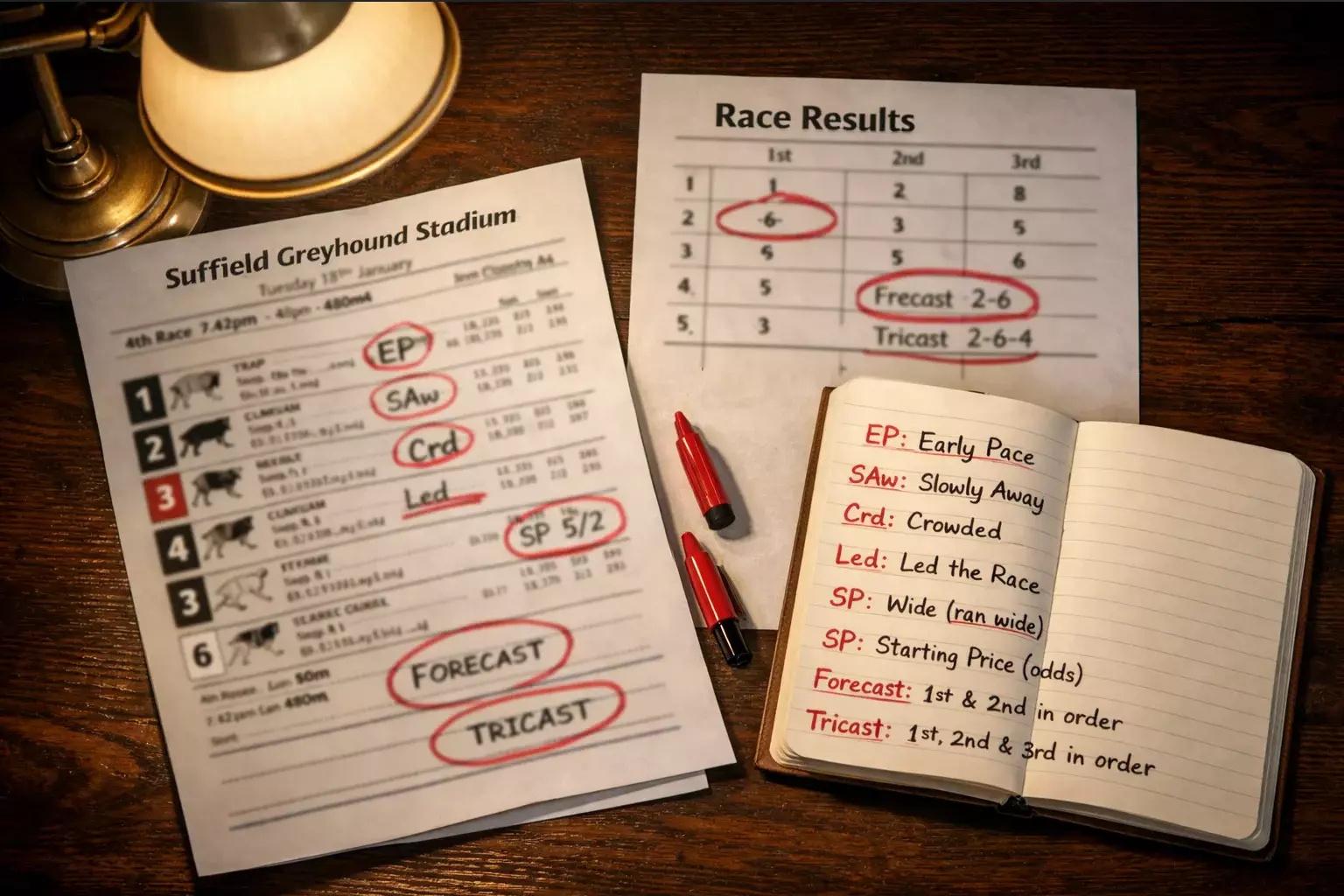
The Language of Greyhound Racing in One Place
Greyhound racing has its own vocabulary, and if you are new to the sport — or returning after years away — the jargon in racecards, results, and commentary can feel impenetrable. Abbreviations that mean nothing to a first-time visitor at Monmore Green are second nature to regulars. Betting terms that appear in every result line go unexplained because everyone is assumed to know them already. This glossary exists to close that gap. It covers the race terms, the betting terms, and the result abbreviations you will encounter at any GBGB-licensed track, including Monmore.
The terms are grouped by category rather than listed alphabetically, because understanding them in context is more useful than looking them up one at a time. The industry that produces this language spans 18 licensed stadiums, around 500 trainers, and approximately 6,000 registered greyhounds per year — a compact ecosystem with a dense, specialised vocabulary.
Race and Track Terms: A to Z
BAGS — Bookmakers Afternoon Greyhound Service. Daytime meetings staged primarily for off-course betting, broadcast into betting shops via SIS. Monmore hosts BAGS meetings on Monday, Tuesday, Wednesday and Friday.
Bend — One of the curved sections of the oval track. A standard circuit has four bends. Monmore’s first bend is 103 metres from the traps, a short run that places a premium on early pace.
Circuit — The full lap of the track. Monmore’s circuit circumference is 419 metres.
Grade / Graded race — A race restricted to dogs within a specific ability band (e.g. A1, B3, D4). Grades are assigned by the racing manager based on recent adjusted times. Dogs move between grades based on results. The full grading rules are set out in the GBGB Rules of Racing.
Going — The condition of the track surface. In greyhound racing, the going is affected by moisture content — a wet sand surface runs slower than a dry one. Unlike horse racing, greyhound going is not formally declared as a category; it is inferred from times and conditions.
Hare — The mechanical lure that dogs chase. Monmore uses a Swaffham inside hare, which runs on the inside rail of the track.
Kennel — The housing facility for racing greyhounds, maintained by the trainer under GBGB licence standards. Kennel inspections are part of the regulatory framework.
Open race — A race with no grade restriction, open to any dog. Open races typically appear on evening cards and during major competition rounds, attracting the strongest fields.
Racecard — The programme for a meeting, listing every dog, its trap, trainer, form figures, best time, and other data. Available on-course in printed form and online through bookmaker sites and form platforms.
Sectional time — The split time recorded at the first bend, measuring how quickly a dog reached the first corner from a standing start. Used to assess early pace and running style.
Trap — The starting box from which a dog begins the race. Traps are numbered one (inside) to six (outside), each with a corresponding jacket colour: red, blue, white, black, orange, striped.
Trial — A non-competitive run used to assess a dog’s fitness after a break, test it over a new distance, or establish a grading time. Trials appear in form records but carry less weight than competitive results.
Betting Terms: SP, Forecast, Tricast and More
SP (Starting Price) — The official odds at the moment the traps open, determined by on-course bookmakers. SP is the price returned for bets placed at starting price rather than at a fixed earlier price.
BSP (Betfair Starting Price) — The exchange-derived starting price calculated from the last matched odds on Betfair at the off. BSP can differ significantly from track SP, particularly in thin greyhound markets.
Forecast — A bet predicting the first and second dog in the correct order. Forecast payouts are listed in full results and are pool-based (tote) or fixed-odds depending on where the bet is placed.
Tricast — A bet predicting the first, second, and third dog in the correct order. Tricasts offer larger payouts than forecasts but are harder to land.
Each-way — A bet consisting of two parts: a win bet and a place bet. In a six-dog greyhound race, each-way typically pays out if the dog finishes first or second.
Tote — The totalisator pool betting system, where all stakes are pooled and the payout is determined by dividing the pool among winners. The tote operates on-course and through online tote platforms.
Tissue — The bookmaker’s preliminary odds for a race, compiled before any money is wagered. The tissue is the opening offer and shifts as bets are placed.
Value — A bet where the odds offered exceed the bettor’s assessment of the dog’s true chance of winning. Value is not about backing winners — it is about backing dogs at prices that are too generous.
Result Abbreviations: EP, SAw, Crd, Rls, Led, Bmp
Running comments in greyhound results use a standardised set of abbreviations. Here are the most common ones you will encounter in Monmore results:
EP (Early Pace) — The dog showed speed from the traps, breaking quickly and reaching the first bend among the leaders. EP is a positive indicator for dogs drawn in inside traps, where early pace translates directly into a rail position.
SAw (Slow Away) — The dog was slow to leave the traps, losing ground at the start. SAw often explains a disappointing finishing time — the dog lost position at the break and spent the rest of the race recovering.
Led — The dog led the race, either from the traps or after taking the lead at some point during the race. Leading is tactically advantageous at Monmore because the tight circuit makes overtaking difficult.
Crd (Crowded) — The dog was crowded by other runners, losing ground or momentum through lack of racing room. Crowding typically occurs on the bends, where six dogs converging on a tight turn create traffic.
Rls (Rails) — The dog raced on the inside rail, following the shortest path around the track. A rails run is generally advantageous because it covers less distance and avoids the wider running lines that cost time.
Mid (Middle) — The dog raced in the middle of the pack, neither on the rail nor wide. A mid-track running position is neutral — it avoids the traffic risks of the rail but does not offer the clean running of a wide line.
W (Wide) — The dog raced wide on the bends, covering more ground than dogs on the rail. Running wide is generally a disadvantage, but some dogs prefer the wide line because it gives them room to accelerate without interference.
Bmp (Bumped) — The dog made contact with another runner during the race. A bump can slow a dog momentarily and alter its running line, costing ground that may not be recoverable on a short circuit like Monmore.
RnOn (Ran On) — The dog finished strongly in the closing stages, gaining ground on the leaders. A dog that consistently runs on is a closer — a running style that requires a clean passage through the field but can produce dramatic late finishes.
Fdd (Faded) — The dog lost speed in the closing stages, dropping back through the field after leading or racing prominently. Fading can indicate tiredness, unsuitability for the distance, or the after-effects of early exertion.
These abbreviations appear in every Monmore full result. Learning them is a ten-minute investment that transforms how you read results — every comment becomes a compressed race narrative, and the patterns across multiple results reveal a dog’s running style more clearly than any single finishing time.
The wider context is set out in our Monmore greyhound results guide.
The abbreviations in a result are decoded in results decoded.
