

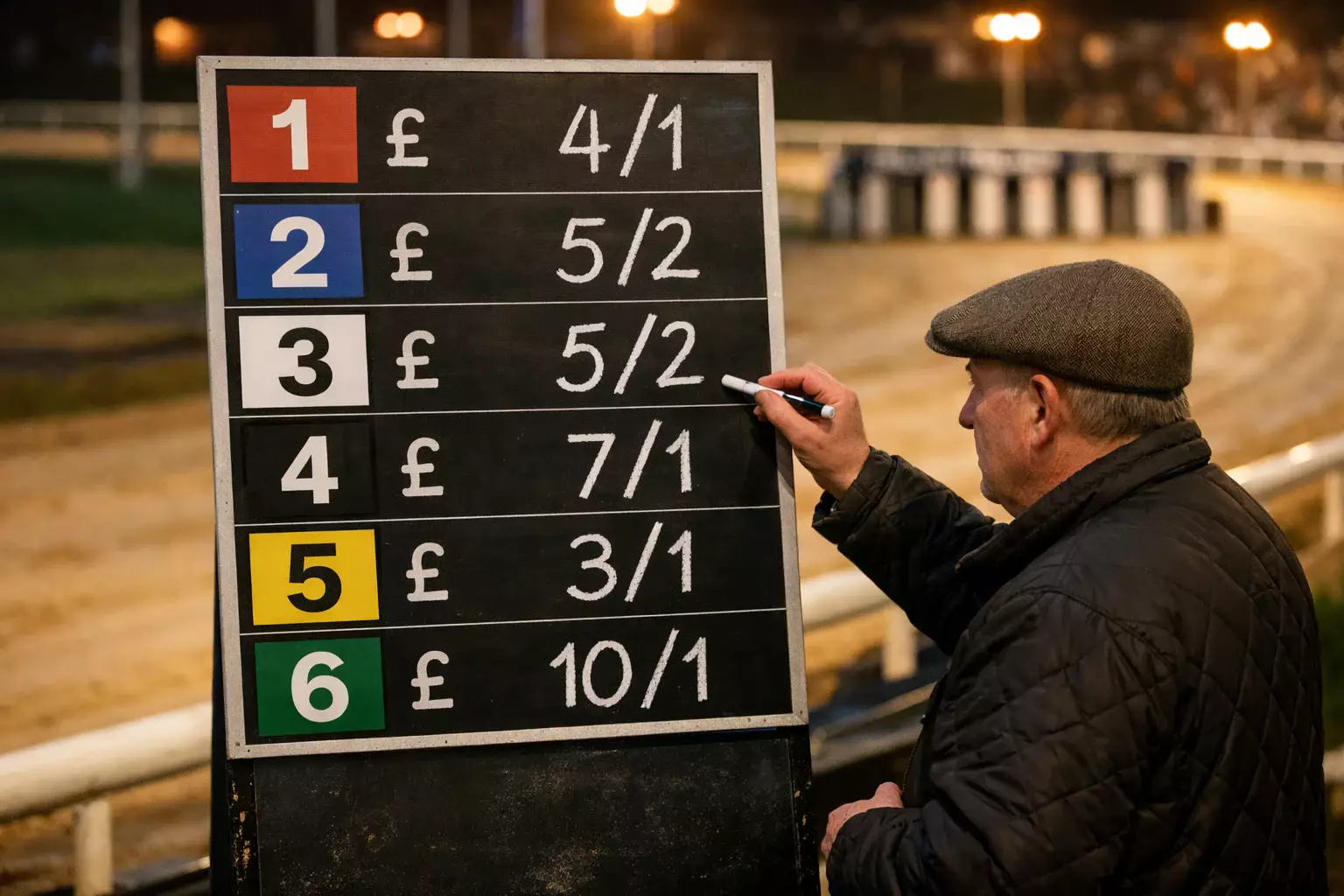
Starting Prices and Payouts: The Numbers After the Dogs
Every Monmore result comes with a set of numbers that have nothing to do with how the dogs actually ran. Next to the finishing positions and times, you will find the starting price, the forecast return, and the tricast payout. These are the market numbers — the translation of the race into money — and they tell a parallel story about how the betting public and the bookmakers read the same event.
For anyone new to greyhound results, the SP, forecast, and tricast figures can look like background noise. They are not. The starting price tells you how the market assessed each dog’s chances before the traps opened. The forecast and tricast payouts tell you how accurately the market predicted the finishing order. Together, they form a record of collective opinion against which you can measure your own judgement. Greyhound betting in the UK turned over £794 million in betting shops in the year to March 2024, and every penny of that was funnelled through exactly these pricing mechanisms.
Understanding how starting prices are formed, what forecasts and tricasts actually reward, and where the exchange market diverges from the on-course market is fundamental to reading Monmore results as anything more than a list of names and numbers.
How Starting Prices Are Formed on Track
The starting price — SP — is the official odds at which a dog is returned after the race begins. At Monmore, as at all UK greyhound tracks, the SP is determined by on-course bookmakers. These are the independent bookmakers standing at the trackside, each offering their own prices, and the SP is derived from a consensus of their boards at the moment the traps open.
The process works like this. Before each race, the on-course bookmakers put up their tissue — an initial set of prices based on form, trap draw, and their assessment of likely demand. Money then flows in. A dog might open at 3/1 and, if enough punters back it, shorten to 2/1 or even shorter. Another might drift from 5/2 to 4/1 as the market turns against it. The SP is the price showing when the race starts, and it becomes the official return for anyone who took SP rather than a fixed price.
For greyhound racing, the SP mechanism is particularly important because the markets are thin. A horse race at Ascot might have tens of millions of pounds wagered. A midweek BAGS race at Monmore might turn over a few thousand. In a thin market, individual bets can move the price. One punter putting £200 on a dog at a BAGS meeting can visibly shift the SP, which creates opportunities for those who understand market dynamics and anomalies for those who do not.
The SP also serves as a historical record. When you look back at a Monmore result from last month, the SP tells you what the market thought at the time. A dog that won at 8/1 was considered an outsider — either the form did not support it, or the market missed something. A winner at 4/6 was a strong favourite that delivered. Over a series of runs, a dog’s SP trajectory reveals how the market is adjusting to its improving or declining form. That trajectory is data, and it is free.
It is worth noting that SP only applies to on-course and traditional bookmaker markets. Betting exchanges use a different pricing mechanism entirely, which is where the distinction between track SP and exchange SP becomes relevant.
Forecasts and Tricasts: Predicting the Exact Order
A forecast bet asks you to predict the first and second dog in the correct order. A tricast asks for first, second and third. Both are tote-pool bets at the track — the payout depends on the total pool staked and how many winners share it — though bookmakers also offer their own fixed-odds versions.
Forecast and tricast payouts appear in every Monmore result, and they can be startling. A straightforward graded race where the two shortest-priced dogs finish first and second might return a forecast of £8 or £10 to a £1 stake. A result where two outsiders fill the places can push the forecast to £50 or £100, and a tricast involving three unconsidered runners can return several hundred pounds. The numbers reflect scarcity: few people predicted that exact combination, so the pool is divided among fewer winners.
For regular Monmore punters, forecasts and tricasts are where the biggest payouts come from on a routine card. Win bets on short-priced favourites return modest profits. Forecasts reward precision. The analytical challenge is different, too. Instead of asking u201cwhich dog wins?u201d, you are asking u201cwhich dog wins and which dog finishes second?u201d — a question that requires you to think about running lines, trap positions, and how the race will unfold tactically rather than just who is fastest.
A practical example: if you identify a Monmore dog that consistently breaks fast from trap one and leads to the first bend, and another dog that always finishes strongly from midfield, a forecast with the early-pace dog first and the closer second becomes a structured bet rather than a guess. The result line confirms or denies your reading. Over time, punters who consistently identify accurate forecasts — even at modest stakes — can generate returns that outstrip simple win betting. The flip side is that forecasts are harder to land, and losing runs can be long. But the data is all in the result line: finishing order, distances between dogs, sectional times, running comments. Every forecast payout you see in the results is a price tag on a specific sequence of events that someone, somewhere, either predicted or stumbled into.
Betfair SP vs Track SP: Key Differences
The rise of betting exchanges — Betfair chief among them — introduced an alternative pricing mechanism that runs alongside the traditional on-course SP. The Betfair Starting Price (BSP) is calculated from the exchange market at the off: the last matched odds weighted by volume. It is not set by a bookmaker making a judgement call. It is set by the aggregate of money laid and backed on the exchange.
The differences between track SP and BSP can be significant in greyhound racing. On horse racing, the two tend to converge because the markets are deep and well-informed. In greyhounds, where the betting volume is lower and the exchange liquidity is thinner, BSP and track SP can diverge by considerable margins. A dog returned at 3/1 SP on track might show a BSP of 4.5 (7/2) on Betfair, or vice versa. The divergence tells you something: one market sees value that the other does not.
For Monmore punters, this has practical implications. If you habitually take SP with a high-street bookmaker, you are accepting the track-based price. If you use the exchange, you might get better odds on outsiders — exchange markets tend to be more generous at the top of the market — but worse odds on favourites. Knowing which pricing mechanism suits your style of betting is part of the game. The exchange also allows you to lay dogs (bet against them winning), which opens up an entirely different approach to Monmore results: instead of picking winners, you pick losers. That inversion changes the analysis.
One more wrinkle. The overall greyhound betting market has contracted in recent years — turnover in UK betting shops fell by 23% in real terms over three years to March 2024, according to Gambling Commission data reported by the Racing Post. That contraction means thinner markets, more volatile prices, and a greater chance that the SP on a Monmore race does not fully reflect the true probability. For analytical punters, thinner markets mean more edge. For casual punters, they mean more randomness. Either way, the SP, forecast, and tricast numbers in the result line are the final word on what the market thought, and comparing them to what actually happened is the starting point for any serious approach to greyhound betting.
The wider context is set out in our Monmore greyhound results guide.
Where to find the prices is in Monmore betting odds.
