
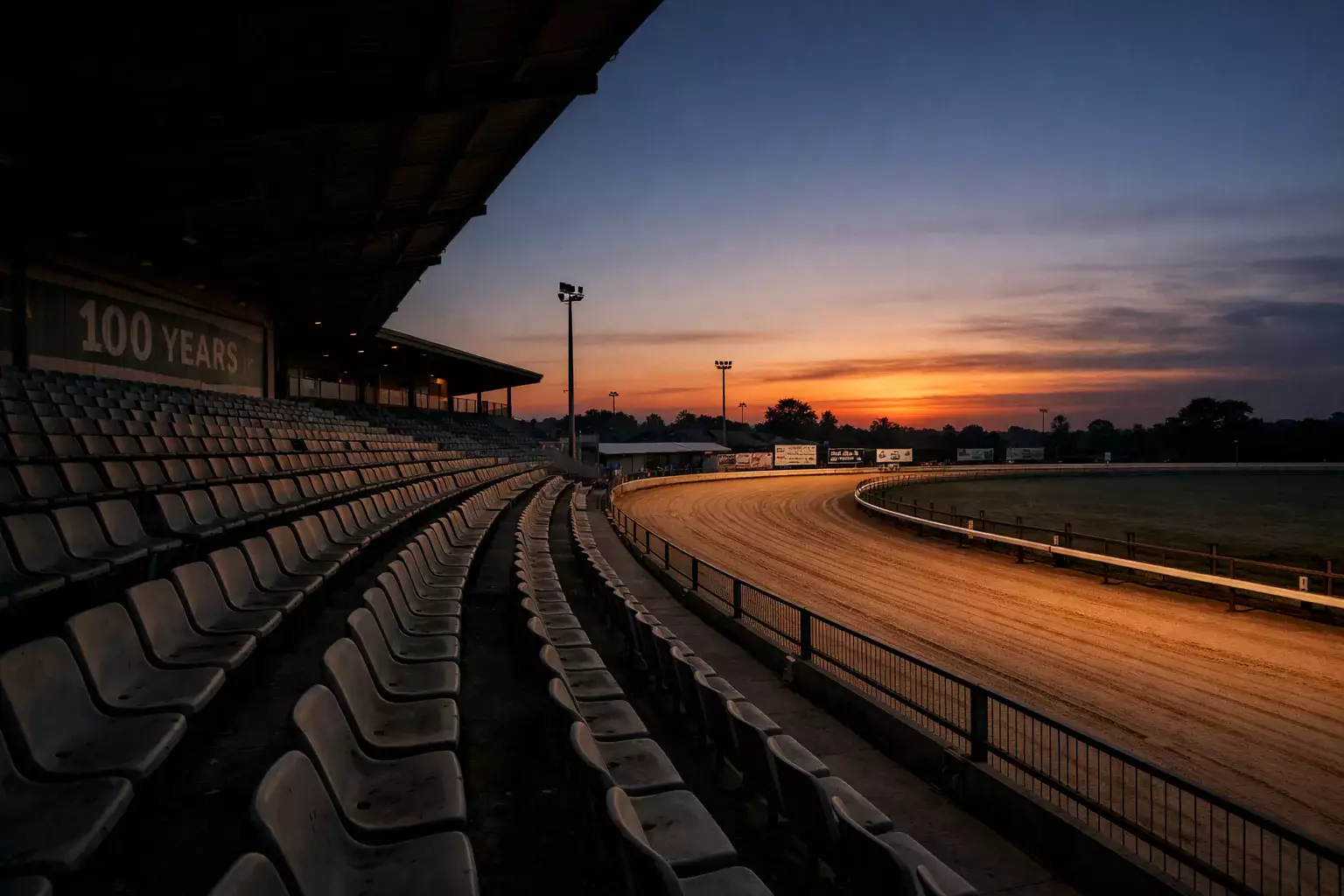
One Hundred Years On: A Sport at a Crossroads
In 2026, greyhound racing in Britain turns 100 years old. The first meeting on an oval track with a mechanical hare took place at Belle Vue in Manchester in 1926, and the sport that followed went on to become one of the most popular spectator events in mid-twentieth-century Britain. At its peak, more than 34 million paying spectators passed through the turnstiles in a single year. The country had at least 77 licensed tracks. Greyhound racing was, for several decades, a bigger draw than football.
The centenary arrives in a very different landscape. The UK now has 18 GBGB-licensed stadiums — down from 77 at the sport’s height. Betting turnover is declining year on year. Wales is legislating to ban the sport outright. Scotland’s animal welfare commission has issued a critical assessment of the industry. And yet Monmore Green still races six days a week, the SIS cameras still broadcast every meeting, and punters in betting shops across Britain still place bets on the next race from Wolverhampton. The sport is contracting, but it is not gone, and the tension between its shrinking footprint and its continuing operation defines everything about where it stands in 2026. The question for the centenary and beyond is what shape it takes next.
The 2026 Centenary: Celebrations and Context
The centenary of British greyhound racing in 2026 is both a milestone and an awkward moment. The industry will mark it — tracks will run commemorative events, the GBGB will issue statements about the sport’s heritage, and the racing press will produce retrospectives tracing the arc from Belle Vue to the present. But the celebrations land in a year where the sport faces existential questions that no amount of nostalgia can answer.
The context is unavoidable. A century ago, greyhound racing was a new entertainment for the working class, a cheap night out with the thrill of live wagering. By the 1940s and 1950s, it was a national institution. By the 1980s, it was in decline — television, changing leisure habits, and the erosion of the industrial communities that had sustained the sport all contributed to falling attendances. The tracks closed, one by one, and the survivors adapted by pivoting from spectator entertainment to a broadcast betting product delivered through BAGS and SIS.
That pivot kept the sport alive but changed its character fundamentally. Modern greyhound racing at Monmore is not the same activity that drew 10,000 people to the stadium’s opening night in 1928. It is a content-generation business, producing races for betting consumption, funded by bookmaker contracts rather than gate receipts. The centenary celebrates the heritage of the first version while the industry operates firmly in the second. Whether there will be a 150th anniversary to mark depends on decisions being made now — in parliaments, in boardrooms, and in the betting shops where the revenue is generated.
Betting Turnover Decline: Minus 23% in Three Years
The financial picture is where the centenary optimism meets cold reality. Greyhound betting turnover in UK betting shops fell by 23% in real terms over the three years to March 2024, according to Gambling Commission data reported by the Racing Post. That decline is not a blip. It is a structural trend driven by multiple factors: the migration of betting from shops to online platforms where greyhound racing competes poorly against football and horse racing, the reduction in the betting shop estate as operators consolidate, and the broader post-pandemic shift in consumer behaviour.
The revenue decline has direct consequences for the sport’s welfare and prize fund infrastructure. The British Greyhound Racing Fund, which distributes money to tracks for prize funds and welfare programmes, reported income of £7.3 million in 2023-24, down from £7.6 million the previous year and far below its historical norm of £10-14 million. The fund’s income is derived from the voluntary levy that bookmakers pay on their greyhound betting profits, and as those profits shrink, so does the levy income.
For tracks like Monmore, the turnover decline manifests in tighter budgets, more reliance on BAGS broadcast income, and less room for investment in facilities and prize money. The track continues to operate because the BAGS and SIS contracts provide a revenue floor, but that floor is not rising. The economics of greyhound racing in 2026 are sustainable in the narrowest sense — the lights stay on, the dogs run, the results come through — but there is no growth engine and no obvious source of new revenue. The question the sport cannot yet answer is whether the current model represents a stable plateau or a slow descent.
Wales, Scotland and the Political Landscape
The regulatory pressure on greyhound racing is not confined to Wales. In Scotland, the Scottish Animal Welfare Commission concluded in 2023 that where gambling and commercial activity are involved, the welfare risks of greyhound racing outweigh its likely positive aspects. Scotland does not currently have a licensed greyhound track — the last one closed years ago — so a Scottish ban would be largely symbolic in practical terms. But the SAWC’s assessment carries moral weight and provides ammunition for campaigners pushing for action at Westminster.
In England, where all 17 remaining GBGB tracks outside Wales operate, the political dynamics are different. Animal welfare legislation at Westminster competes for parliamentary time with larger priorities, and the greyhound racing industry has allies among MPs representing constituencies with tracks. But the trajectory is clear. Public opinion on animal welfare is shifting, the campaigning organisations are better funded and more sophisticated than a decade ago, and the data — both the industry’s own welfare data and the cumulative harm figures cited by abolitionists — is more widely available than ever. The sport’s centenary may buy it a year of goodwill. It will not buy it immunity from the political forces gathering around it.
New Zealand provides an international reference point. In 2024, the New Zealand parliament passed legislation banning greyhound racing, with a phased closure running to July 2026. The decision followed years of welfare concerns and public campaigning that closely mirror the British experience. The NZ ban demonstrates that legislative abolition is not a theoretical exercise — it is happening, in real time, in countries with similar legal traditions and similar industries.
For Monmore, the political landscape is a background variable that does not affect tomorrow’s racecard but may determine whether there is a racecard five or ten years from now. The sport enters its second century with its best-ever welfare data and its worst-ever political position. Whether the data is enough to sustain political support — or whether the cumulative weight of campaigning, legislative precedent, and changing public attitudes will eventually tip the balance — is the open question that the centenary year cannot answer.