
Greyhound Grades Decoded: Why Every Race Has a Letter
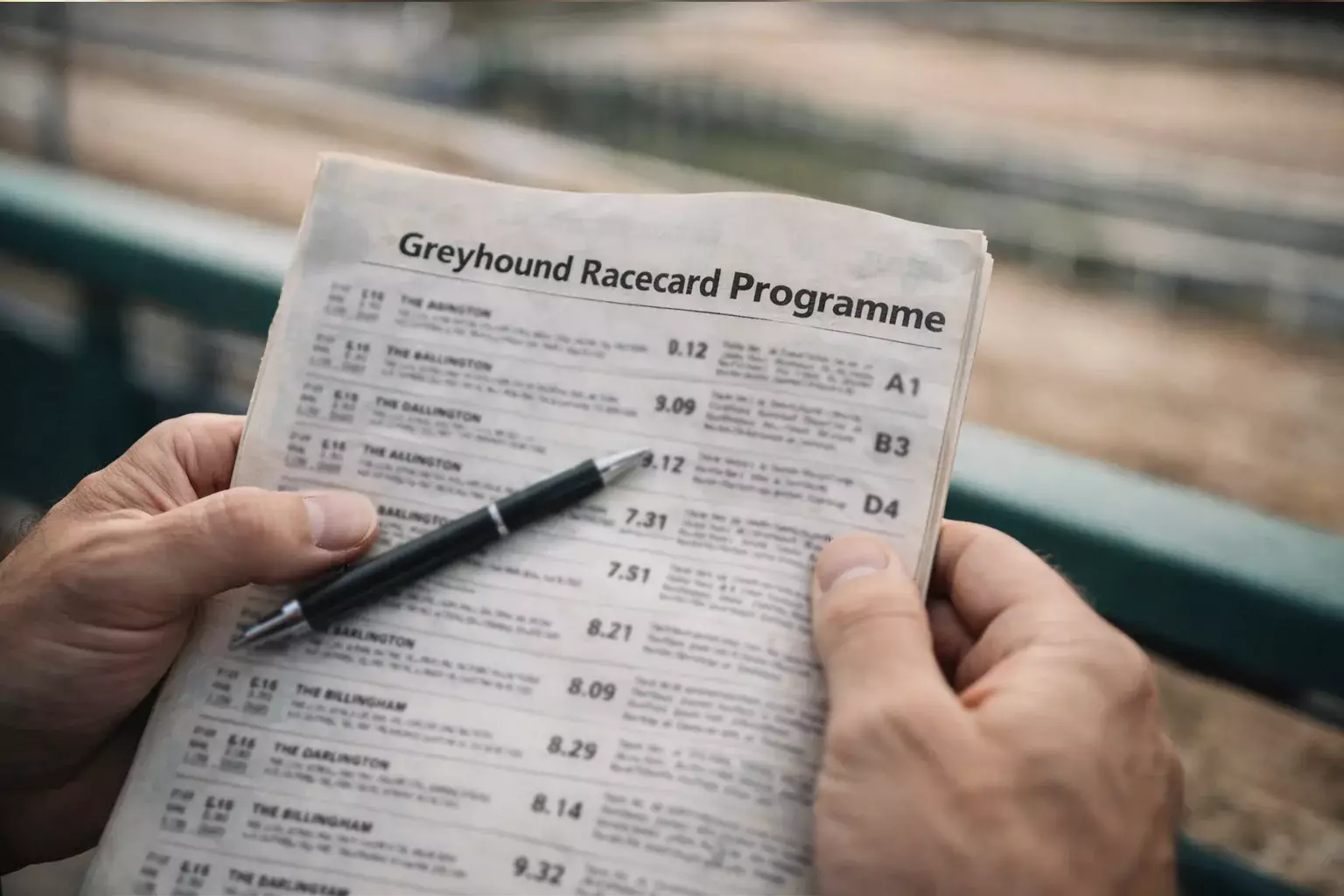
Open any Monmore racecard and you will see a code beside each race: A1, B3, D4, OR. That code is not decoration. It is the grading system that determines which dogs run against which, and it affects everything from the likely pace of the race to the price you will get from a bookmaker. Understanding grades is not optional for anyone trying to read greyhound results with any seriousness. Every letter means something, and the grade assigned to a race shapes the outcome before the traps even open.
The UK greyhound grading system exists to create competitive racing. Without it, the fastest dogs at a track would win every week and the slower ones would never see a prize. Grades sort dogs into bands of roughly equivalent ability based on their recent times at the track, so that a race between six D4 dogs is genuinely contested even if none of them would trouble an A1 field. Across Britain’s 18 GBGB-licensed stadiums, with approximately 6,000 greyhounds registered annually and around 500 trainers managing their careers, the grading system — codified in the GBGB Rules of Racing — is the mechanism that keeps the whole operation functional. Without grades, there is no competitive balance. Without competitive balance, there is no betting market.
The Grade Ladder from D4 to A1
The grade ladder at a UK greyhound track runs from the bottom — D4 — to the top — A1. The letter indicates the division and the number indicates the sub-level within that division. A1 is the elite tier for graded racing at any given stadium. D4 is the slowest band. Between those extremes sit the B and C grades, each subdivided in the same way.
At Monmore specifically, the grading is based on a dog’s calculated time over the relevant distance. The racing manager takes each dog’s recent finishing times, applies adjustments for things like going wide on bends or being checked by another runner, and arrives at an adjusted time that reflects the dog’s true ability at the track. Dogs with the fastest adjusted times go into the A grades. Dogs running a second or two slower end up in B or C. The slowest runners fill the D bands.
Each grade should, in theory, produce a race where the six dogs are evenly matched. In practice, there are always marginal differences — a dog moving up after two wins might be slightly faster than its new grade peers, while a dog dropping down after poor runs might be slightly slower. These marginal mismatches are precisely where punters look for value. A dog freshly promoted from B2 to B1 may be outclassed. A dog recently demoted from A3 to A4 may be a value selection running against weaker opposition.
The number of grades in active use varies by track and by period. A large, busy track with a deep pool of resident dogs might use the full range from A1 to D4. A smaller venue might compress the scale. Monmore, as one of Britain’s most active tracks, tends to use most of the available grades across its BAGS and evening cards, which gives form students a rich data set to work with. You can track a dog’s career trajectory through the grades — arriving in D3, climbing to C1 over three months, hitting a ceiling at B4, dropping back after injury — and that trajectory tells you far more than any single result.
It is worth noting that grades are track-specific. An A1 dog at Monmore is not necessarily an A1 dog at Romford. Different tracks have different circuities, different surfaces, and different pools of dogs. A greyhound that dominates the 480-metre trip at a tight Midlands oval may struggle on the longer run to the first bend at a larger track. Grades are local rankings, not national ones.
How Dogs Move Up and Down the Grades
Promotion and demotion in the grading system happen based on results, and the racing manager at each track has a degree of discretion in applying the rules. The general principle is simple: if a dog wins, it is likely to go up a grade for its next outing. If it finishes last or runs a significantly slower time, it may drop. The reality is more nuanced than that binary, because the racing manager considers not just finishing position but adjusted times, the margin of victory or defeat, and whether the run was affected by interference.
At Monmore, a dog that wins an A5 race in a quick time might jump two grades to A3 rather than the standard one-grade promotion. Conversely, a dog that finishes last in a D1 might not drop further if its time was reasonable and it was simply outpaced on the night. The system is designed to find each dog’s natural level as quickly as possible, so that races remain competitive and the betting market stays healthy.
This creates a pattern that experienced form readers exploit. A freshly promoted dog is often over-graded — running against faster opposition than its previous form warrants — and tends to be underbet. A freshly demoted dog is often under-graded and tends to attract disproportionate money because punters see the drop in class as a green light. Neither assumption is always correct, but the grade movement itself is a reliable signal of where a dog sits relative to its current competition.
Injuries and absences complicate the picture. A dog returning from a layoff of several weeks is typically regraded based on a trial run rather than its pre-absence form. If the trial time is slower — which is common after time off — the dog enters a lower grade than it left. GBGB chief executive Mark Bird has noted that the welfare initiatives introduced in recent years are now embedded across the sport, and the care protocols around returning dogs include structured regrading to prevent mismatches that could lead to further injury. This is one area where welfare policy and racing policy intersect directly: the grading system protects dogs as well as bookmakers.
Open Races: The Grade-Free Competitions
Sitting above the graded system are open races, marked as OR on the racecard. Open races have no grade restriction. Any dog can enter, regardless of its grading history, and the field is typically composed of the strongest available runners. At Monmore, open races appear primarily on Thursday and Saturday evening cards and during competition rounds for the track’s marquee events.
The significance of open racing extends beyond individual results. The total prize fund for UK greyhound racing reaches approximately £15.7 million, and open races claim a disproportionate share of that figure. At the top end, the Greyhound Derby winner takes home £175,000. At track level, Monmore’s open events do not reach those heights, but they offer meaningfully more than graded affairs — enough to attract entries from trainers who would not bother sending a dog across the Midlands for a D3 purse.
For punters, open races at Monmore present a different analytical challenge. In a graded race, you can reasonably assume that the six dogs are of similar ability and focus your analysis on trap draw, recent form, and running style. In an open race, the ability gap between the best and worst dog in the field can be substantial. A dog stepping up from A1 graded company to open class might be outclassed. A seasoned open-race performer might be running below its best after a tough recent campaign. The grading shorthand disappears, and you are left with raw form — times, sectional splits, finishing positions — as your only tools.
This is why open-race results are the most referenced data points when comparing dogs across different tracks. Graded results are track-specific and grade-specific. Open-race results are closer to a universal standard, because the competition is not artificially constrained. If you are looking at a Monmore result and trying to assess whether a dog could perform at Nottingham or Hove, an open-race time is your best starting point.