
From Manchester to the Centenary: A Hundred Years in Summary
British greyhound racing turns 100 in 2026, and the distance between where the sport started and where it stands now is extraordinary. In 1926, a crowd in Manchester watched dogs chase a mechanical hare around an oval track for the first time in Britain, and the response was electric — within three years, the sport had spread to cities across the country and was attracting millions of spectators. By mid-century, greyhound racing was one of the most popular entertainment forms in Britain. By the end of the century, it was fighting for survival. The centenary year finds the sport with 18 licensed tracks, a declining betting market, and a political environment that grows less friendly with each passing session of parliament.
This is the arc of that century: explosive growth, cultural dominance, gradual decline, and a present defined by contraction and adaptation. Understanding the history does not change a Monmore result, but it provides the context that explains why the sport looks the way it does today — why there are only 18 tracks, why BAGS meetings exist, why the betting levy debate never ends, and why greyhound racing’s centenary feels more like a moment of reflection than a celebration.
1926: The Night at Belle Vue That Started It All
The first licensed greyhound meeting on an oval track with a mechanical hare in Britain took place at Belle Vue Stadium in Manchester on 24 July 1926. The concept was imported from the United States, where Owen Patrick Smith had patented the mechanical lure in 1919 and commercial tracks had already opened in several states. A group of British investors saw the potential, secured the rights, and built the first track at an existing entertainment venue in east Manchester.
The response exceeded every projection. The Belle Vue meeting drew a large, enthusiastic crowd, and the combination of live animal racing, betting, and accessible pricing proved irresistible to a working-class audience that had limited entertainment options in the mid-1920s. Within months, promoters across Britain were building greyhound tracks. London’s White City opened in 1927. Wimbledon followed. Birmingham, Glasgow, Leeds, Liverpool — the sport spread with a speed that reflected both the appetite of the public and the low capital requirements of building an oval track compared to a horse racecourse.
By 1928, the sport had reached the Midlands in force. Monmore Green Stadium in Wolverhampton opened on 11 January 1928, organised by the Midland Greyhound Racing Association, and 10,000 spectators attended the first meeting. The venue was one of dozens that sprang up in industrial towns and cities during the late 1920s, each catering to local working communities that wanted a night out with the thrill of live betting. The growth was so rapid that the government introduced the Racecourse Betting Act 1928 to regulate the new industry, establishing the legal framework within which licensed greyhound racing has operated ever since.
Post-War Boom: 34 Million Annual Attendees
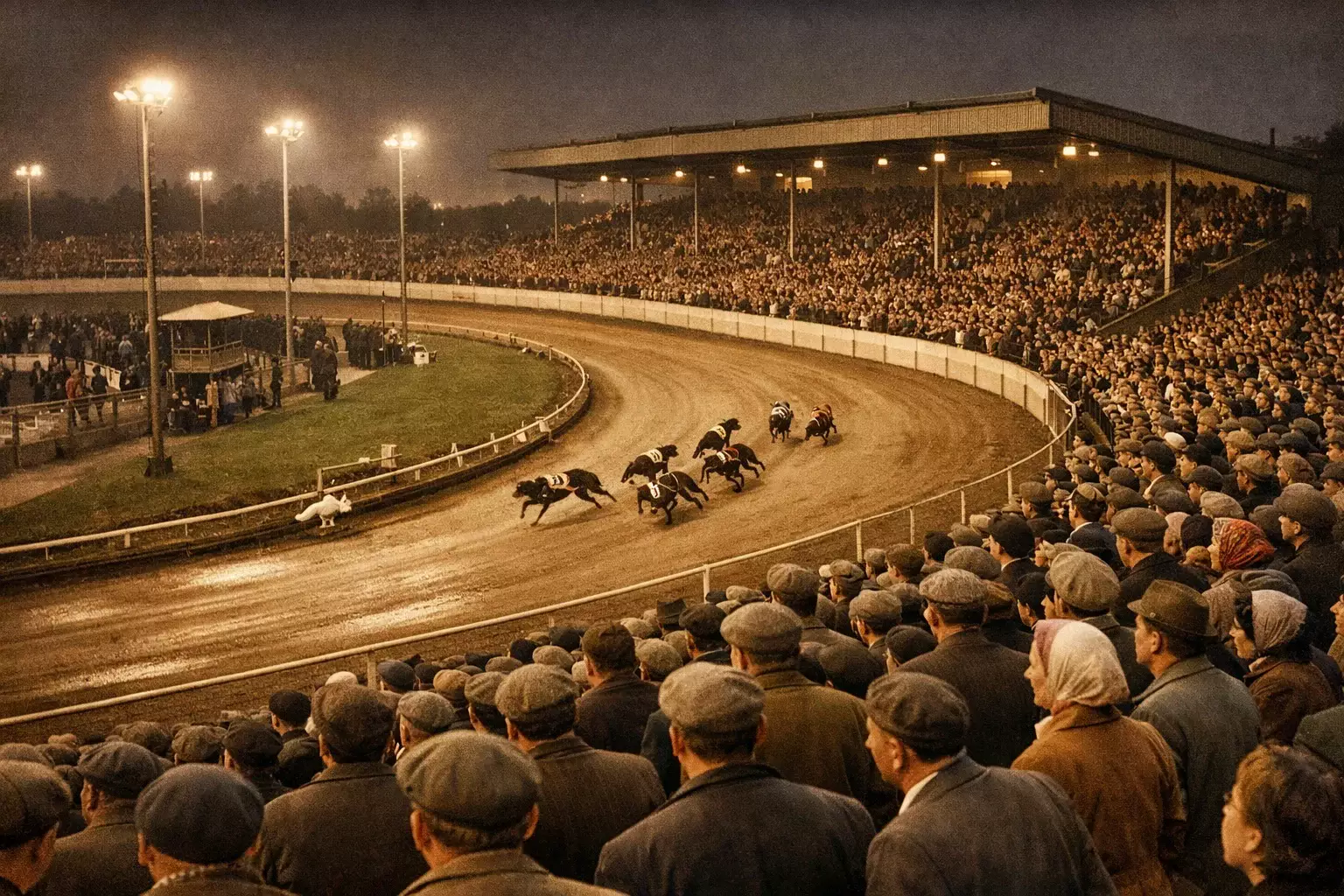
If the 1920s were the birth, the late 1940s and 1950s were the golden age. British greyhound racing reached its absolute peak in attendance during the immediate post-war period, with an estimated 34 million paying spectators passing through the turnstiles in a single year. That figure placed greyhound racing ahead of football as a spectator sport for a brief, remarkable period — a fact that surprises most people today, when the sport operates in near-obscurity compared to its mid-century prominence.
The reasons for the post-war boom were structural as much as cultural. Television was not yet widespread. Disposable income was growing but entertainment options were limited. Greyhound tracks were located in or near urban centres, accessible by public transport, and offered an affordable evening out that combined entertainment with the excitement of betting. The tracks themselves became social venues — restaurants, bars, tote halls, and grandstands that served as community gathering points in a way that is difficult to replicate in the modern entertainment landscape.
The golden era also produced the sport’s greatest competitions. The English Greyhound Derby, the St Leger, the Grand National — these events drew national media coverage and produced stars known by name to a broad public. Greyhound racing was, for two or three decades, part of the mainstream fabric of British popular culture, and the tracks that hosted it were embedded in the communities they served.
The decline began in the 1960s and accelerated through the following decades. Television, car ownership, package holidays, changing work patterns, the legalisation of off-course betting in 1961, and the rise of competing entertainment forms all contributed to a steady erosion of live attendance. The tracks that had been built for crowds of 10,000 found themselves half-empty, then quarter-empty, then economically unviable.
From 77 Tracks to 18: What Caused the Contraction
The decline from more than 77 licensed tracks to today’s 18 was not caused by a single event but by a convergence of economic, social, and regulatory forces that compounded over decades. The most fundamental was the shift in entertainment economics. Running a greyhound stadium requires land — typically in urban areas where land values rise fastest — and the commercial return from live racing declined as crowds fell. Track owners found that selling the land for redevelopment was more profitable than continuing to race, and one by one, stadiums across Britain were bulldozed to make way for housing, retail parks, and industrial estates.
The legalisation of off-course betting in 1961 was a turning point. Before that date, punters who wanted to bet on greyhounds had to attend the track. After legalisation, they could place bets in high-street shops without leaving their neighbourhood. Live attendance dropped, and the tracks lost the gate revenue that had subsidised the racing product. The BAGS model — staging daytime meetings for the benefit of betting shop screens — emerged as a survival strategy, not a growth plan. It kept tracks open by replacing spectator income with broadcast income, but it changed the character of the sport irreversibly.
More recently, the shift from shop-based to online betting has accelerated the financial pressure. Online platforms carry greyhound racing as one product among hundreds, and the share of betting spend allocated to greyhounds has declined as punters migrate to football, in-play markets, and other high-profile betting products. The Scottish Animal Welfare Commission’s 2023 conclusion — that where gambling and commercial activity are involved, the welfare risks of greyhound racing outweigh its likely positive aspects — added a political dimension to the economic pressure, signalling that the contraction is not just commercial but ideological.
The 18 tracks that remain in 2026 are the survivors of a century-long process of selection. Monmore Green, open since 1928, is among the longest-running of the survivors, and its position as an Entain-owned, PGR-managed venue with six racing days per week suggests it is among the more commercially resilient. But resilience is not immunity. The forces that reduced the track network from 77 to 18 have not disappeared — they have simply paused at a level where the BAGS model, SIS broadcasting, and corporate ownership keep the remaining venues viable. Whether that level holds for another decade, or whether the contraction continues, is the question that the centenary year cannot answer but cannot avoid.