

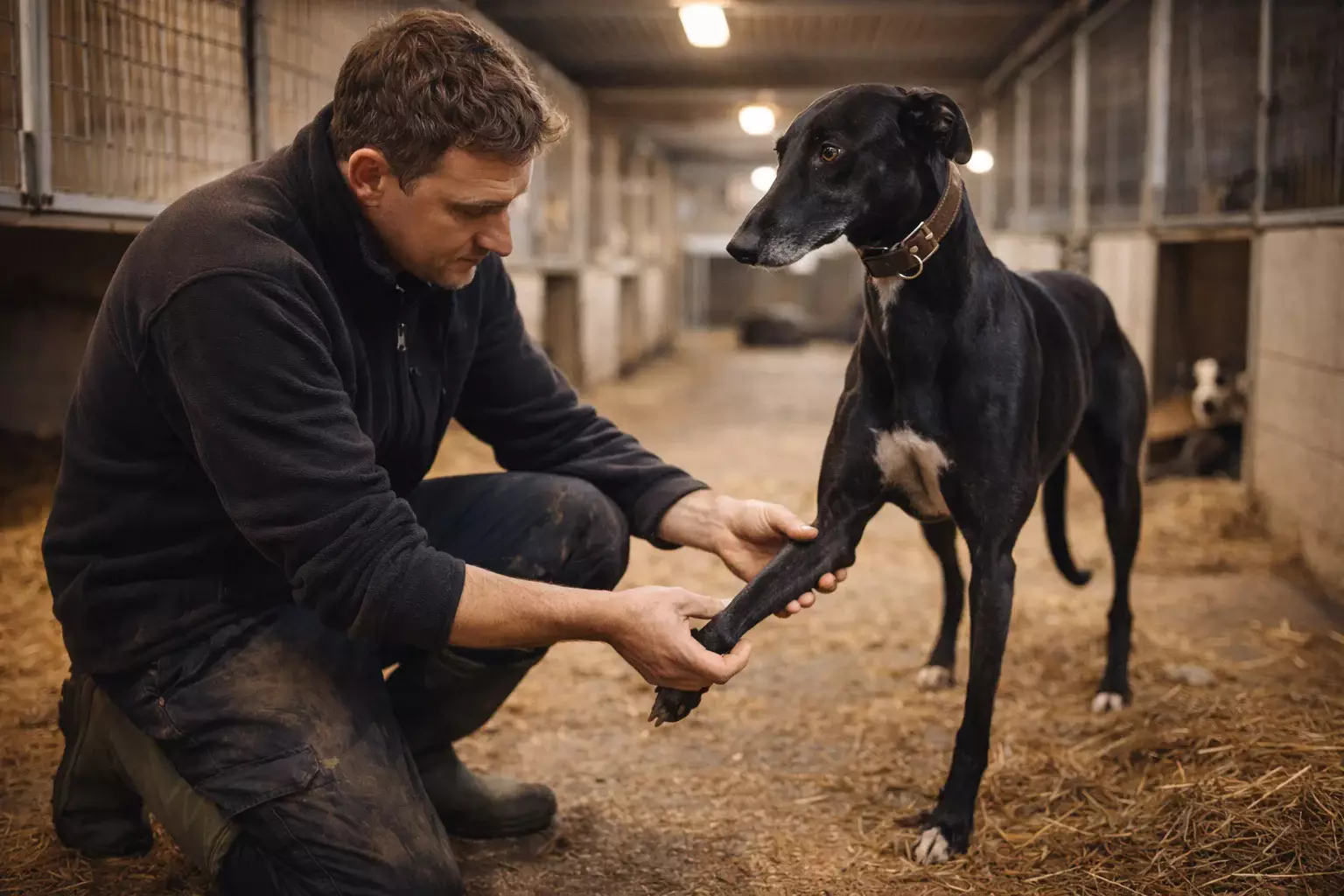
Monmore Trainers: The People Behind the Results
Results do not happen in a vacuum. Every finishing time, every trap break, every tactical run on the bend at Monmore Green is the product of a trainer’s decisions — which race to enter, which distance to choose, how to prepare the dog for conditions on the night. Yet trainer data is among the most overlooked variables in greyhound form analysis. Punters study times, trap draws, and running comments in forensic detail, then ignore the person responsible for putting the dog on the track in the first place.
At Monmore, a small group of contract trainers supplies the bulk of the weekly racecard. These are professionals who kennel their dogs locally, know the track’s characteristics intimately, and make daily judgements about fitness, distance suitability, and grading that directly shape the results you read online. The UK has approximately 500 licensed greyhound trainers managing dogs across 18 GBGB-regulated stadiums, but the ones attached to Monmore form a much tighter circle. Understanding who they are, how they operate, and where to find their statistics is a practical edge that costs nothing to acquire.
How the Contract Trainer System Works
British greyhound tracks operate on a contract trainer model. Each licensed stadium has agreements with a set of trainers who commit to providing a certain number of dogs to fill the weekly racecard. In return, the trainers receive kennel facilities, access to the track for trials, and — critically — guaranteed race opportunities for their dogs. The arrangement is symbiotic: the track needs a reliable supply of runners to stage six meetings a week, and the trainers need a consistent venue where their dogs can race and earn.
At Monmore, the contract trainers are based in kennels within reasonable travelling distance of the stadium in Wolverhampton. Some are attached directly to the track’s kennel complex. Others operate from private kennels in the surrounding West Midlands area and transport their dogs to the track on race days. The distinction matters because a trainer based on-site has advantages — daily access to the track surface for trials, immediate proximity for veterinary checks, and a deeper familiarity with how the track runs in different weather conditions.
Each trainer manages a roster of dogs at various stages of their careers and in various grades. A typical Monmore contract trainer might have 20 to 30 dogs in their kennel at any given time, spread across D4 to A1 in the grading system. Managing that roster — deciding which dogs race on which days, over which distances, and from which traps — is the core of the trainer’s skill. A trainer who consistently places dogs in the right grade at the right distance will post a higher strike rate than one who enters dogs speculatively or too frequently.
The relationship between trainer and racing manager is also worth understanding. The racing manager controls the grading and the card composition. The trainer submits entries and preferences. When the two are aligned — the trainer entering a dog at its optimal grade and the racing manager slotting it into an appropriate race — the result tends to be competitive. When there is a mismatch — a dog entered too ambitiously or placed in a race that does not suit its running style — the result often reflects the error. Experienced Monmore punters learn to read the entry patterns of individual trainers as a form variable in its own right.
GBGB’s executive veterinarian Tiffany Blackett has highlighted the uptake of educational programmes among licence holders, with increased participation in welfare-focused CPD opportunities. For trainers at Monmore, these programmes are not abstract — they feed directly into daily kennel management and the decisions that produce the results punters analyse each week.
Current Leading Trainers by Strike Rate
Strike rate — the percentage of runners that win — is the simplest and most revealing trainer statistic at any greyhound track. At Monmore, the leading trainers by strike rate tend to hover in the 20% to 30% range over a rolling 12-month period. That might not sound impressive until you consider that a random outcome in a six-dog race would produce a strike rate of roughly 16.7%. A trainer consistently hitting 25% or above is placing dogs accurately and preparing them well.
The leading names at Monmore shift over time, but the pattern is remarkably stable. A small group of trainers dominates the statistics year after year, because the contract system favours established operators with deep kennel pools and institutional knowledge of the track. New trainers do emerge — a young handler picking up a kennel, a freelance operator gaining a Monmore contract — but breaking into the top tier requires time and a string of dogs that suits the track’s characteristics.
One name that illustrates Monmore’s relationship with its trainers is Blastoff Josifa, the dog that set the track record for graded starts with 203 runs at a single venue, accumulating 49 wins over her career. That longevity was a product of the trainer’s management as much as the dog’s talent — 203 starts requires careful scheduling, intelligent grading choices, and the kind of kennel care that keeps a dog healthy through years of competition. The dog’s record is exceptional, but it reflects a broader truth about Monmore training: the best results come from trainers who manage careers, not just individual races.
For punters, trainer strike rates are actionable data. A dog trained by a handler running at 28% from 200 runners is a qualitatively different proposition from the same dog — hypothetically — in the hands of a trainer running at 15%. The trainer signal does not override time, trap draw, or grade, but it adds a dimension that most casual bettors ignore entirely.
Where to Look Up Trainer Statistics
Trainer data for Monmore is available from several sources, though none of them present it in the neat, sortable dashboard that form analysts would ideally want. The most reliable aggregated data comes from specialist greyhound statistics sites that compile results from all GBGB tracks and allow filtering by trainer, track, and time period. SIS Racing publishes monthly summaries that include leading trainers by strike rate alongside trap statistics for each of the venues it broadcasts.
Sporting Life and Timeform both offer trainer records as part of their greyhound form databases, and the information can be cross-referenced with the results published on the GBGB website. For Monmore-specific data, the track’s own website and social media channels occasionally highlight leading trainers, particularly during major competitions when the narrative around individual trainers adds to the event’s appeal.
The practical approach for a regular Monmore punter is straightforward: pick the three or four leading trainers at the track, note their strike rates over the past three months, and use that as a background variable when assessing races. You are not looking for a magic formula. You are looking for a marginal advantage — a reason to prefer one 3/1 shot over another when the times and trap draws are similar. Trainer form provides that reason, and the data is free to anyone willing to spend ten minutes compiling it. Over a season of betting, that ten-minute investment pays for itself repeatedly.
The wider context is set out in our Monmore greyhound results guide.
