
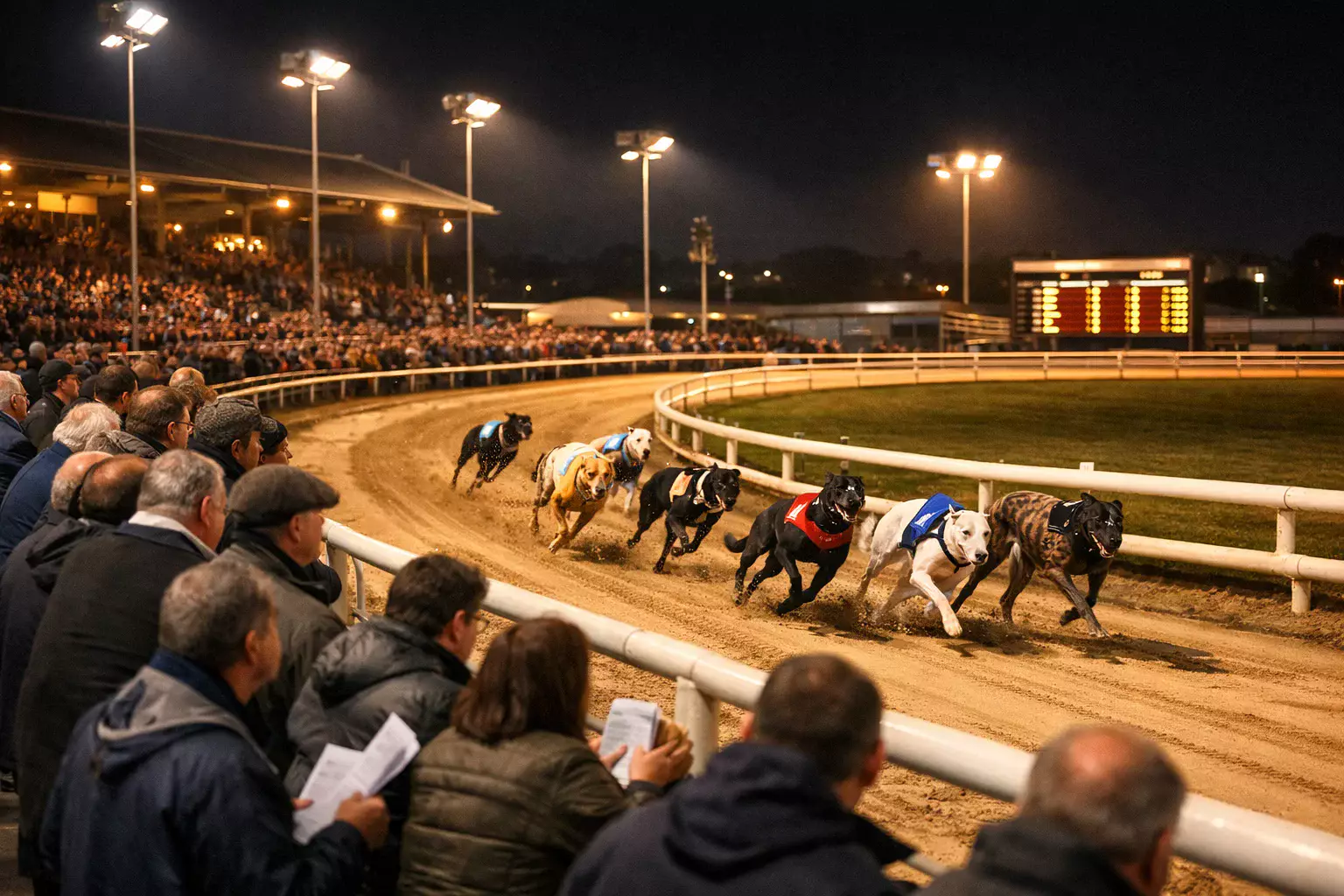
Monmore Evening Racing: The Main Event
There are two versions of Monmore Green. One is the daytime factory — BAGS cards running through the morning and afternoon, cameras rolling for betting shop feeds, barely a soul in the stands. The other is the Thursday and Saturday evening operation, where the floodlights come on, the grandstand fills, and the racecard reads like the track actually wants to impress somebody. These are the races the track makes a fuss about, and for good reason.
Evening meetings at Monmore occupy a distinct slot in the weekly schedule. While BAGS fixtures dominate Mondays through Fridays under a broadcast contract with SIS, Thursday and Saturday evenings are designated flagship cards with a different character entirely. The fields are stronger, the prize money is higher, and the format accommodates open races that draw dogs from outside the track’s resident kennel pool. For anyone following Monmore results, the evening meetings offer a different quality of data — faster times, stiffer competition, and a context that tells you more about a dog’s genuine ceiling than a Tuesday afternoon graded affair ever will.
The distinction matters practically. A dog that wins an A3 on a Wednesday BAGS card is doing its job. The same dog running a competitive third in an open race on Saturday evening is proving something else entirely. If you are building a picture of Monmore form, the evening meetings are where the signal gets clearest.
How an Evening Card Differs from a BAGS Card
On paper, a BAGS card and an evening card at Monmore look similar — a list of races, trap draws, dogs, trainers, and times. Peel back the surface and the differences become significant. The evening card is built with a different philosophy. BAGS meetings prioritise volume and consistency: 12 races, tight intervals, predictable grading, all designed to keep the betting feed ticking. Evening meetings prioritise quality and spectacle.
A typical Thursday or Saturday evening card at Monmore runs 10 to 12 races, but the composition changes. You will find a higher proportion of A-grade races, and the card almost always includes at least one open event — a race not restricted by grading that attracts the best available dogs. Open races are the headline acts, and they tend to produce faster times because the field is genuinely competitive rather than artificially balanced by the grading system.
The intervals between races are wider on an evening card, usually 12 to 15 minutes compared to the eight-to-ten-minute BAGS cycle. This is partly because there are spectators to accommodate — people buying food, placing bets at the tote windows, moving between the grandstand and the trackside rail. It is also because the presentation is more considered. There is a parade of dogs before selected races, commentary over the public address system, and a general sense that the evening is an event rather than a production line.
Prize money is another separator. BAGS races carry modest purses — enough to cover a trainer’s diesel to the track, not enough to plan a holiday around. Evening open races at Monmore offer considerably more, particularly during competition rounds for events like the Golden Jacket or the Puppy Derby. The economics of an evening meeting are different: gate receipts, on-course food and drink sales, and tote revenue all contribute to a richer purse structure. For the dogs running, higher prize money means trainers send their best, which means the results from Thursday and Saturday are a better gauge of genuine ability.
From a form analysis perspective, the implication is clear. A time recorded on an evening card usually means more than the same time on a BAGS card because the dog was running against tougher opposition, on a track that has been rested for longer since the previous meeting, and in conditions that favour peak performance.
Open Races on Evening Cards and Why They Matter
Open races are the main reason serious form students pay particular attention to Monmore’s evening results. In the grading system, dogs are slotted into categories — A1 through D4 — based on recent times and finishing positions. Open races bypass all of that. They are invitation-based or entry-based competitions that pit the best available dogs against one another regardless of grade. Think of it as the difference between a local league match and a cup tie: the rules of the game are identical, but the quality on show is not.
Monmore’s evening cards regularly feature open races over various distances, with the 480-metre trip being the most common. During major competition rounds — the heats and semi-finals of events like the Golden Jacket (684 m) or the Winter Derby — the evening card becomes almost entirely open-race territory. These are the nights when Monmore’s 1,150-capacity stadium gets closest to full, and when the results carry the most weight for anyone tracking the sport nationally.
What makes open-race results analytically valuable is the calibration they provide. In a graded race, a dog might win by six lengths and clock 29.50 over 480 metres. That tells you the dog is well graded — too good for its current opponents — but not much about how it would fare against better company. In an open race, the same dog might finish third in 29.10 and lose by a neck. That third-place finish is, in many ways, more informative than the six-length romp. It reveals how the dog handles genuine pace pressure, whether it finishes strongly when challenged, and whether it can run a time that would be competitive at other tracks.
For this reason, punters who focus on Monmore form will often weight evening open-race results more heavily than graded BAGS results, even if the graded results are more recent. A Saturday open race from last week may be a better predictor than a Wednesday A4 from three days ago. The context shifts the value of the data.
Trackside on a Thursday Night: A Visitor’s Perspective
If you have only ever consumed Monmore results as lines of text on a screen, a Thursday evening visit is worth the trip. The stadium sits in the Bilston area of Wolverhampton, a no-frills industrial pocket of the West Midlands, and the venue matches its surroundings — functional rather than glamorous, with a covered grandstand, a restaurant overlooking the track, and a bar that does the basics well enough.
The crowd on a Thursday tends to be a mix of regulars and occasional visitors. The regulars know every trainer’s pattern and can tell you which dogs prefer the inside line before the traps open. The occasionals are often groups out for an evening — birthdays, works dos, stag nights testing their luck. The atmosphere is relaxed but charged in the way that any live betting environment is. There is a collective intake of breath as the hare rounds the first bend, a roar or groan at the finish, and then the immediate recalibration as the next race loads.
Saturday evenings draw a slightly larger crowd and tend to carry the week’s strongest card. If a major competition round falls on a Saturday — a Golden Jacket semi-final or a Puppy Derby heat — the atmosphere ratchets up noticeably. These are nights when the result matters beyond the accumulator. Local trainers have dogs running for real prize money, and the on-course bookmakers work harder because the market is better informed. Prices move faster, the betting ring has a pulse, and the results that emerge carry genuine sporting weight.
None of this is visible in the result line you read online the next morning. But knowing that a race took place under floodlights, in front of an engaged crowd, on an evening card with open-race competition, gives that result a texture that a BAGS fixture simply cannot replicate. Evening meetings are where Monmore is at its best, and their results deserve to be read with that context in mind.