
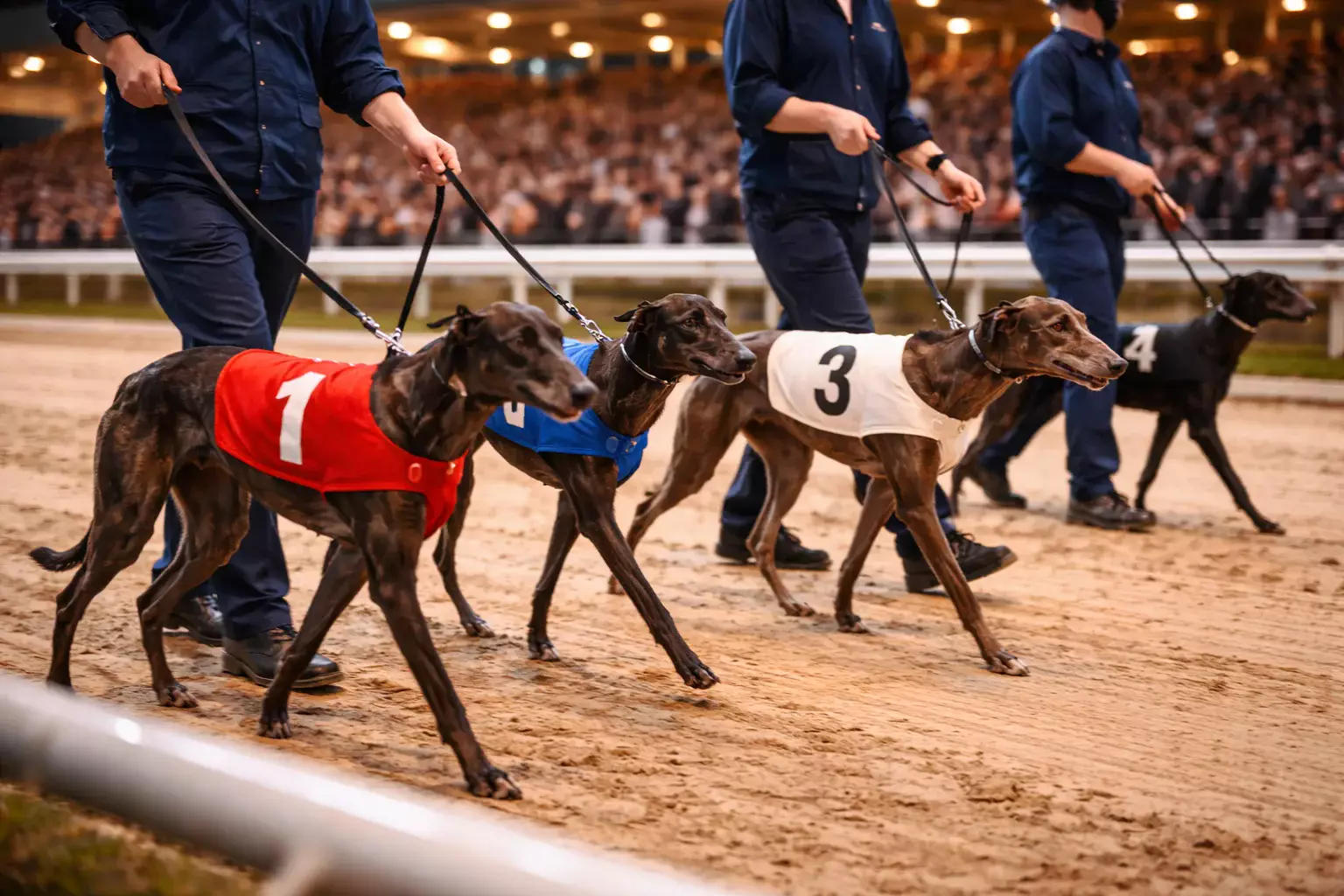
The Trafalgar Cup: Monmore’s Own Puppy Classic
Monmore Green’s competition calendar extends well beyond the Golden Jacket and the Winter Derby. Sitting alongside those headline events is a roster of named competitions that serve different constituencies within the sport — younger dogs, specific distances, and seasonal slots that give the track a competitive pulse throughout the year. The Trafalgar Cup is the most prominent of these secondary competitions, and its relatively recent introduction shows that Monmore is still building its racing programme rather than simply maintaining a legacy calendar.
The Trafalgar Cup is a puppy competition, restricted to young greyhounds, and run over a distance that tests speed and competitive instinct in dogs at the early stage of their careers. It sits in Monmore’s calendar as a complement to the established Puppy Derby, giving the track two distinct youth events that serve different slots in the racing year and often attract different entries. For form analysts, puppy competitions are forward-looking data — the results predict which dogs will feature in graded and open company for the seasons ahead.
Launched in 2015: Format and Growth
The Trafalgar Cup was introduced to the Monmore calendar in 2015, making it one of the newer named competitions at the track. Its introduction reflected a deliberate effort by the venue to expand its competition offering and attract entries from trainers beyond the immediate Wolverhampton area. New competitions need time to establish credibility, and the Trafalgar Cup has used its first decade to build a reputation as a well-organised, competitive event that produces meaningful results.
The format follows the standard knockout structure: heats, semi-finals, and a final staged over consecutive evening meetings. The eligibility criteria restrict entry to dogs within a defined age range, ensuring that the field consists of genuine prospects rather than seasoned campaigners slumming in a youth event. The distances and prize money have evolved since the competition’s launch, with the event growing in stature as it has become established in the racing calendar.
What distinguishes the Trafalgar Cup from the Puppy Derby is timing and positioning. The two events occupy different slots in the calendar, which means a young dog can contest both in the same year without the schedule conflicts that would arise if they overlapped. For trainers with promising pups, the combination of Puppy Derby and Trafalgar Cup provides two competitive benchmarks against which to measure development — a useful feature for a sport where young dogs can improve dramatically from month to month.
Premier Greyhound Racing’s investment in open racing across its nine-track portfolio — over £2.5 million annually — provides the financial framework within which competitions like the Trafalgar Cup can offer meaningful prize money. Without that backing, newer events would struggle to attract the field quality needed to generate credible results. The PGR investment is, in effect, a subsidy for competitive depth at track level.
Summer Classic, Midland Gold Cup and the Festival 630s
Beyond the Trafalgar Cup, Monmore’s secondary competition calendar includes several events that cater for different distances, age groups, and competitive tiers. The Summer Classic provides a warm-weather equivalent to the winter-season competitions, giving Monmore a named event during a period when the calendar might otherwise consist entirely of routine graded cards. The timing ensures that the track maintains competitive interest year-round rather than clustering all its marquee events into a single season.
The Midland Gold Cup targets the middle-distance sector, providing a competitive outlet for dogs whose best trip falls between the standard 480 m and the staying distances of 684 m and 835 m. Middle-distance races occupy a distinctive niche in greyhound form analysis — they require a blend of pace and stamina that pure sprinters and pure stayers cannot replicate — and the Gold Cup gives Monmore a showcase for dogs with that profile.
The Festival 630s represent an interesting addition to the programme, focusing on the 630 m trip that sits between Monmore’s standard 480 m and its staying distances. The 630 m is a trip that tests versatility — dogs need enough early speed to avoid trouble on the first bend but enough stamina to sustain pace over a distance that is neither a sprint nor a marathon. Festival events around this distance attract entries from dogs that might struggle at 684 m but are too slow to compete with the best over 480 m, creating a competitive middle ground that produces closely contested racing.
Each of these secondary events generates data that enriches the overall form picture at Monmore. A dog that wins the Midland Gold Cup has proven something about its middle-distance ability that routine graded form might not reveal. A Festival 630 finalist has demonstrated versatility. A Summer Classic contender has shown it can perform in warmer conditions on a faster surface. The results from these competitions fill gaps in the analytical profile of Monmore’s resident dogs and give form students additional reference points beyond the weekly graded output.
Where Monmore’s Competitions Sit in the National Calendar
British greyhound racing does not have a formal national competition calendar in the way that horse racing has its Classics and festival weeks. Instead, each track operates its own programme of named events, and the national picture emerges from the aggregate of those track-level calendars. Monmore’s programme — the Golden Jacket in autumn, the Winter Derby in the early months, the Puppy Derby and Trafalgar Cup for younger dogs, and the secondary events scattered through the year — is typical of a well-managed PGR venue: comprehensive enough to maintain competitive interest across all seasons, without overreaching into events the track cannot credibly sustain.
The total UK prize fund for greyhound racing sits at approximately £15.7 million, and Monmore’s share of that figure — distributed across its full programme of graded, open, and named competition racing — reflects the track’s position as one of the busier and more commercially stable venues in the GBGB network. The secondary competitions contribute to that total, and their existence ensures that Monmore’s results carry analytical weight beyond the routine graded card.
For punters following the track, the competition calendar is worth marking. Named events produce higher-quality data than routine meetings, because the fields are stronger, the racing is more competitive, and the dogs are performing under the pressure of knockout formats that graded races do not replicate. The Trafalgar Cup, the Summer Classic, and the Festival 630s may not carry the prestige of the Golden Jacket, but their results are among the most informative the track produces — and in a sport where information is the primary currency, that makes them worth watching.