

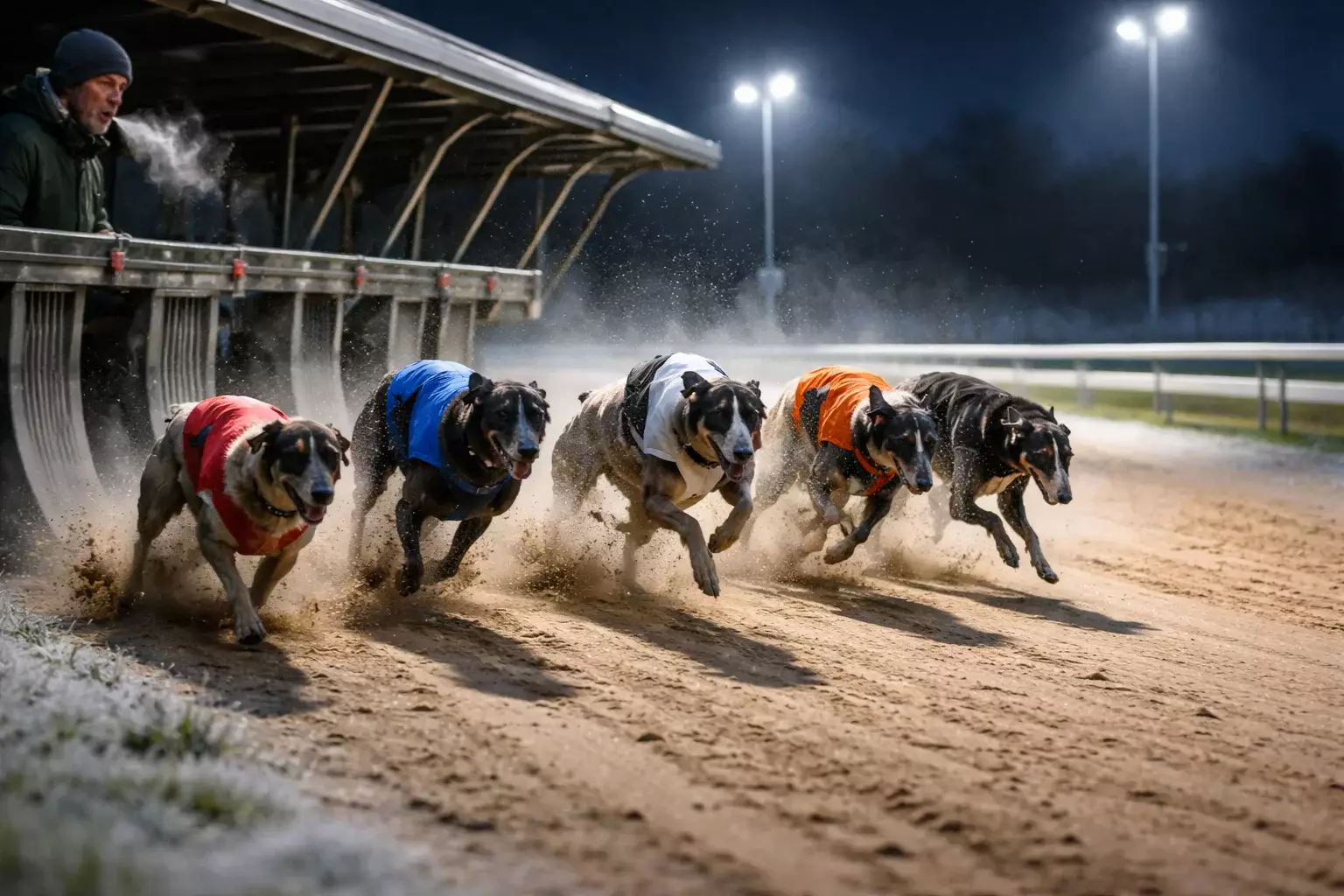
The Winter Derby: Monmore’s Premier 480 m Open
If the Golden Jacket is Monmore’s test of stamina, the Winter Derby is its test of raw speed. Run over the standard 480 m trip, the Winter Derby is a Category One competition that brings together the fastest dogs in the region for a multi-round knockout staged during the coldest months of the racing calendar. It is the point in the winter programme where Monmore stops treading water with routine graded cards and produces something with genuine competitive teeth.
The 480 m distance makes the Winter Derby the most directly comparable of Monmore’s major events. Almost every dog at the track has a body of 480 m form, which means that assessing Winter Derby contenders does not require guesswork about how a dog will handle an unfamiliar trip. The data already exists. What the Winter Derby adds is pressure — the pressure of a knockout format, stronger opposition, and the knowledge that a slow start or a missed break cannot be explained away as a bad night in a D3. In the Winter Derby, every run is under scrutiny.
For punters and form analysts, the competition is among the most useful Monmore produces all year. The heats and semi-finals generate a concentrated block of high-quality 480 m data at a single venue, and the results have predictive value that extends well beyond the final itself. A dog that performs well in Winter Derby rounds but does not win the final often carries that form into the spring graded calendar, making the competition a forward indicator as much as a standalone event.
Heats, Semi-Finals and the £10,000 Final
The Winter Derby follows the established multi-round structure. First-round heats divide the entered dogs into groups of six, with qualifiers advancing based on finishing position and, where necessary, fastest loser times. Semi-finals reduce the field further, and the final brings the surviving six together on a Saturday evening — Monmore’s premier card of the week — for a single decisive race.
The final prize of approximately £10,000 places the Winter Derby at the upper end of Monmore’s prize scale. It is not the richest greyhound race in Britain — that distinction belongs to events at the sport’s national-level tracks — but it is substantial enough to attract serious entries and to justify the multi-week commitment that the knockout rounds demand from trainers and their dogs.
The structure rewards consistency as much as outright speed. A dog that wins its heat in an eye-catching time but fades in the semi-final has told you something about its temperament. A dog that scrapes through the heats as a fastest loser but produces a personal best in the final has told you something about its competitiveness under pressure. These narratives emerge naturally from the knockout format, and they add a layer of meaning to the final result that a standalone open race cannot replicate.
The backing of Premier Greyhound Racing helps sustain events like the Winter Derby. The Entain-ARC joint venture directs over £2.5 million per year into open racing across nine tracks, and the Winter Derby is one of the competitions that investment underwrites — visible in the prize structure, the broadcast coverage through SIS, and the quality of fields the event attracts.
2026 Edition: Early Form and Contenders
The 2026 Winter Derby arrives in a year that carries particular significance for British greyhound racing. The sport marks its centenary — 100 years since the first oval-track meeting at Belle Vue, Manchester, in 1926 — and Monmore’s major competitions carry a little extra weight as a result. Whether the centenary translates into larger fields or increased prize money remains to be seen, but the context adds a narrative dimension that routine years do not have.
Identifying contenders for the Winter Derby before the heats are drawn is part of the analytical game. The dogs most likely to feature are those currently running the fastest 480 m times in A-grade and open company at Monmore, plus a handful of entries from other Midlands tracks whose trainers believe their dogs can handle the specific demands of the Monmore circuit. The track record over 480 m stands at 27.48 seconds, set by Ballymac Eske in 2012, and while no one expects a record-breaking run in the depth of winter — surface conditions and colder air temperatures typically add a few tenths to finishing times — the benchmark serves as a reference point for assessing the quality of the field.
Form students preparing for the Winter Derby should focus on three things. First, recent 480 m times at Monmore, adjusted for grade and conditions. Second, trap records — how each contender performs from different boxes, because the draw in a competitive open race has a greater tactical impact than in a graded affair where the pace differentials are smaller. Third, the heat-to-semi-final progression. Dogs that improve through the rounds are the ones to watch. Dogs that peak in the heats and regress in the semis are often feeling the cumulative effect of racing hard over consecutive weeks.
How the Winter Derby Sits in the UK Calendar
The UK greyhound racing calendar does not have a formal structure in the way that flat horse racing has its Classic season. But there is an informal rhythm, and the Winter Derby occupies a distinctive slot within it. The major national competitions — the English Greyhound Derby at Towcester, the St Leger at Sheffield — tend to fall in the summer months. Monmore’s Golden Jacket runs in the autumn. The Winter Derby fills the January-to-March window, when the calendar is thinner and the competition for top-quality dogs is less intense.
This timing is advantageous for the Winter Derby’s competitiveness. Trainers with good 480 m dogs that are not being aimed at the spring or summer national events are happy to route them through the Winter Derby instead. The competition does not clash with higher-profile races, so the field is not weakened by withdrawals in favour of bigger targets. The result is a competition that consistently attracts strong entries without having to compete with the sport’s major travelling events for the best dogs.
For the Monmore calendar specifically, the Winter Derby serves as the centrepiece of the first quarter. BAGS cards continue as usual through the week, providing the steady stream of graded results that form the backbone of the track’s data output. But the Winter Derby evenings punctuate that routine with something sharper — open-race competition at Category One level, broadcast live through SIS, with results that carry weight in the national form picture.
Whether you are a Monmore regular who follows every meeting or an occasional analyst who dips into the track’s results when a big race warrants attention, the Winter Derby is the 480 m benchmark event. It answers the simple question — which is the fastest dog at Monmore right now — and the answer holds for months. The finalists become reference points against which every subsequent 480 m result at the track is measured, making the Winter Derby not just a competition but a calibration exercise for the rest of the year.
The wider context is set out in our Monmore greyhound results guide.
