
The Weather Report You Didn’t Know You Needed
Greyhound form analysts check times, trap draws, grades, and running comments. Almost none of them check the weather. That is a mistake. At Monmore Green, where the racing surface is sand and the track sits in the West Midlands — a region that receives its fair share of rain throughout the year — weather conditions affect running times, trap bias, and race outcomes in measurable ways. A dog that clocks 29.20 on a dry Friday afternoon and 29.60 on a wet Thursday evening has not suddenly lost ability. The surface changed beneath it.
Weather is the variable that explains discrepancies in form that cannot be attributed to grade, distance, or trap draw. If you are comparing a dog’s last four runs and one time is significantly slower than the others, the first question should not be \u201cwhat went wrong?\u201d but \u201cwhat was the weather?\u201d The answer often resolves the anomaly without requiring any further analysis.
Sand Tracks vs Turf: Why Monmore Runs on Sand
Every GBGB-licensed greyhound track in the UK runs on a sand-based surface. There are no turf tracks in the licensed sector, which distinguishes greyhound racing from horse racing where the going — firm, good, soft, heavy — is determined by the moisture content of natural ground. Greyhound sand surfaces are engineered products, composed of specific sand grades mixed and maintained to provide consistent grip, cushioning, and drainage.
The choice of sand is not arbitrary. Sand surfaces offer several advantages for a sport that runs multiple meetings per week on the same circuit. Sand drains faster than turf, which means a track can race in conditions that would make a grass surface unrunnable. Sand can be raked, levelled, and regraded between meetings, ensuring a consistent racing line. And sand provides a predictable cushioning effect that reduces the impact forces on dogs’ legs — a factor directly relevant to the injury rate that GBGB monitors and publishes. The 2024 injury rate of 1.07% across all licensed tracks reflects, in part, the investment in surface technology and maintenance that keeps sand tracks safe.
At Monmore, the sand surface is maintained by the track’s ground staff and periodically assessed by external consultants. The surface is watered before meetings to achieve a target moisture level, raked between races to restore the running line, and tested for compaction and drainage at regular intervals. The goal is consistency: a dog should encounter roughly the same surface on Monday as it does on Saturday, all else being equal. In practice, weather disrupts that consistency, which is where the analytical opportunity lies.
How Rain Changes Trap Bias and Running Times
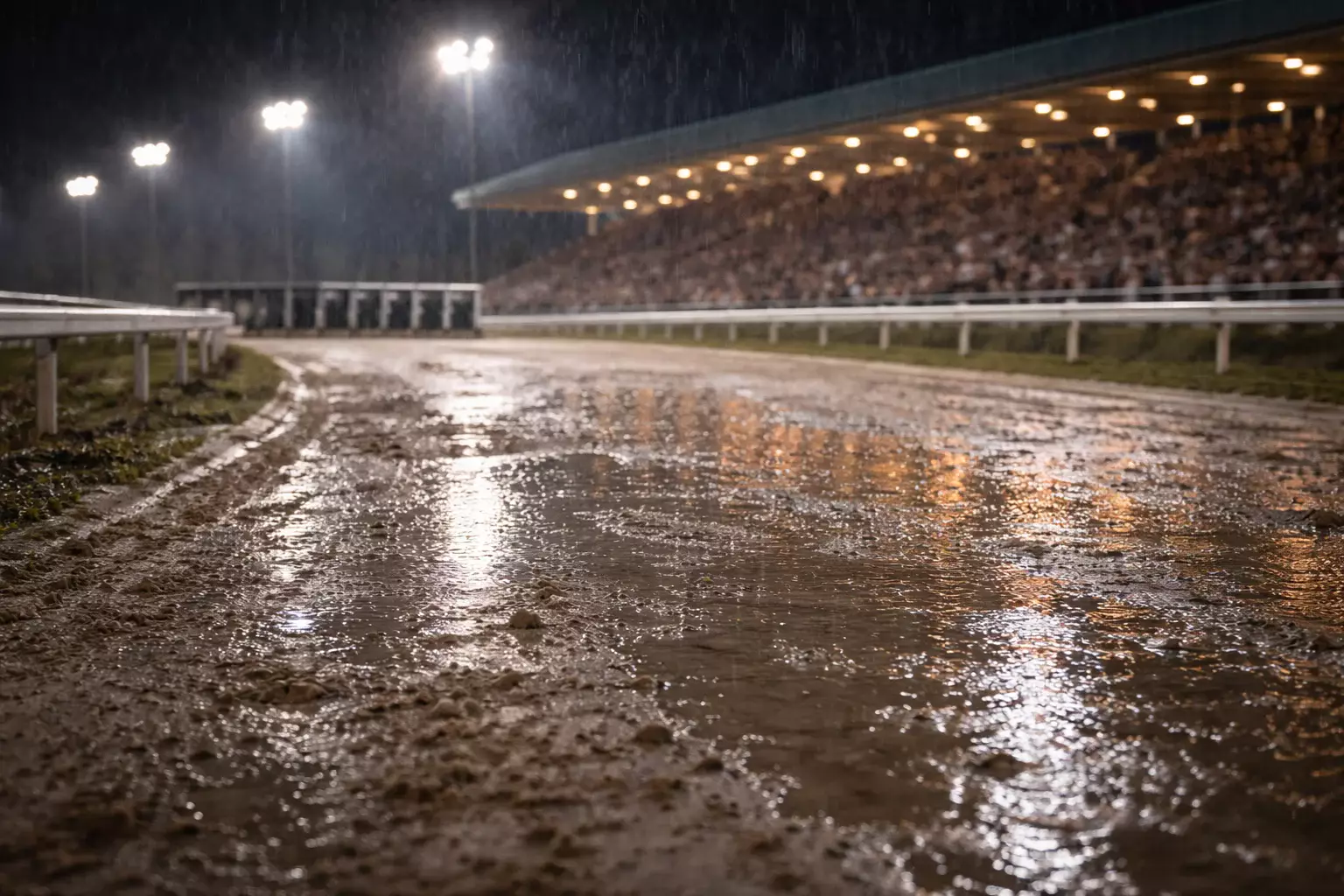
Rain is the most significant weather variable at Monmore. Heavy or persistent rain saturates the sand surface beyond its optimal moisture range, making it heavier and slower. Dogs running on a wet track expend more energy per stride because their paws sink deeper into the surface and the grip dynamics change. The result is slower finishing times across the entire card — not just for one dog, but for all of them.
More interestingly, rain changes the trap bias. On a dry surface, the running line is relatively uniform around the circuit, and the advantage of inside traps — while real, due to the shorter geometry to the first bend — is moderate. On a wet surface, the inside line becomes even more advantageous because the rail provides a reference point and the firmer sand near the rail edge offers slightly better footing than the churned-up centre of the track. In wet conditions, inside traps at Monmore — particularly trap one — tend to produce an elevated win rate that exceeds their already-favourable dry-weather baseline.
For punters, the implication is practical. On a rainy evening at Monmore, dogs drawn in traps one and two carry an even greater structural advantage than usual. Dogs drawn wide face a double disadvantage: a longer run to the first bend and a slower, heavier surface that penalises the extra ground they cover. Adjusting your selections to account for weather conditions is a simple analytical step that most bettors skip entirely.
Temperature also plays a role, though it is subtler than rain. Cold air increases air density, which marginally affects the aerodynamic drag on a running dog — not enough to change the result in most cases, but enough to add a few hundredths of a second to finishing times across a card. Extremely hot conditions can affect a dog’s stamina and increase the risk of heat-related issues, though British summers rarely reach the temperatures that would make this a primary concern at Monmore.
STRI: The Track Safety Consultants Behind the Surface
Behind Monmore’s sand surface is a specialist consultancy that most greyhound punters have never heard of. STRI — the Sports Turf Research Institute, based in Bingley, West Yorkshire — provides independent technical advice on playing surfaces for a range of sports, including greyhound racing. STRI’s involvement in greyhound tracks covers surface composition, drainage, compaction testing, and safety assessments.
GBGB requires tracks to maintain their surfaces to standards that are informed by STRI research and recommendations. The consultancy has worked with greyhound tracks across the UK to develop surface maintenance protocols that balance racing performance — fast, consistent times — with animal safety — reduced injury risk from excessive hardness, poor drainage, or uneven composition. The work is technical and unglamorous, but it directly affects the quality of the results you read.
For form analysts, STRI’s involvement is relevant because it means track surface quality is not static. When STRI recommends changes to a track’s sand composition or maintenance schedule, the result can be measurably different running times. A Monmore card run on a freshly relaid or regraded surface may produce times that differ from the previous week, not because the dogs have changed but because the surface beneath them has. These changes are rarely announced publicly, which means that unexplained shifts in track speed — every dog running half a second faster or slower than expected — are sometimes attributable to surface work rather than to form fluctuations.
The practical lesson is to treat track conditions as a live variable, not a constant. Check the weather before a meeting. Note when times across an entire card run consistently faster or slower than recent form suggests. And factor the surface into your analysis alongside the form, the trap, and the grade. Weather and track conditions are the context in which every Monmore result is produced, and ignoring them means ignoring a variable that shapes every finishing time you read.