
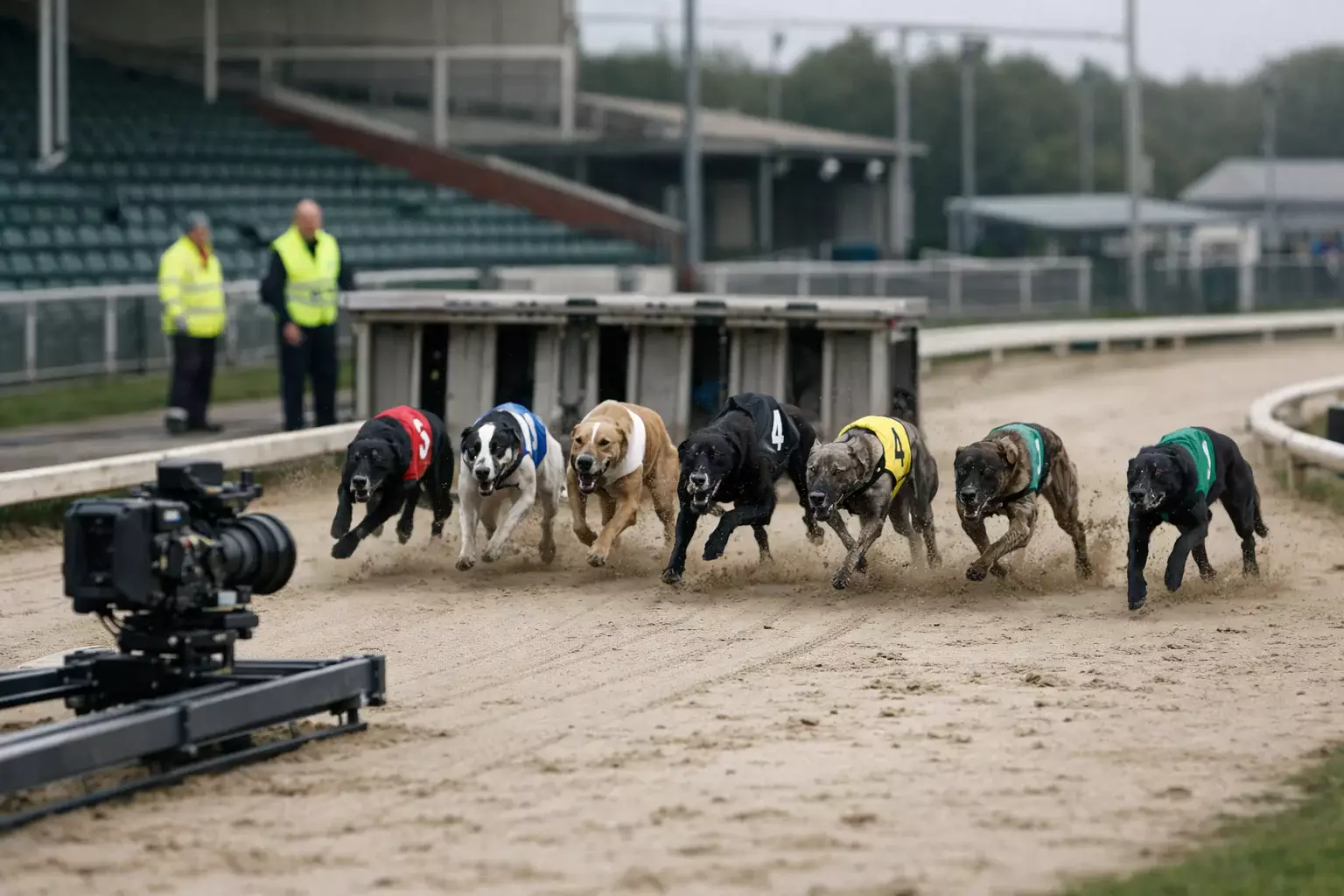
What a BAGS Meeting Is and Why It Matters to Your Bet
If you have ever glanced at Monmore greyhound results on a Tuesday lunchtime and wondered who exactly is watching a 12:47 race in Wolverhampton, the answer is: almost nobody in the stands, and thousands of punters in betting shops across Britain. That disconnect between an empty grandstand and a busy turnover sheet is the entire point of a BAGS meeting. BAGS stands for Bookmakers Afternoon Greyhound Service, and it is the engine behind daily results at tracks like Monmore Green.
The concept is straightforward. Bookmakers need content to fill afternoon and morning slots in their shops. Horse racing does not run every hour of every day. Greyhound racing can. A BAGS fixture exists primarily to generate a live betting product, streamed into high-street bookmakers via satellite feeds and, increasingly, into online platforms through the same infrastructure. The dogs race, the cameras roll, the odds open and close, and results appear within minutes. There is no crowd to entertain, no pageant to stage. The racecard is functional, the gaps between races are tight, and the whole operation is built for throughput.
This matters to anyone reading Monmore results because the vast majority of races at the track are BAGS fixtures. Monmore hosts BAGS meetings on Mondays, Tuesdays, Wednesdays and Fridays, with evening cards reserved for Thursdays and Saturdays under a separate arrangement. Four out of six racing days each week are BAGS days. If you are analysing form at Monmore, you are mostly analysing form produced under BAGS conditions: smaller crowds, daylight running, and a schedule dictated by broadcast contracts rather than tradition.
Understanding what a BAGS meeting is — and what it is not — changes how you interpret the results it generates. The fields are graded, the distances are standard, and the dogs are the same ones you will see on an evening card. But the context around the race is different, and context shapes performance.
How BAGS Started at Monmore in 1981
Afternoon greyhound racing for the bookmaking trade did not spring from thin air. It evolved out of a specific commercial problem. By the late 1970s, licensed betting shops were hungry for live content during the hours between morning opening and the first horse race at two o’clock. Some shops showed Australian racing via grainy satellite links. Others simply had dead air. The greyhound industry spotted the gap.
BAGS was incorporated in 1967 as a company limited by guarantee, originally set up to provide betting shop content on afternoons when horse racing was cancelled. It ran with a small group of participating tracks for over a decade. Then, in 1981, severe winter weather decimated the horse racing calendar and forced an urgent expansion. Monmore Green was one of the tracks chosen to stage BAGS fixtures for the first time that year, joining Cambridge, Romford and Crayford as emergency replacements for the lost racing programme. The Wolverhampton venue already had the infrastructure — a floodlit oval track, kennelling facilities, and a location in the industrial Midlands where labour and land costs were manageable. What it gained from the BAGS deal was a guaranteed income stream from bookmakers, paid in exchange for exclusive daytime broadcasting rights.
The early BAGS fixtures at Monmore were crude by current standards. Races were filmed by a single camera, results were phoned through to a central feed, and the entire operation felt like an afterthought compared to the glamour of evening racing. But the economics worked. Tracks that had struggled to fill grandstands on wet Wednesday afternoons suddenly had a reason to race — the betting shops wanted product, and the tracks needed revenue. Over the following decades, BAGS became the financial backbone of British greyhound racing. Today, approximately 5,772 greyhounds compete across 74 meetings per week across the United Kingdom, a figure that has grown by 71% since 2017. That growth is almost entirely driven by BAGS demand.
Monmore’s role in this expansion has been consistent. The track’s four weekly BAGS slots make it one of the most productive venues in the BAGS calendar, and its results feed directly into the daily rhythm of Britain’s betting shop ecosystem.
How the BAGS Schedule Works: From 10:30 AM to Late Afternoon
A typical BAGS meeting at Monmore opens with the first race around 10:30 or 11:00 in the morning. The exact start time varies slightly depending on the day and what other tracks are running simultaneously — BAGS schedulers stagger fixtures across venues so that betting shops always have a race about to jump, without too much overlap. On a busy weekday, a punter standing in a Ladbrokes on any high street in Britain might see Monmore starting at 10:47, Romford going off at 10:52, and Sheffield following at 11:01. The gaps are calibrated to keep the money flowing.
Each BAGS card at Monmore typically consists of 12 races, occasionally 13 or 14 if the card is extended. The interval between races is usually eight to ten minutes, which is tight by evening-meeting standards but efficient for a broadcast product. There are no elaborate introductions, no parade ring formalities for the benefit of spectators. The dogs are loaded, the hare runs, the traps open, and within 30 seconds the race is done. Results are processed and transmitted almost immediately.
The meeting wraps by mid-to-late afternoon, usually around 3:30 or 4:00 PM. This timing is deliberate — it overlaps with the afternoon horse racing window, giving betting shops a parallel product that runs on a faster cycle. A greyhound BAGS race turns over in under a minute. A horse race might take two to four minutes plus the build-up. For a shop manager watching the screens, greyhounds are filler, background, and impulse betting all at once.
One practical consequence of this schedule is that BAGS results from Monmore are available online well before evening commuters check their phones. If you are tracking a dog’s recent form, the afternoon results from Monday, Tuesday, Wednesday and Friday give you four fresh data points each week — far more frequent than most horse racing fixtures. That density of data is one reason greyhound form students tend to look at recent runs in clusters rather than individual outings.
The Betting Shop Connection: SIS Feeds and Live Streaming
None of this works without the broadcast link, and that link is SIS. Sports Information Services is the company that films, produces, and distributes the vast majority of BAGS greyhound racing to licensed betting operators in Britain and beyond. SIS provides more than 38,000 greyhound races per year through a dedicated channel separate from its horse racing output. Monmore’s BAGS fixtures are part of this feed, transmitted live into shops and onto online sportsbooks.
The SIS arrangement is not just about cameras and satellites. It is a commercial contract that determines when Monmore races, what time slots it fills, and how much revenue flows back to the track. Monmore’s current deal with SIS dates from 2018 and covers the four weekday BAGS slots plus a framework for evening meetings distributed through different channels. The money SIS pays to Monmore — and to every other BAGS track — comes from the fees bookmakers pay SIS for access to the content. It is, in effect, a media rights deal, no different in principle from the Premier League selling television contracts. The scale is humbler, the audience smaller, but the mechanics are identical.
For punters, the SIS feed is what makes remote greyhound betting possible. You do not need to be at Monmore to watch a 12:47 race on a Wednesday. You can stream it through most major bookmaker apps or websites, watch the dogs load, see the race unfold in real time, and have the result confirmed within seconds of the finish. The quality of these streams has improved significantly over the past five years — multi-camera coverage, slow-motion replays, and on-screen trap statistics are now standard. The gap between watching a greyhound race online and being trackside has narrowed to the point where many regular punters never visit the stadium at all.
That shift has consequences. It means BAGS results are consumed overwhelmingly by people who are betting, not watching for entertainment. The audience is transactional. They want the result, the time, the trap draw, and the SP — and they want it quickly. This is why BAGS meetings feel utilitarian compared to evening racing. They are not trying to be a spectacle. They are trying to be a reliable, high-frequency betting product, and at Monmore, that is exactly what they deliver.