
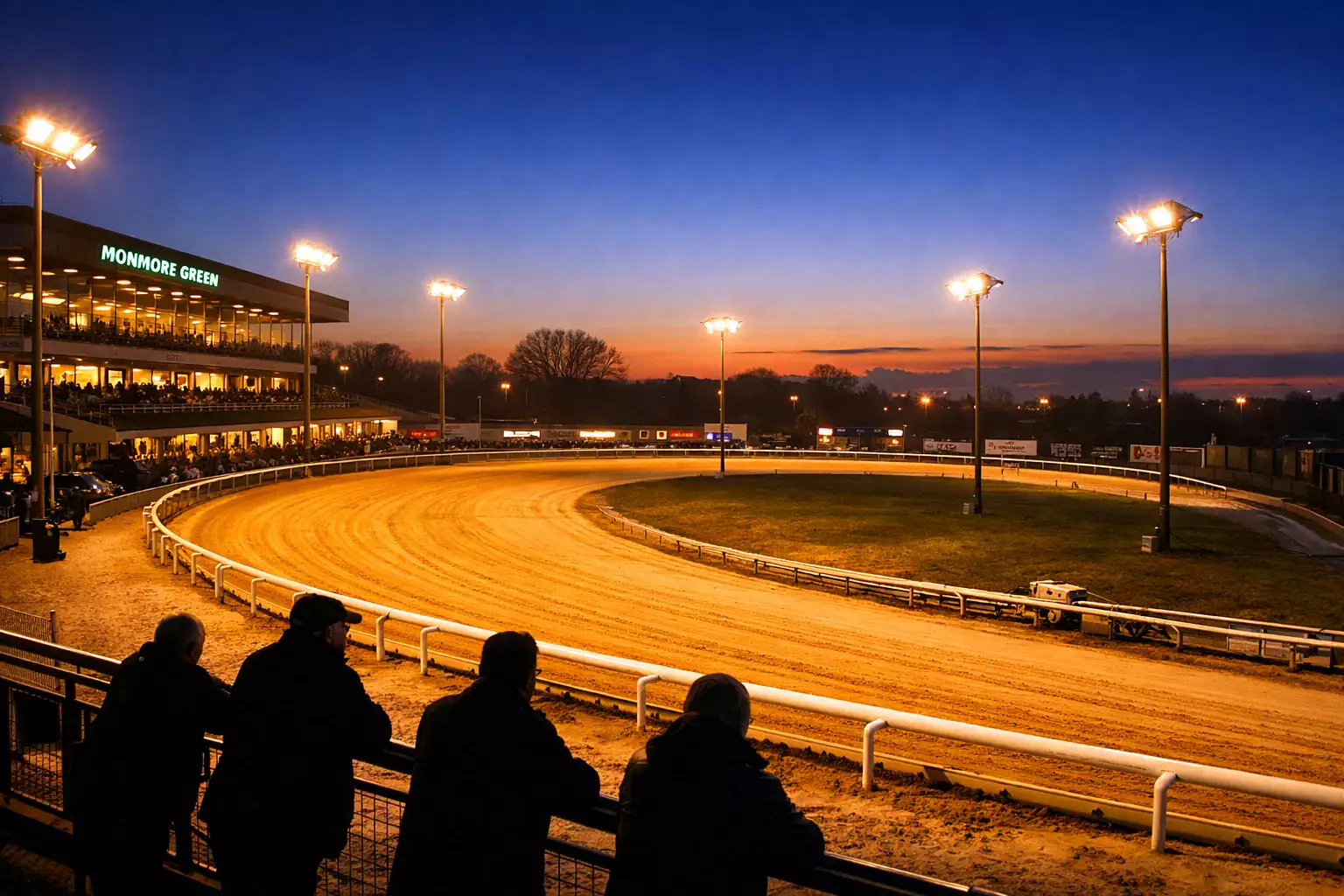
Monmore Green runs greyhound racing six days a week, and if you have ever wondered why the results appear at seemingly random hours — sometimes at half two on a Tuesday, sometimes at ten on a Saturday night — the answer is not randomness at all. It is a fixture map shaped by broadcasting contracts, bookmaker demand, and a tradition that splits the weekly card into two completely different types of meeting.
Since a deal with SIS took effect in 2018, Monmore has settled into a reliable weekly rhythm: BAGS afternoon meetings on Mondays, Tuesdays, Wednesdays and Fridays, with evening meetings on Thursdays and Saturdays. That leaves Sunday as the only dark day at the Wolverhampton track. The pattern rarely changes outside bank-holiday reshuffles and the occasional fixture swap during major open competitions.
Understanding the Monmore weekly fixture map matters more than most punters realise. BAGS meetings and evening meetings are not the same product wearing different clothes. They differ in field composition, grading weight, crowd size, prize money, and — crucially — the way results reach you online. A BAGS afternoon card exists primarily for the betting-shop audience: it is broadcast into thousands of licensed premises via SIS, the races are spaced to fill a slot in the national schedule, and the dogs are drawn from a pool designed to keep the afternoon product competitive. An evening meeting, by contrast, is a spectator event. The atmosphere changes, the racecards often carry open races with larger fields, and the results land on a different timeline because the broadcast infrastructure serves a different audience.
This guide is built around a practical question: if you follow Monmore greyhound fixtures, when should you expect racing, what kind of meeting will it be, and how quickly will the results appear once the last dog crosses the line? The answers sit in the mechanics of the BAGS system, the SIS broadcasting schedule, and the small seasonal disruptions that move races around the calendar. We will walk through each in turn, starting with the engine that drives four out of every six Monmore race days — the Bookmakers’ Afternoon Greyhound Service.
What BAGS Meetings Are and Why They Dominate the Weekly Card
BAGS stands for the Bookmakers’ Afternoon Greyhound Service, and the name tells you almost everything you need to know about its purpose. The service exists to supply licensed betting shops with a continuous stream of live greyhound racing during daytime hours when horse racing alone cannot fill the screens. It is not a charity arrangement. Bookmakers pay for the product, tracks receive a fee for staging it, and SIS handles the broadcast logistics. The result is a commercial loop that funds the majority of UK greyhound racing’s weekly output.
The scale of that output is considerable. Across Britain, approximately 5,772 greyhounds compete in around 74 BAGS meetings every week — a figure that has grown by 71 per cent since 2017, when only 3,360 dogs were running in the service. That growth did not happen because of a sudden boom in greyhound ownership. It happened because bookmakers wanted more content, SIS expanded its channels, and tracks like Monmore agreed to host more afternoon fixtures as part of multi-year contracts.
At Monmore, the BAGS commitment translates to four afternoon meetings each week: Monday, Tuesday, Wednesday and Friday. A typical BAGS card at Monmore runs 12 races, occasionally 13, with first-race times usually set between 11:00 and 14:00 depending on the national schedule that day. The spacing between races — roughly 15 minutes — is dictated not by track logistics but by SIS transmission windows. Every BAGS meeting across every participating track is stitched into a national timetable so that betting shops always have a race either running or about to start.
This has a direct effect on what you see in the results. BAGS races at Monmore are overwhelmingly graded events. Graded races match dogs of similar ability within a narrow band (A1 through to D4 at most tracks), and the fields are typically six runners. Open races, which attract higher-quality dogs and carry bigger prizes, are rare on an afternoon card because the BAGS product prioritises reliability over spectacle. Bookmakers need predictable markets, and graded racing delivers exactly that: competitive fields where the form book has a reasonable chance of being right, and where each race can be priced up quickly by odds compilers working under time pressure.
For the punter checking Monmore results on a Tuesday afternoon, this creates a particular profile. The winners will mostly come from dogs whose recent graded form at Monmore is publicly available. Outsiders do land, but far less frequently than in open competition, because the grading system is specifically designed to keep fields close on paper. If you are using results to build a form picture, BAGS meetings are your richest data source — not because they produce the best racing, but because they produce the most racing, on the most predictable schedule, with the most standardised field composition.
SIS itself stages more than 38,000 greyhound races per year through its dedicated channels, and Monmore contributes a significant share of that number. The track’s four weekly BAGS meetings, at roughly 12 races each, add up to around 2,500 races a year from Monmore alone — all of them filmed, broadcast, and settled within the SIS system before they filter through to results services and form databases.
One practical consequence that catches newcomers off guard: BAGS results tend to be finalised and published faster than evening results. The entire SIS infrastructure is built for speed, and the quick turnaround is not accidental — it is part of the commercial proposition. Bookmakers need settled results promptly so they can pay out and move on to the next race. We will cover the exact timelines in detail later.
Thursday and Saturday Evenings: The Flagship Race Nights
If BAGS meetings are the factory floor, Thursday and Saturday evenings at Monmore are the showroom. The shift is tangible the moment you walk through the turnstiles. The lights are on — properly on, not just the functional strip lighting that keeps the afternoon going — and the crowd is different. Evening meetings draw spectators who have come to watch greyhound racing as an event, not just as a feed on a betting-shop screen. The stadium’s capacity sits at 1,150, and while it rarely fills completely on a standard Thursday, Saturday evenings during major competitions can push it close.
The racecard changes too. Evening meetings at Monmore are where open races, invitation events, and semi-finals of the track’s major competitions tend to appear. The Golden Jacket, Winter Derby, and Puppy Derby all run their knockout rounds on evening cards, which means the field quality on those nights is markedly higher than anything you will find on a Monday afternoon. Dogs from outside the Monmore contract pool sometimes travel in for open events, and that introduces a variable that BAGS graded racing deliberately removes: unfamiliarity. When a dog from, say, Perry Barr or Romford enters a Monmore evening race, the local form book has a blind spot, and the market adjusts accordingly.
Prize money reflects the split. A standard BAGS graded race at Monmore might offer a winner’s purse in the low hundreds. An evening open race can pay significantly more, and the feature events at the track carry four-figure purses that attract serious connections. The prize-money gap is one reason trainers manage their dogs’ schedules carefully: a dog that runs hard in BAGS races all week may not be at its sharpest when an evening open comes around, so kennel management becomes part of the strategy.
From a results-reading perspective, evening meetings at Monmore demand a slightly different approach. The races tend to be more tactical. On a 480-metre BAGS card, early pace (EP in the result comments) is often enough to secure a position and hold on. On an evening card, where faster dogs from higher grades meet, trapping speed alone does not guarantee front-running success. You are more likely to see mid-race position changes, dogs being checked (Crd), and finishes decided by fractions. The sectional times on evening results, when available, are usually faster than BAGS equivalents, which makes direct comparison between an afternoon winner’s time and an evening winner’s time misleading unless you account for the grading difference.
The broadcast arrangements for evenings differ too. While BAGS meetings are distributed exclusively through SIS into betting shops, evening racing at Monmore is typically available through a wider set of channels, including some online streaming options offered by licensed bookmakers. This means that the audience watching a Saturday evening meeting is not confined to retail premises — it includes online bettors and the live crowd — which tends to produce deeper markets and more volatile starting prices than the relatively thin pools of an afternoon race.
One thing that stays consistent across both types of meeting: the track itself. Monmore’s 419-metre circuit, with its tight first bend at 103 metres, does not change between 14:00 and 20:00. The trap bias that favours inside boxes on shorter distances does not care whether the crowd is ten people in a betting shop or a thousand in the stands. What changes is the quality of the dogs exploiting — or being punished by — that geometry. That is what makes evening results a useful calibration tool: the same track, the same distances, but faster animals, and therefore a cleaner signal about what the track actually rewards.
How SIS Broadcasting Determines What Gets Raced and When
To understand why Monmore’s fixture list looks the way it does, you need to understand SIS — Satellite Information Services — and the role it plays as the connective tissue between greyhound tracks and the betting industry. SIS does not own Monmore. It does not train the dogs or set the grades. What it does is far more influential on a day-to-day basis: it controls the broadcast schedule that dictates when races happen, how many races appear on each card, and in what order tracks across the country take their turn on the live feed.
The mechanism works like a national rota. SIS operates dedicated racing channels that pipe live coverage into betting shops, online platforms, and some international markets. On any given afternoon, multiple BAGS tracks will be running simultaneously, but only one will be on-screen at any moment. The schedule is designed so that there is always a race either about to start, in progress, or just finished — a seamless loop of content that keeps the shop floor engaged and the betting terminals active. Monmore’s Monday, Tuesday, Wednesday and Friday afternoon slots are assigned within this rota, and the first-race time on each day is not chosen by the Monmore racing manager but negotiated as part of the broader SIS timetable.
This explains certain quirks that confuse newcomers to the fixture list. Why does Monmore sometimes race at 11:22 on a Wednesday but 13:45 on a Friday? Because the SIS schedule on those days has different tracks filling different windows. If Perry Barr has the early slot on Friday, Monmore slides to the mid-afternoon window. The inter-race gap of roughly 15 minutes is also a SIS requirement, not a Monmore preference. It exists to allow betting-shop punters enough time to study the next race, place their bets, and watch the action without dead air on screen.
The commercial implications run deep. Premier Greyhound Racing, the joint venture between Entain and Arena Racing Company that manages media rights for nine UK tracks including Monmore, negotiated a long-term agreement with major retail bookmakers to underpin the BAGS fixture programme. As a Premier Greyhound Racing representative stated, the commitment from retail bookmakers underpins the viability of the service while driving a competitive betting product alongside the highest welfare standards for dogs racing at these tracks. That is corporate language, but the practical meaning is straightforward: bookmaker money guarantees fixtures, and SIS is the pipe through which that money flows.
For anyone tracking Monmore greyhound fixtures with the aim of building a form database, the SIS relationship has a useful byproduct: consistency. Because the broadcasting contract demands a set number of meetings per week at predictable times, Monmore’s output is more stable than you might expect from a sport that runs outdoors on a sand track. Abandoned meetings are rare — greyhound racing is far less weather-sensitive than horse racing, though extreme conditions can still force a cancellation — and when a meeting is lost, SIS and the track will usually reschedule it within the same week to maintain content volume.
The flip side of SIS control is rigidity. Monmore cannot simply decide to add an extra meeting on a Sunday or move a Thursday evening card to a Wednesday. The broadcast schedule is locked months in advance and alterations require SIS approval, because any change at one track cascades through the national timetable. This is why the fixture list, once published, is remarkably stable — and why you can plan your results-tracking around it with a high degree of confidence.
Bank Holidays, National Greyhound Week and Schedule Disruptions
The standard Monmore weekly fixture map holds for most of the year, but a handful of recurring disruptions bend it out of shape. Bank holidays are the most frequent cause. When a Monday falls on a bank holiday, Monmore’s afternoon BAGS meeting may be dropped, rescheduled to a different time on the same day, or replaced by an evening fixture depending on the SIS schedule and the bookmaker demand profile for that date. Easter Monday, the early and late May bank holidays, and the August bank holiday are the usual candidates. The pattern is not always the same year to year, so checking the published fixture list in the days before a bank-holiday weekend is the only reliable way to know what is running and when.
National Greyhound Week, held annually and typically falling in the autumn, also reshapes the card. This is the sport’s promotional window — a coordinated effort across GBGB-licensed tracks to raise public awareness and drive attendance. During National Greyhound Week, Monmore may add special events to its evening cards, run demonstration races, or adjust its afternoon schedule to accommodate a higher-profile fixture that would normally sit on an evening slot. The disruption is minor in practical terms, but if you rely on the standard fixture map for timing your form study, it is worth flagging the week in advance.
Major open competitions create another kind of disruption. When the Golden Jacket or Winter Derby reaches its semi-final and final stages, the Saturday evening card at Monmore builds around those feature races. The supporting card may be trimmed to accommodate the showpiece events, which means a standard 12-race Saturday card could become a 10-race card with two high-profile opens replacing a pair of graded races. For results purposes, these evenings produce a different data profile: fewer races, higher average quality, and starting prices that reflect the deeper betting interest attracted by televised finals.
Weather cancellations at Monmore are genuinely rare. The track surface — sand-based and well-drained — copes with rain far better than the turf courses used in horse racing. Fog is the more likely culprit if a meeting is abandoned, and even then, the threshold for calling off racing is high: the dogs need to be visible to the judges at key points around the circuit, but the bar for cancellation is visibility-related, not safety-related in the way a waterlogged horse course would be. Over a typical year, you might see one or two Monmore meetings lost to conditions, and SIS will usually slot a replacement into the schedule within days.
When Monmore Results Appear Online After Each Meeting
The question most punters actually want answered is not what time the first race starts but what time the results appear — because plenty of people following Monmore greyhound fixtures are doing so remotely, checking results after the fact rather than watching the broadcast live. The answer depends on the type of meeting.
For BAGS afternoon meetings, the results pipeline is fast. SIS settles race results as part of its broadcast operation, and the data feeds into aggregator sites — Sporting Life, Timeform, Racing Post, and the various odds-comparison platforms — within minutes of each race finishing. The full card results, including finishing positions, distances, race times, sectional times (where recorded), starting prices, and forecast and tricast dividends, are typically available within 20 to 30 minutes of the final race. On a standard 12-race BAGS card that begins at midday, you can reasonably expect the complete set of results to be online by 15:30 at the latest, and usually earlier.
Evening meetings follow a similar technical process, but the clock shifts. A Thursday evening card at Monmore usually has a first race around 18:30, running through to approximately 21:00. Saturday evenings tend to start slightly later and may stretch to 21:30 or beyond if the card includes feature races with extended pre-race coverage. Results begin filtering through from the first race onward — each race settles individually — but the complete card will not be fully published until roughly 30 minutes after the last race. If you are waiting for a Saturday evening result summary, expect to be checking around 22:00.
There is a useful shortcut for anyone who needs faster updates. Several licensed bookmakers with live streaming rights publish individual race results as they happen, often within two or three minutes of each race finishing. These in-running results are stripped-down — finish order and starting price, without the detailed comments or sectional breakdowns — but they serve the purpose if all you need to know is which dog won and at what price. The richer data set, including race comments and adjusted times, takes longer because it involves human input: the race commentator’s running line needs to be transcribed, the judge’s official distances need to be confirmed, and the sectional splits need to be validated.
One edge case worth mentioning: stewards’ inquiries. If a race at Monmore is subject to an inquiry — a dog interfered with another on a bend, or a starting issue is flagged — the result for that individual race may be delayed by anything from five minutes to an hour while the inquiry is resolved. This does not hold up the rest of the card; subsequent races run on schedule. But the affected result will show as provisional on most platforms until the stewards’ decision is confirmed, at which point the finishing order may be amended, a dog may be disqualified, or the original result may stand. When you see a gap in an otherwise complete results page, a stewards’ inquiry is almost always the reason.
Planning a Track Visit: Timing, Admission and What to Expect
If you are considering attending Monmore rather than following from a distance, the fixture type determines the experience. Afternoon BAGS meetings are technically open to spectators, but they are not designed for a crowd. The atmosphere is functional — dogs run, results are recorded, and the broadcast goes out to betting shops. You will find the doors open, you can watch from trackside, and you can place bets with the on-course bookmaker or through the Tote, but there will be no restaurant service, no event hospitality, and very few other people in the stands. For a form student who wants to watch runs in person, a BAGS afternoon is useful precisely because it is quiet: you can see the dogs up close, note how they break from the traps, and form your own view on running style without the distraction of a busy crowd.
Evening meetings are a different proposition. Thursday nights offer a middle ground — busier than an afternoon, with a more active bar and a fuller trackside area, but still manageable. Saturday evenings, particularly during high-profile competition rounds, are the busiest sessions of the week. Monmore offers restaurant packages for Saturday nights that include a meal, a racecard, and a reserved table with a view of the track. These packages need to be booked in advance, especially during the Golden Jacket and Winter Derby seasons, when corporate and group bookings fill the available slots quickly.
Monmore Green Stadium sits in the Wolverhampton area of the West Midlands, accessible from the city centre in about ten minutes by car. Parking on site holds 400 vehicles and is free for racegoers. There is no dedicated rail link to the stadium, so most visitors arrive by car or taxi. If you are coming from Birmingham, the drive is around 30 minutes via the M6; from the wider West Midlands conurbation, most journeys fall within 45 minutes.
Admission prices for evening meetings vary depending on whether you are buying a standard entry or a restaurant package. Standard admission to a Saturday evening is modest — a few pounds at the gate — and gives you access to the grandstand and trackside areas. BAGS afternoon admission is typically free or nominal. It is worth checking the Monmore website or calling ahead before your first visit, because pricing and availability for hospitality packages change seasonally and during feature events.
A first-time visitor’s practical checklist is short: arrive 20 to 30 minutes before the first race if you want time to study the racecard, bring cash if you plan to bet with the on-course bookmaker (card payments are accepted at the Tote and the bar but not always with independent bookmakers), and dress for the weather. Monmore is an open-air stadium, and while the grandstand provides cover, trackside viewing is exposed. British weather being what it is, a coat in your car is not paranoia — it is planning.