
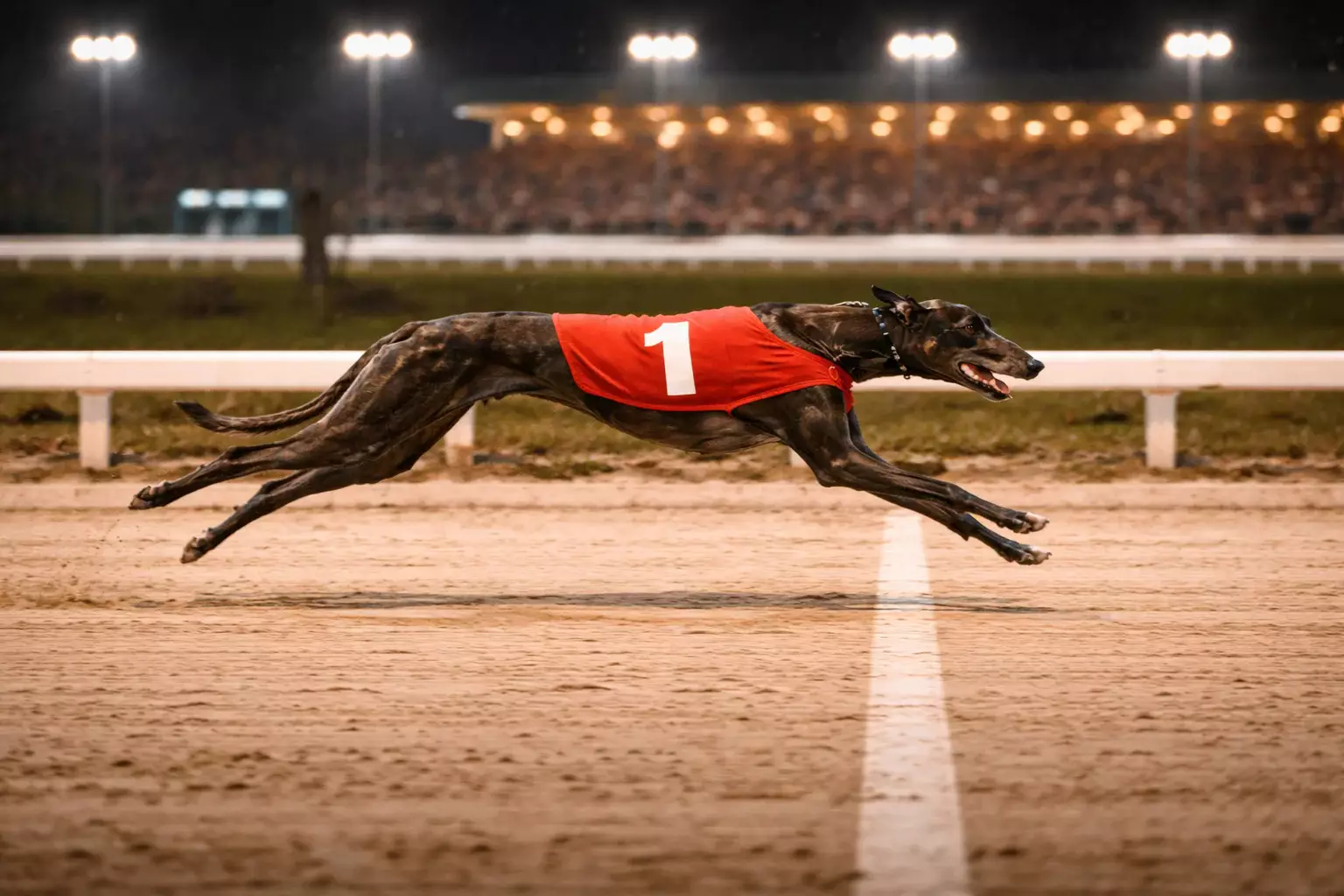
Track records are the simplest numbers in greyhound racing and the most misunderstood. A time printed next to a dog’s name and a date looks like a bare fact — 27.91 seconds, 480 metres, Express Hancho, August 2003 — but it is actually the product of dozens of variables that will never line up in exactly the same way again. The dog’s fitness on that night. The condition of the sand. The weather. The quality of the hare run. The absence of trouble on the bends. A track record is not just fast; it is lucky, in the precise sense that everything that could go right did go right at the same moment.
That is what makes Monmore’s track records worth studying in context rather than in isolation. Speed in context means understanding not just how fast a dog ran, but what conditions produced that time, what the track looked like when the record was set, and how the stadium’s nearly hundred-year history has shaped the surface, the circuit, and the competition that produced these benchmarks. A record set in 2003 was set on a different track surface, under different ownership, and in a different competitive landscape than a record set in the 1970s or one that might fall tomorrow.
Monmore Green has been racing greyhounds since 1928, which means the stadium’s record book spans almost a century of the sport. Some of those records are ancient — products of an era when track preparation was rudimentary and timing technology was imprecise. Others are modern, set on a circuit that was substantially redesigned in 1996 and has been maintained to GBGB standards ever since. The distinction matters because pre-1996 and post-1996 times at Monmore are not directly comparable; the track geometry changed, the distances were recalibrated, and the surface was upgraded. Every current Monmore track record dates from the post-redesign era, which gives the record book a natural starting point and a consistent baseline.
This guide walks through the full set of Monmore track records by distance, explains the conditions that make records possible, traces the key historical moments that shaped the track from its opening day to the present, examines the 1996 redesign that reset the clock, and looks at how the modern era of corporate ownership and media rights has changed the competitive environment at the stadium. The numbers come first. The story that explains them follows.
All-Time Track Records by Distance
Monmore Green stages races over five standard distances, and each has its own all-time fastest time. The headline records are the 264-metre mark of 15.32 seconds, set by Parliament Act on 28 August 2001, and the 480-metre record of 27.91 seconds, set by Express Hancho on 23 August 2003. Both times have stood for more than two decades, which puts them in a category of their own: not just fast runs, but performances that no subsequent dog at the track has been able to match under race conditions.
The 630-metre, 684-metre, and 835-metre records complete the set, each representing the fastest time recorded at its respective trip since the 1996 track redesign. The longer the distance, the more variables feed into the final time — stamina, bending ability, pace judgement — and the more remarkable a record-breaking run becomes. At 835 metres, a dog is running for nearly a minute across two full laps of the circuit, which means any record at that distance required sustained excellence rather than a single burst of speed.
A few patterns emerge from the record book when you lay the times out side by side. First, the sprint record is the oldest survivor, which suggests that early pace — the raw acceleration from box to bend — may have peaked earlier than endurance-based performance. Parliament Act’s 15.32 was a freak of trapping speed combined with a clean run on a fast surface, and no combination of genetics and conditions has replicated it since. Second, the 480m record sits in a similar category of untouchable times: 27.91 seconds requires a dog to average roughly 17.2 metres per second over two bends and two straights, which is close to the biomechanical limit for the breed on a circuit of Monmore’s dimensions.
For the punter using track records as a practical tool, the key question is not whether a dog will break a record — that almost never happens — but how close a dog’s recent times sit relative to the benchmark. At 480 metres, any time below 28.5 seconds at Monmore is an outstanding run. A time below 28.2 is exceptional and places the dog among the fastest currently racing at the track. Below 28.0, you are in track-record territory, and the dog either had ideal conditions or is a genuine once-in-a-generation talent. Framing a dog’s time as a percentage of the track record gives you an instant quality calibration that works regardless of the grade the dog is racing in.
One note on record validity: all current Monmore track records were set in official GBGB-sanctioned races, using calibrated electronic timing. Trial times and unofficial clockings do not count, no matter how fast they are. This matters because dogs occasionally produce faster raw times in trials than in races — no traffic, no bending pressure from other runners — but those times exist outside the record framework. The official record book measures competitive speed, not theoretical speed, and that distinction is what gives the numbers their value.
What Makes a Track Record at Monmore
A track record requires the convergence of at least four factors, none of which a trainer or dog can fully control. The first is the dog itself: it needs to be at peak fitness, carrying no residual fatigue from recent races, and ideally entering the race with the kind of form trajectory that suggests it is ready to produce a career-best effort. Greyhounds, like human sprinters, have a narrow window of peak performance, and a record-breaking run almost always falls within that window.
The second factor is the track surface. Monmore runs on a sand-based surface that is graded and watered before every meeting. The surface condition is described in general terms — fast, standard, or slow — but those labels mask a range of micro-conditions that affect grip, bounce, and drag. A fast surface at Monmore on a dry summer evening, when the sand has been compacted by warm weather and has just enough moisture to hold together, produces noticeably quicker times than the same surface on a cold, wet January afternoon. The difference can be half a second over 480 metres, which is the margin that separates a very fast run from a record-breaking one.
The third factor is the weather, and its influence extends beyond the track surface. Wind matters. Monmore’s home straight, where dogs are typically at full stretch approaching the finish, is exposed to prevailing conditions. A tailwind through the home straight can shave hundredths of a second from a finishing time; a headwind adds them. Temperature affects the dogs directly too: greyhounds run fastest in moderate conditions, roughly 10 to 18 degrees Celsius, and their performance drops measurably in extreme heat or cold. The best record-setting conditions at Monmore tend to be mild summer evenings with light or no wind — the kind of weather that lets the dog, the surface, and the atmosphere all contribute to speed.
The fourth factor is the race itself. A dog that leads from trap to line in a cleanly run race will post a faster time than a dog that is checked on a bend, forced wide by traffic, or involved in a bumping match in the first fifty metres. Track records almost always come from races where the winning dog had an unimpeded run — first out of the traps, first to the bend, first around every turn, first across the line. That is not a criticism of the record; it is an observation about the conditions required. Records are set in perfect storms, and perfect storms are rare.
There is a fifth factor that rarely gets mentioned: the hare. Monmore uses a Swaffham-type mechanical hare that runs on an outside rail. The hare’s speed and consistency affect the dogs’ pace through the race. A hare that runs smoothly and maintains a consistent distance ahead of the field encourages the dogs to stretch out and sustain their speed. A hare that slows, jerks, or runs too close to the field can cause dogs to check their stride or lose focus. The hare operator’s skill is invisible to most spectators, but experienced trainers know that a well-run hare is a precondition for fast times.
When all five factors align — a peak-fitness dog, a fast surface, favourable weather, a clean race, and a well-run hare — the result is a time that sits in the record book for years. When they do not align, the same dog on the same track might run half a second slower and nobody would think twice about it. That half-second gap is the difference between a good time and a record, and it explains why records endure: the alignment required is so specific that it happens only a handful of times per decade.
From 1928 to 2026: Key Moments in Monmore’s Racing History
Monmore Green Stadium opened on 11 January 1928, organised by the Midland Greyhound Racing Association, with approximately 10,000 spectators attending the first meeting. That attendance figure is worth pausing on. Ten thousand people turning up to watch greyhound racing at a brand-new stadium in Wolverhampton, in the depths of a British winter, tells you something about the sport’s grip on the public imagination in the late 1920s. Greyhound racing had arrived in the United Kingdom only two years earlier, with the first oval-track meeting at Belle Vue in Manchester in 1926, and the speed at which new tracks opened across the country was extraordinary. Monmore was part of a wave, and the crowds that came through its gates reflected a genuine national enthusiasm for a new form of entertainment that combined live sport, spectacle, and the thrill of a wager.
The interwar years were the high-water mark for greyhound racing in Britain. At the sport’s peak, the United Kingdom had no fewer than 77 licensed greyhound tracks. That number is almost impossible to comprehend from the vantage point of 2026, when just 18 GBGB-licensed stadiums remain. The contraction happened slowly at first and then with gathering speed: tracks closed as urban land values rose, as television drew audiences away from live attendance, and as the betting industry evolved from an almost exclusively in-person activity to one dominated by online platforms. Each closure removed a piece of the sport’s infrastructure and concentrated the surviving tracks into a smaller, more commercially pressured circuit.
Monmore survived where dozens of rivals did not, and the reasons are partly geographic and partly commercial. Wolverhampton sits at the heart of the West Midlands conurbation, with a catchment area that includes Birmingham, Walsall, Dudley, and the Black Country — a densely populated region with a long tradition of working-class sport and gambling. The stadium’s location gave it a reliable local audience even as national attendance declined. Equally important, Monmore’s operators adapted. When the BAGS system formalised in the 1970s and 1980s, Monmore signed up early, securing the afternoon fixture slots that guaranteed broadcast income regardless of gate receipts. That decision — trading some autonomy over the schedule for financial stability — proved critical in keeping the stadium operational through decades that saw competitors close.
The post-war period brought gradual modernisation. Floodlighting arrived, allowing evening racing to extend into the winter months without relying on daylight. The tote system was upgraded. Photo-finish technology replaced the judge’s naked eye for close finishes. Timing moved from manual stopwatches to electronic sensors. Each improvement made the results more reliable and the sport more credible as a betting medium, which in turn supported the commercial relationships — with bookmakers, with broadcasters, with the betting levy system — that funded the track’s continued operation.
By the 1990s, Monmore was a well-established mid-tier track: not one of the glamour venues like Wimbledon or White City (both now closed), but a solid, profitable stadium with a loyal following and a steady fixture schedule. The decision to redesign the track in 1996 — which we will examine in detail in the next section — marked a line between old Monmore and new Monmore, resetting the record book and reconfiguring the racing surface for a modern era.
The 2000s brought ownership changes that would reshape the stadium’s identity. Monmore passed into the portfolio of what is now the Entain Group, one of the largest gambling companies in the world, and the stadium’s media rights were bundled into the Premier Greyhound Racing joint venture. These corporate shifts did not change the experience of watching dogs run around an oval track, but they changed the economics beneath it — prize money, broadcasting reach, and the infrastructure investment that keeps a nearly century-old stadium functioning.
In 2026, greyhound racing marks its centenary in the United Kingdom, with the sport tracing its origins to that first meeting at Belle Vue in 1926. Monmore, having opened just two years after the sport’s UK debut, is among the oldest continuously operating greyhound stadiums in the country. That continuity is not guaranteed — the sport faces political pressure, with a ban already progressing through the Welsh Senedd and welfare debates intensifying across the UK — but the fact that Monmore has survived for 98 years, through wars, recessions, cultural shifts, and the collapse of three quarters of its competitor stadiums, is itself a kind of record. Not one measured in seconds, but in resilience.
Track Redesign of 1996 and Its Impact on Times
The 1996 redesign of Monmore Green is the single most important event in the stadium’s modern racing history, yet it is barely discussed in most coverage of the track. Before 1996, Monmore ran on a different circuit configuration with different dimensions. The redesign changed the circumference, adjusted the bend radii, recalibrated the race distances, and upgraded the running surface. In effect, the Monmore that existed before 1996 and the Monmore that exists today are two different tracks sharing the same postcode.
The practical consequence is that every pre-1996 track record became obsolete overnight. Times set on the old circuit — at old distances, on an old surface, around bends with different geometry — could not be meaningfully compared with times set on the new layout. The record book was wiped clean, and the current set of all-time track records dates entirely from the post-redesign era. This is why the oldest surviving records at Monmore are from the late 1990s and early 2000s: not because no fast dogs raced there before, but because the clock was reset when the track was rebuilt.
The redesign gave Monmore its current 419-metre circumference with a first bend at 103 metres from the traps. The distances were standardised to 264, 480, 630, 684, and 835 metres — a set that aligns with the distance categories used across the wider GBGB circuit, making Monmore results directly comparable with results from other licensed tracks of similar dimensions. Before the redesign, Monmore’s idiosyncratic distances made cross-track comparison difficult, which limited the usefulness of form data for punters who followed dogs across multiple venues.
The surface upgrade was equally significant. The post-1996 track was built with improved drainage and a sand composition designed for more consistent racing across different weather conditions. A well-drained track produces more reliable times, which benefits the grading system (grades are assigned based on recent times, so surface consistency makes grading more accurate) and makes the form book a more trustworthy guide to future performance. The surface has been maintained and refreshed periodically since 1996, but the underlying engineering of the track bed has remained broadly unchanged.
The bend geometry introduced in 1996 also shaped the track’s competitive character. Monmore’s bends are relatively tight for a track of its circumference, and the first bend in particular — arriving at just 103 metres from the start — creates a natural bottleneck that favours dogs with fast early pace and clean bending technique. This characteristic is baked into the track’s design and has defined Monmore’s racing profile ever since: it is a track that rewards trappers and railers, a track where inside boxes carry a structural advantage, and a track where trouble on the bends has a disproportionate impact on finishing positions. Every current track record was set within this geometry, which means they reflect not just the speed of the dogs but the specific demands of a tight, fast circuit with compressed first-bend approaches.
For form students, the 1996 redesign has one final implication: historical comparisons that reach back before that date are meaningless in statistical terms. A dog that ran a certain time over a certain distance at old Monmore was running a different race on a different surface around different bends. The comparison simply does not hold. Speed in context requires knowing which context — and at Monmore, the context begins in 1996.
The Entain Era: PGR, Media Rights and Rising Prize Money
Monmore’s modern identity has been shaped by corporate ownership as much as by track geometry. The stadium is owned and operated by the Entain Group, the FTSE 100 gambling company whose portfolio includes Ladbrokes, Coral, and a range of international betting brands. For a greyhound stadium in Wolverhampton, having a parent company of that scale brings advantages that smaller independent tracks cannot match: investment in facilities, guaranteed media distribution, and a prize-money structure that attracts competitive dogs from across the region.
The key commercial vehicle is Premier Greyhound Racing, a joint venture between Entain and Arena Racing Company that controls the media rights for nine of the twenty licensed UK greyhound tracks, including Monmore. PGR has invested more than £2.5 million in open racing prize money across its portfolio, and the deal it struck with major retail bookmakers in 2023 secured a long-term revenue stream that underwrites the fixture programme at all nine venues.
What does this mean for Monmore’s track records and competitive quality? In practical terms, PGR’s investment has elevated the prize money available at Monmore’s flagship events. The Golden Jacket, the Winter Derby, and the Puppy Derby all carry purses that are competitive with — and in some cases exceed — equivalent events at rival tracks. Higher prize money attracts better dogs, which raises the standard of competition, which in turn produces faster times. The link between corporate investment and on-track performance is not abstract; it is visible in the racecard every time a high-quality open race appears on a Saturday evening.
The media-rights dimension is equally important. PGR’s deal ensures that Monmore’s racing is broadcast via SIS into betting shops and online platforms nationwide, which means the track’s results reach a far larger audience than the stadium’s 1,150 physical capacity could ever serve. That broadcast reach drives betting turnover, which feeds back into the sport through the voluntary bookmaker levy and through direct commercial agreements between PGR and the betting operators. The result is a funding loop: broadcasting generates revenue, revenue funds prize money, prize money attracts quality, and quality produces the competitive racing that keeps the broadcast valuable.
GBGB’s governance framework sits alongside the commercial structure. As former GBGB Chairman Jeremy Cooper described when launching the organisation’s welfare strategy, it represented one of the most comprehensive frameworks for working-animal welfare ever produced in the country. That governance applies to every race run at Monmore, from a Monday afternoon BAGS graded event to a Saturday evening Golden Jacket final. The welfare infrastructure — veterinary inspections before and after racing, regulated kennel standards, injury reporting — is the same regardless of prize money or broadcast profile, which means the conditions under which track records are set are subject to consistent regulatory oversight.
The Entain era has not resolved all of the sport’s challenges. Greyhound racing still faces declining betting turnover, political opposition, and the long-term threat of further track closures. But at Monmore specifically, the combination of corporate backing, PGR media rights, and GBGB regulation has created an environment where the track can maintain its facilities, sustain competitive racing, and preserve a record book that stretches back to the post-1996 era with a reasonable expectation that the stadium will continue to operate. That stability is not glamorous, but for anyone relying on Monmore’s track records as a form tool, it matters. A record has value only if the track that produced it is still running.