
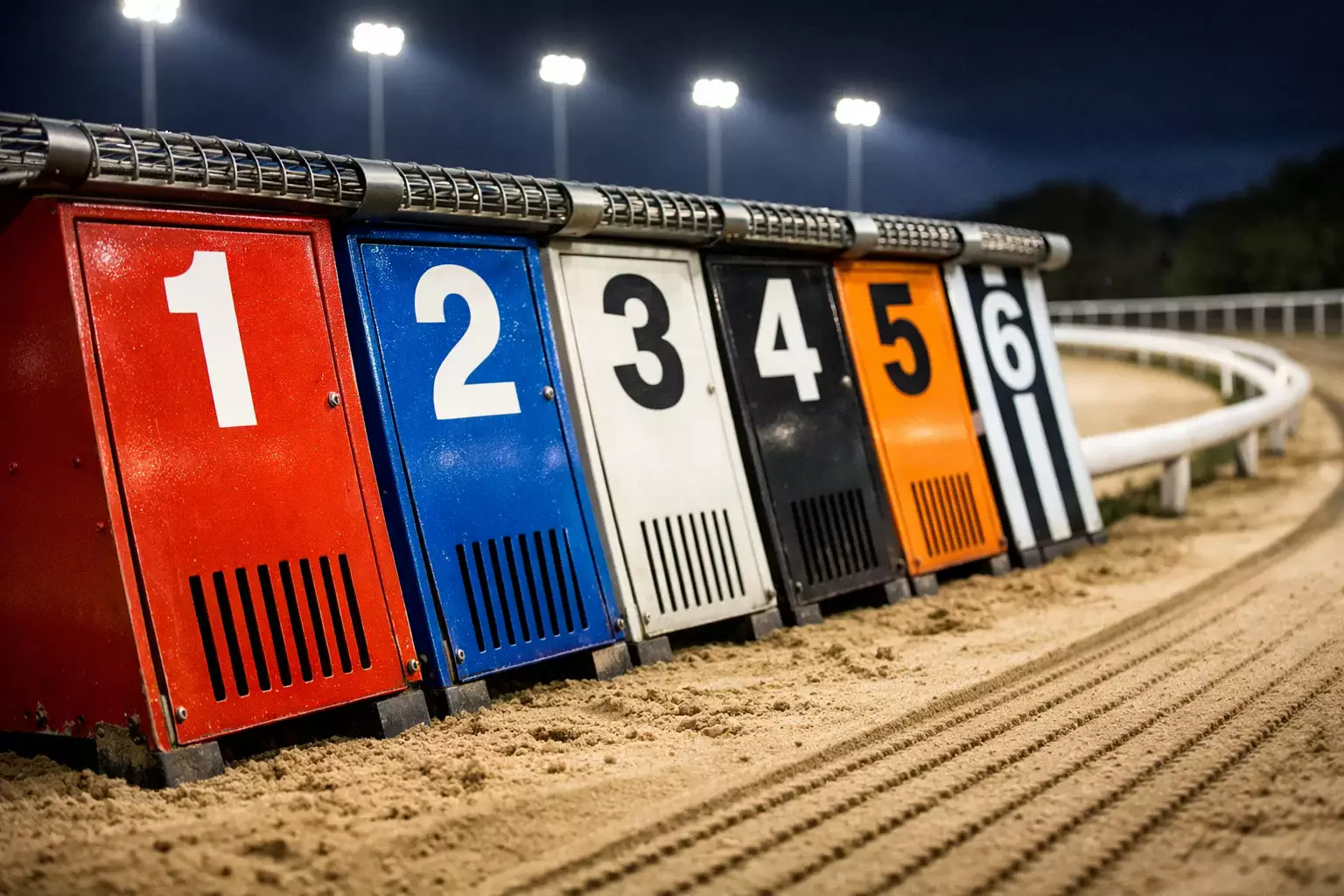
Ask ten greyhound punters which trap they fancy at Monmore and you will get ten answers shaped by habit, superstition, and whatever happened last Saturday. Ask the data the same question and you get something more useful: a measurable, repeatable pattern that shifts with distance, weather, and running rail condition. The difference between those two approaches — hunches versus numbers — is the difference between guessing and analysing, and it is the difference this guide is built around.
Trap bias is real. It is not a myth invented by losing gamblers looking for an edge, and it is not a conspiracy theory about rigged traps. It is a structural feature of every oval greyhound track, created by the geometry of the circuit, the position of the starting boxes relative to the first bend, and the physics of six dogs converging on a single racing line through a turn. At Monmore, the effect can be dramatic: in one documented meeting, trap one won seven of twelve races — a 58 per cent strike rate against an expected baseline of 16.66 per cent. That is not variance. That is geometry expressing itself through the results.
But a single meeting’s data, however striking, is not a strategy. Trap numbers, not hunches, means working with aggregated data over weeks and months, understanding how the bias changes when the distance changes, recognising the conditions under which the inside rail advantage intensifies or fades, and knowing where to find regularly updated statistics rather than relying on one dramatic snapshot. Monmore’s trap profile is not static. It moves with the track surface, with the weather, and with the mix of dogs on any given card. The punter who treats trap bias as a fixed input — “always back trap one” — will have some good days and many mediocre ones. The punter who treats trap bias as a variable input — “what is trap one doing this month, at this distance, in these conditions?” — has a framework that adapts to reality.
This guide breaks down the mechanics of trap bias at Monmore, shows you where the data comes from, explains the factors that make the bias shift, and offers a practical method for incorporating trap statistics into your race-day analysis. We will start with the general concept and work toward the specific.
What Trap Bias Means and Why Every Track Has One
Every greyhound track in the world has a trap bias, and the reason is elementary physics. Six dogs start from six numbered traps arranged in a line, all facing the same direction. Within a few seconds, all six need to negotiate the first bend, which is a single arc of track with one racing rail on the inside. The dogs drawn closest to that inside rail — traps one and two — have less ground to cover on the bend. The dogs drawn widest — traps five and six — have more ground to cover, and they must either accelerate hard enough to reach the bend ahead of the inside runners or accept that they will lose lengths through the turn simply because of where they started.
This is not unique to Monmore. It applies at every oval greyhound track in the United Kingdom and everywhere else greyhounds are raced on a bend. What varies between tracks is the degree of the bias, and that degree is determined by three design features: the distance from the traps to the first bend, the radius of the bend itself, and the overall circumference of the circuit.
At tracks where the run to the first bend is long — say, 150 metres or more — the bias is less pronounced because the dogs have more time and space to sort out their positions before the turn arrives. Fast outside dogs can use the straight to cross to the rail before the bend, negating much of the geometric disadvantage. At tracks where the run to the first bend is short, the bias is amplified because there is not enough straight to allow repositioning. The bend arrives while the field is still bunched, and the dogs closest to the rail arrive there first.
Monmore falls firmly into the second category. With the first bend at 103 metres from the traps on a 419-metre circumference track, the dogs hit the turn while still at full acceleration. There is no long home straight to separate the field before the bending begins. This compressed approach amplifies the inside-trap advantage to a degree that is measurable across thousands of races: trap one wins more often than any other trap at Monmore, and the win rate declines progressively as you move outward to trap six.
The bend radius compounds the effect. Tighter bends force wider-drawn dogs to cover proportionally more extra ground than gentler bends would. Monmore’s bends are relatively tight for a track of its circumference, which means the geometric penalty for running wide is significant. A dog drawn in trap six that races two lanes off the rail through the first bend covers roughly three to four metres more than a dog on the rail — and at racing speed, three metres is approximately one and a half lengths, enough to turn a winning position into a trailing one.
It is worth stating clearly: trap bias is not the same as a guaranteed winner. Trap one has a statistical advantage at Monmore, but it does not win every race, because the dog in trap one still needs to be fast enough, fit enough, and skilled enough to exploit that advantage. A slow dog drawn in trap one will still lose to a fast dog drawn in trap four, because speed ultimately matters more than geometry. What trap bias does is tilt the probability — it adds a percentage to the inside and subtracts a percentage from the outside — and over a large enough sample of races, that tilt becomes unmistakable in the data.
Monmore-Specific Trap Win Rates: Where to Find Them
Knowing that trap bias exists is only useful if you can quantify it, and quantifying it requires data. Not a single evening’s results, not a gut feeling from twenty years of trackside observation, but a large enough sample of race outcomes to produce percentages that mean something. The good news is that this data exists for Monmore, is published regularly, and is freely accessible if you know where to look.
The primary source is SIS Racing, which publishes monthly trap statistics covering fifteen UK tracks including Monmore. These reports break down win rates by trap number, by distance, and by meeting type, and they are updated on a rolling basis so that the data reflects recent conditions rather than historical averages that may have drifted. The SIS monthly reports are the closest thing Monmore punters have to an official trap-bias scoreboard, and they should be the first stop for anyone building a systematic approach to trap analysis.
What do the Monmore-specific numbers typically show? The pattern across most reporting periods is consistent with what the track geometry predicts: trap one leads in win frequency, trap two follows, and the rates decline outward through to trap six. But the margin fluctuates. In some months, trap one at Monmore wins 22 to 25 per cent of all races — well above the 16.66 per cent you would expect if all traps were equal. In other months, particularly those with heavy rain and a softer inside rail, the advantage narrows to 18 or 19 per cent, and middle traps gain ground. These fluctuations are real and meaningful, and they are the reason that static trap-bias tables — the kind printed once and never updated — are inferior to rolling monthly data.
Beyond SIS, there are secondary sources that compile Monmore trap data. Several independent greyhound-analysis websites maintain their own databases, scraping results from official feeds and repackaging them into trap-performance tables. These sites vary in quality and update frequency, so it is worth cross-referencing any independent source against the SIS figures to check for consistency. If two independent data sets agree that trap one has been dominant at Monmore’s 480-metre distance over the past month, you can treat that signal with reasonable confidence. If they disagree, one of them may be working from incomplete data or using a different methodology for categorising results.
The most granular data comes from compiling your own records. Every Monmore result is publicly available on race-results aggregators, and building a simple spreadsheet that logs trap number, distance, finishing position, and time for every race over a given period gives you a personalised trap-bias database that no third party can match. The effort involved is not trivial — Monmore runs roughly 60 to 70 races per week across its six meeting days — but the reward is a data set that answers your specific questions rather than the generic questions that published reports are designed to address. If you want to know trap-one win rates specifically on Friday afternoons over 480 metres in wet conditions, no published report will tell you that. Your own data will.
Whichever source you use, the critical principle is sample size. Trap-bias data drawn from fewer than 100 races at a given distance is unreliable — the sample is too small for the percentages to stabilise, and individual race outcomes have too much influence on the aggregate. A minimum of 200 races per distance gives a more solid foundation, and 500 or more races per distance produces percentages you can lean on with confidence. At Monmore’s racing volume, 500 races over 480 metres accumulates in roughly ten to twelve weeks, which makes quarterly snapshots a practical reporting interval for serious analysts.
Rain, Sand and the Inside-Rail Advantage at Monmore
Weather is the variable that most punters underestimate when thinking about trap bias, and at Monmore it has a direct, measurable effect on the inside-rail advantage. The track surface is sand-based, and sand behaves differently when wet than when dry. After sustained rain, the surface holds more moisture, which changes its firmness and grip characteristics. The inside running lane — the strip of sand closest to the rail, where the dogs that take the shortest path around the bends run — gets the most traffic over the course of a meeting. On a dry day, that compacted inside lane is fast and firm. On a wet day, the combination of moisture and repeated traffic can make it heavy and clinging, which saps speed from dogs running the rail and closes the gap between inside and outside traps.
The effect is not dramatic enough to eliminate the inside advantage entirely, but it can reduce it to the point where middle traps — three and four — become more competitive than usual. A dog drawn in trap three on a rain-soaked Wednesday afternoon at Monmore may face a softer inside rail that slows down the trap-one and trap-two runners just enough for the middle draw to become viable. This is visible in the monthly SIS data: wet months tend to show a flatter distribution of wins across traps compared to dry months, where the inside bias sharpens.
Monmore’s 419-metre circumference and its first bend at 103 metres mean that the inside rail absorbs a lot of punishment during every meeting. Twelve races per card, six dogs per race, and the majority of competitive runners seeking the shortest path through the bends — by the end of a meeting, the inside lane has been churned more than any other part of the track. On a dry evening, the surface crew can restore it between races with minimal intervention. On a wet evening, the damage accumulates faster than it can be repaired, and the inside lane deteriorates visibly as the card progresses.
This creates a micro-pattern within individual meetings that sharp-eyed punters can exploit. The first three or four races on a wet card at Monmore may still show a normal inside-trap advantage, because the surface has not yet deteriorated significantly. By the eighth or ninth race, the inside lane has taken enough traffic that dogs drawn in the middle or outside traps are on comparable footing — or even at an advantage, because they are running on less-used, firmer ground. The practical implication is simple: if you are following a wet meeting at Monmore in real time and adjusting your analysis race by race, you should weight the inside traps less heavily in later races than in earlier ones.
Temperature matters too, though its effect is less direct. Cold weather firms up a wet surface, which can restore some of the inside advantage even after rain. Warm weather keeps the surface softer for longer. Wind affects the dogs’ effort through exposed straights but does not meaningfully alter trap bias, because the wind blows equally on all six runners regardless of starting position. The weather variable that matters most for trap-bias purposes is, overwhelmingly, rainfall — specifically, how much rain fell in the 24 hours before the meeting and whether it continued during racing.
How Trap Bias Shifts Across Monmore’s Five Distances
The single biggest mistake in using trap data at Monmore is treating the track as though it has one trap-bias profile. It does not. It has at least five, one for each race distance, and the differences between them are large enough to change your selection in a meaningful number of races. Aggregating trap wins across all distances into a single table produces a number that is technically accurate and practically misleading, because it blends signals from five distinct race shapes into one meaningless average.
At 264 metres, the bias is extreme. The race is a sprint to the first bend and a short dash down the back straight, with no second bend to allow positional recovery. Trap one is overwhelmingly favoured because the dog drawn there has the shortest run to the rail and the least ground to cover around the only turn in the race. Trap two benefits from a similar effect, though slightly diluted. By trap four, the geometric disadvantage is already significant, and by trap six it is severe. A form reader looking at 264-metre results at Monmore should treat trap draw as one of the two or three most important variables, alongside early pace and recent form. A fast dog in a bad trap will struggle over this distance; a moderate dog in a good trap will outperform its raw ability.
At 480 metres, the standard distance, the bias is still present but more moderate. Two bends and two straights give dogs drawn wide enough racing room to recover from a poor first-bend position. A strong middle-section runner drawn in trap five can lose a couple of lengths at the first bend, use the back straight to close the gap, and arrive at the second bend in contention. The 480-metre trap data at Monmore still favours the inside, but the gradient from trap one to trap six is shallower — a matter of a few percentage points per trap rather than the steep drop-off seen in the sprints. At this distance, trap draw is one variable among several, and it can be overridden by superior speed, fitness, or tactical ability.
At 630 metres and 684 metres, the bias flattens further. The extra bends introduce more opportunities for positional change, and the longer race duration means that stamina and bending technique become as important as starting position. A dog drawn in trap six that is a strong stayer with clean bending can find the rail by the third bend and race efficiently from that point onward, effectively neutralising the starting disadvantage. The data for these middle distances at Monmore shows a more even distribution of winners across traps, though the inside positions still produce a marginally higher win rate because the geometric advantage on every single bend adds up incrementally over the course of the race.
At 835 metres, the marathon distance, the bias takes on a different character. The race is long enough — two full laps, eight bends — that starting position is almost secondary to racing style. What matters at 835 metres is whether the dog finds the rail and stays there for the duration. A marathon runner drawn in trap one that lacks the stamina to sustain its speed through two laps will be passed by a fitter dog from trap four on the second circuit, regardless of the early positional advantage. The 835-metre trap data still shows a slight inside lean, but the strongest predictor of success at this distance is running style, not starting box.
The practical lesson is to filter. When you pull up Monmore trap statistics, break them by distance before you draw any conclusions. The trap-one win rate at 264 metres and the trap-one win rate at 835 metres are measuring fundamentally different things, and combining them into a single track-wide number obscures the insight that each provides individually.
Turning Trap Data into Race-Day Selections
Trap data is a filter, not a tipsheet. It does not tell you which dog will win a given race. It tells you which dogs have a structural advantage before the race starts, and which dogs need to overcome a structural disadvantage to win. The distinction matters, because many punters who discover trap bias for the first time treat it as a standalone system — back trap one in every race — and are disappointed when it produces a strike rate that is above average but well below profitable. Trap bias is one input among many. Its value comes from combining it with other inputs: form, speed ratings, distance suitability, and going preference.
A practical approach to using Monmore trap data on race day starts with the racecard. For each race, note the distance and the trap draw. Check the most recent monthly SIS data for that distance and see which traps have been performing above or below expectation. If trap one at 480 metres has been winning at 23 per cent over the past month — well above the 16.66 per cent baseline — then any dog drawn in trap one at 480 metres today starts with a quantifiable edge. That edge does not guarantee victory, but it means you can give that dog a small uplift in your assessment relative to dogs drawn wider.
Next, overlay the form. A dog drawn in the statistically strongest trap that also has the best recent form is a reinforced selection — the data and the form book are pointing in the same direction. A dog drawn in the weakest trap that has strong recent form is a conflict — the form says yes, the trap says maybe not — and that conflict should either reduce your confidence or lead you to look more closely at how the dog ran from similar draws in the past. Some dogs consistently overcome wide draws through sheer speed; others are visibly compromised whenever they draw an outside box.
The volume of data available at Monmore makes this kind of analysis feasible in a way that it would not be at a track with fewer meetings. With approximately 5,772 greyhounds competing in roughly 74 meetings across the country each week, and Monmore contributing around 60 to 70 races to that total, the data set refreshes constantly. A trap-bias reading from last month is useful. A reading from last week is better. And a reading from today’s earlier races — checking which traps are winning on a particular surface under particular conditions — is the most valuable of all, because it reflects the real-time state of the track.
As Star Sports’ Head of Operations Flynn Goward noted when discussing the growth of on-course and online greyhound betting, the industry is now operating across approximately 150 days a year between horse racing and greyhound racing. That expanded calendar gives Monmore punters a deeper pool of data to draw from than ever before, and trap analysis is one of the most direct ways to turn that data into an edge. The numbers are there. The question is whether you use them, or rely on the trap your mate swears by.
Where to Access Monthly Monmore Trap Stats
The most reliable source for current Monmore trap statistics is SIS Racing, accessible at sisracing.tv. The site publishes monthly performance summaries that include trap win rates, forecast and tricast return data, and leading-trainer strike rates for fifteen UK tracks. Monmore is included in every report, and the data is broken down by distance, which makes it directly usable for the kind of distance-filtered analysis described in this guide. The reports are updated monthly, and historical reports are available for comparison, allowing you to track how the bias has shifted over time.
For track specifications and baseline data — Monmore’s circumference, bend radii, distance configurations, and surface type — BettingOdds.com maintains a useful track profile page that consolidates the key numbers in one place. This does not provide rolling trap statistics, but it gives you the structural information that explains why the trap bias exists in the pattern it does.
Independent analysis sites also publish Monmore trap data, though with varying update frequencies. Some scrape results in near real time and produce daily trap summaries; others compile weekly or monthly digests. The value of these sites depends on their methodology and transparency: a site that shows its sample sizes and data sources is more trustworthy than one that presents percentages without context. Where possible, cross-reference any independent source against the SIS data to check for consistency.
Finally, as discussed earlier, building your own trap database from publicly available results remains the most powerful option for punters willing to invest the time. The approach is simple — log every result with its trap, distance, position, time, and going — but the payoff is a personalised data set that answers questions no published report addresses. Over a few months, you will have developed both a dataset and an instinct for how Monmore’s traps behave that no shortcut can replicate.